








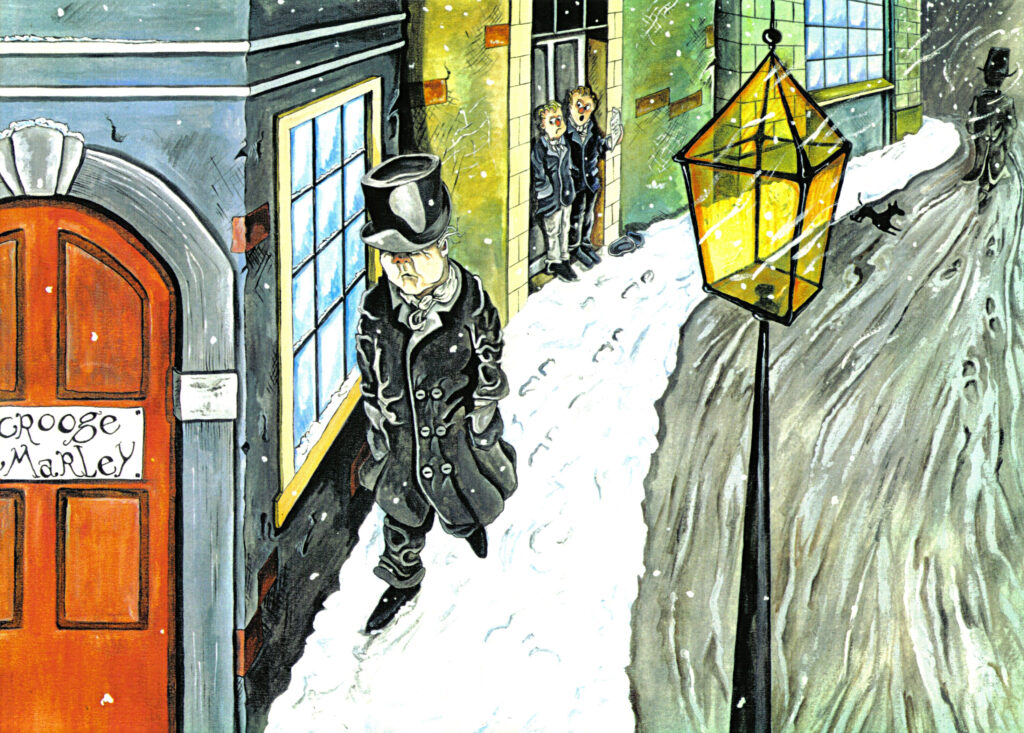
“Keep Christ in Christmas” has become a popular slogan in America in recent decades, but few people have made that argument more persuasively than a writer who was born in England in 1812. His concern, though, was not with acceptable public expressions of faith; instead, he was driven by a religiously motivated sympathy for the poor of Victorian England.
To teach his own children about Jesus, he wrote a short book, “The Life of Our Lord,” that is a retelling of the Gospels with commentary. For example: “And when people speak ill of the Poor and Miserable, think how Jesus Christ went among them and taught them, and thought them worthy of his care.”
He wrote other books, too. In fact, Charles Dickens was the most popular writer of his time, and his seasonal classic “A Christmas Carol” is widely known by American audiences through school plays and popular films. The subtext of story, especially in Dickens’ text, presents Christ’s Birth as not simply an annual celebration of good will, but a history-altering event that demands recognition throughout the year.
In most films, Scrooge’s employee Bob Cratchit reports that his son, the diminutive Tiny Tim, hoped that people noticed him in church “because he was a cripple, and it might be pleasant to them to remember upon Christmas Day, who made lame beggars walk and blind men see.”
Not all the movies include the other, less endearing, children that Scrooge meets through the Ghost of Christmas Present. In contrast to the charming Tiny Tim, who benefits from his parents’ love and devotion, they are wretched and miserable.
“This boy is Ignorance. This girl is Want,” the spirit says, and he has a timeless warning. “Beware them both, and all of their degree, but most of all beware this boy, for on his brow I see that written which is Doom, unless the writing be erased.”
In addition to spirits, “A Christmas Carol” has a door knocker that becomes a ghostly face, a thief who steals the blankets from a man’s deathbed while he still in it, and a euphoric ending. But one of the most telling passages in the book is one in which nothing really happens.
With the Ghost of Christmas Yet to Come, Scrooge is visiting the Cratchit household and “hears” a Bible verse: “And He took a child, and set him in the midst of them” (Mk 9:36).
Shortly after, Cratchit – the personification of the poor in spirit – comes home, and he describes to his wife a chance meeting with Scrooge’s nephew, a man he had met only once before. When the man learns that Tiny Tim has died, he expresses genuine sympathy and offers to help the family in any way he can.
“Now, it wasn’t,” Cratchit explains, “for the sake of anything he might be able to do for us, so much as for his kind way.”
The nephew’s simple concern sets him apart from his uncle, who Dickens describes at the start of the novel as “a squeezing, wrenching, grasping, scraping, clutching, covetous old sinner!” (In describing Tiny Tim, Dickens writes that his “childish essence was from God!”)
The Bible verse Scrooge hears when he enters the Cratchit home is from Saint Mark’s Gospel, whose first recorded words of Jesus are a command to repent (Mk 1:15). This is what Scrooge does on his next, and final stop, which is at his own grave. There he promises not just to think about Christmas differently but to change his life. Scrooge pledges to honor Christmas – and “try to keep it all the year.”
Every Christmas, and every other day of the year, is populated with children named Ignorance and Want, and with countless Bob Cratchits: people who are lonely, grieving or worried about any number of problems, because the variety of human troubles seems infinite. Jesus’ words, as recorded by Saint Mark, hang over the text: “Whosoever shall receive one of such children in my name, receiveth me” (Mk 9:37). To keep Christ in Christmas, Dickens asserts, necessarily means following Christ’s example and teaching all year long.
Dickens read his short book about Jesus to his children every Christmas. It begins: “My dear children, I am very anxious that you should know something about the History of Jesus Christ. … No one ever lived, who was so good, so kind, so gentle, and so sorry for all people who did wrong, or were in any way ill or miserable, as he was. …”
Carl Peters is former managing editor of the Catholic Star Herald.








 at the bottom and then tap “Add to Home Screen”
