






In preparation for a summer class that I am developing on the theologies of Popes Francis and Leo XIV to be taught in Rome, and in honor of our Holy Father’s 70th birthday last weekend, I spent a few recent nights devouring two early biographies of the man formerly known as Robert Prevost.
The first, “Pope Leo XIV: Inside the Conclave and Dawn of a New Papacy,” was written by Christopher White, a longtime National Catholic Reporter journalist who is now with Georgetown University. The second, “Leo XIV: Portrait of the First American Pope,” was written by Matthew Bunson, vice president and editorial director of EWTN News. Because of the speed with which the biographies hit the shelves after the election, they are admittedly slim. Both can be read in just a few sittings. I would argue that those looking to learn more about the new shepherd of the Universal Church ought to track down their own copies soon.
As with so much else in Church history – and really in some ways all global cultural trends – much of the analysis in both volumes focuses on the dialectical tensions between continuity and development. The Trinity, the papacy, the “One, Holy, Catholic and Apostolic Church” – all are examples of inter-generational realities that connect Catholic believers across centuries, and authentic developments whose articulation would’ve never passed the lips of the earliest disciples. So it is clear that when we examine Prevost/Leo with any nuance and depth, some investigators tend to foreground elements of continuity, while others emphasize the obvious discontinuity and novelty involved when an ordinary son of Chicago’s South Side – who grew up pretending to say Mass with Necco Wafers and attending White Sox games – takes on new roles first as a pan-American Church leader and then as the successor to Saint Peter.
What was clear when reading between the lines of two very fair-minded and well-resourced texts was how sentiments about Pope Leo’s immediate predecessor still loom exceedingly large. A lot of what can be said about Pope Leo in the first months of his pontificate seems to rest on whether one hopes that the Pope Francis ecclesial agenda will continue unimpeded, or that the new pope will tread quite distinct paths in style and public statements.
What is clear is that no pope is a carbon copy of any other. There is no one alive who has the same kinds of experiences and formation as Prevost/Leo – a United States (and Peruvian) citizen with a background in advanced mathematics and canon law who has led a peripheral missionary diocese, a major religious order, perhaps the most important Vatican office outside of the pope when it comes to concrete global influence, and who had what was reportedly the closest working relationship with his predecessor out of any curial leader. It is indisputable that the cardinals in the recent conclave chose to make both of the most influential and recognizable faces on the planet “estadounidense” (United-States-ian). But as was pointed out in both biographies, this was likely more a byproduct of other factors than an intentional choice to do so, or explicit statement about American society.
There is also no one alive who will face the same challenges as he will, whether in terms of addressing artificial intelligence, multinational wars, a planet full of more human beings than any of his predecessors ever experienced, or living in the unique fishbowl of Vatican affairs.
There will undoubtedly be millions of words written about Pope Leo XIV in the coming decades. Given his age, likely length of tenure in office, number of people whose lives are directly connected to his mission, and explosion of populist and grassroots media formats, perhaps no person on the planet may be more studied and scrutinized for the remainder of the 21st century. These two resources are then, to my mind, among the best available intellectual crosshatches to begin to sketch what may be in store.
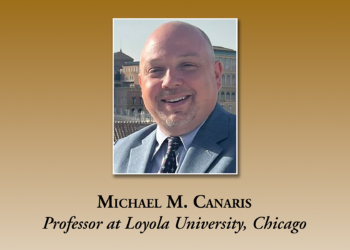
An alumnus of Camden Catholic High School, Cherry Hill, Michael M. Canaris, Ph.D., teaches at Loyola University, Chicago.




 at the bottom and then tap “Add to Home Screen”
