





According to tradition, Saint Paul ordained his disciple Saint Timothy as the first bishop of the Church of Ephesus. Later, Paul encouraged Timothy in his ministry in a letter he wrote: “I remind you to stir into flame the gift of God that you have through the imposition of my hands. For God did not give us a spirit of cowardice, but rather of power and love.” (2 Tim 1:6-7)
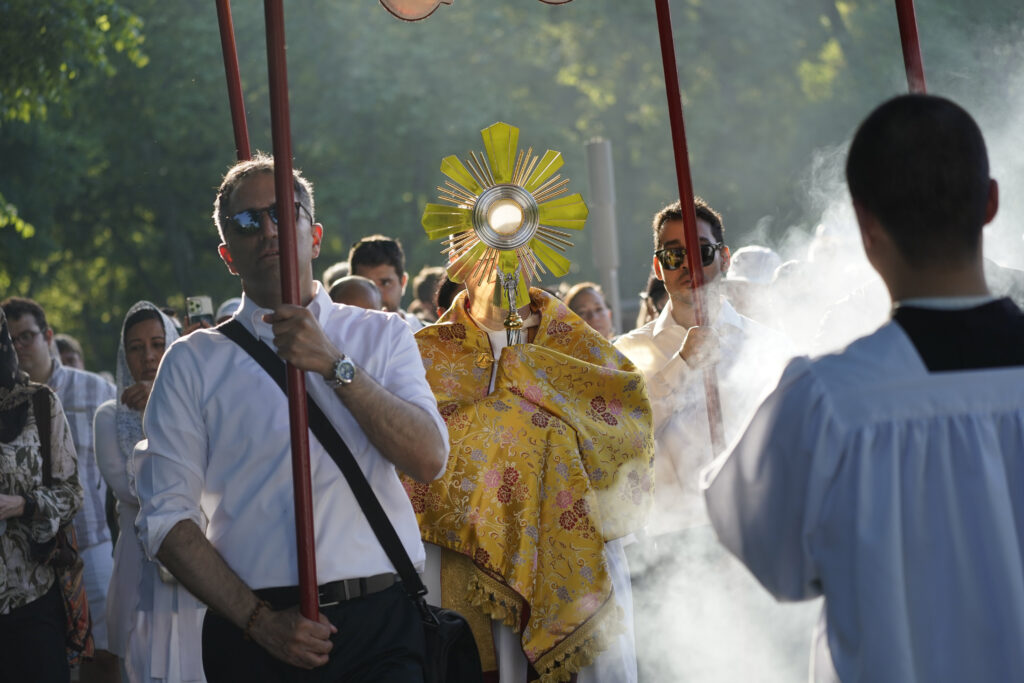
For the past three years, the Church in the United States has been experiencing a Eucharistic revival, which will conclude at the National Eucharistic Congress on July 17-21 in Indianapolis. Leading up to the Congress, four pilgrimages set out May 19, Pentecost, from the north, south, east and west. These pilgrims will converge in Indianapolis on July 17. Together, the pilgrimage routes will cover 6,500 miles and are meant to serve as a contemporary journey to Emmaus with our Eucharistic Lord from the four corners of our nation.
All of those activities are meant to “stir into flame the gift of God,” which the Church has been given in the Most Blessed Sacrament, the Holy Eucharist. This most precious gift of Christ, it seems, has been woefully undervalued and misunderstood in recent years.
In 2019, the results of a survey of American Catholics taken by Pew Forum were released. The survey indicated that only one-third held to the belief that Christ is really and substantially present in the Eucharist under the appearances of bread and wine. Two-thirds erroneously believed that Christ’s presence is merely symbolic.
As a result, the bishops of the United States decided to launch a three-year program to remedy the situation. It would be developed along the lines of the concepts of classical philosophy called transcendentals; namely, the metaphysical ideas of the good, the true and the beautiful.
For example, under the concept of the good, presentations on the Eucharist would focus on the ethical treatment of one’s neighbor. Since the reception of the Eucharist gathers all into a holy communion with Christ and one another, social justice for all, especially the needy and downtrodden, should flow naturally from communicants.
Insofar as what is true about the Eucharist is concerned, the Catholic doctrine of the Real Presence would be emphasized. Reiterating the solemn pronouncement of the Council of Trent in 1551, the Catechism of the Catholic Church teaches: “In the most blessed sacrament of the Eucharist, ‘the body and the blood, together with the soul and divinity, of our Lord Jesus Christ, and, therefore, the whole Christ, is truly, really and substantially contained.’” (1374) This aspect of what is true about the Eucharist has been the major focus of the Eucharistic revival – and not surprisingly, given the results of the 2019 Pew survey.
Concerning the treatment of the Eucharist and beauty – and this perhaps has been the most neglected of the aspects of the revival, at least explicitly – careful attention should be given to the aesthetics of the celebration of the sacred liturgy. As Catholics, the expression of our faith is incarnational. In other words, when we gather for worship, it is no bare-bones affair. We add flesh to the skeleton – vestments, candles, decorations, flowers, music, and sometimes, incense. That is important because we are ensouled bodies who worship with our whole being. It is, therefore, crucial that the Eucharistic liturgy appeals to our senses, as well as to our spirit.
No greater beauty can be added to our understanding and celebration of the Eucharist than the prayers composed by Saint Thomas Aquinas for the feast of Corpus Christi. When Pope Urban IV inaugurated this feast for the universal Church in 1264, he asked both Saint Thomas and Saint Bonaventure to compose prayers for the Mass and Divine Office (Liturgy of the Hours). As Thomas read his prayers to the pope and Bonaventure, they were both brought to tears by the sublime beauty of the angelic Doctor’s composition, and Bonaventure immediately tore up his own work.
Thomas composed five Eucharistic prayers, four of them for the liturgy of the feast and one for private Eucharistic devotion (“Adoro Te”). All of them were written as poems in rhyming verse and were set to music. Parts of those prayers are familiar to many Catholics, such as “Panis Angelicus” (from “Sacris Solemnis”), “O Salutaris” (from “Verbum Supernum”), and “Tantum Ergo” (from “Pange Lingua”).
Poetic translations of those texts in English can be accessed online and may serve to form both the mind and heart in the truth and beauty of the Eucharist as we are inspired to seek the good of our brothers and sisters in Christ. Thus, as the Eucharistic revival formally draws to a close, may we all continue ceaselessly to “stir into flame the gift of God” that has been given to us in the Holy Eucharist.
Father Edward Kolla is a retired priest of the Diocese.



 at the bottom and then tap “Add to Home Screen”
