





Pope Francis recently gave an important, if not widely discussed, speech to the European Parliament in Strasbourg. In it, he laid out his vision and hope for Europe’s relationship with the church, other parts of the world, and the human family at large.
The pope recognized the changing complexity of the globalizing and increasingly interconnected world, and the resultant consequence that it has as a whole become “less and less Eurocentric.” He was brutally honest in his appraisal: “Europe seems to give the impression of being somewhat elderly and haggard, feeling less and less a protagonist in a world which frequently regards it with aloofness, mistrust and even, at times, suspicion.” He lamented that so many see it as a weary and aging “grandmother,” no longer fertile and vibrant.
And yet the more than 500 million people who live in Europe (of which I am one) are no doubt powerful influences on all aspects of the world’s culture, economy, history and social fabric (which I am not).
The pope’s central theme in the speech was an emphasis on the people of the continent not as citizens or economic agents, but on “persons endowed with transcendent dignity” (Italics in the original official text).
He stresses that these two words are, or should be, closely bonded together.
Dignity, as found in the human rights tradition advanced by the contemporary European Union, cannot be read to mean hyper-individualism, where each person lives as a “monad, increasingly unconcerned with other surrounding monads.” True, their dignity is always assured; but in so being, is also always linked to the concept of duty. The culture of human rights mandates an appreciation of limits in view of the common good, or as he put it, “of the ‘all-of-us’ made up of individuals, families, and intermediate groups who together constitute society.”
The transcendent is also an element of this. Our interior moral “compass” makes clear that no human being is his or her own absolute, but rather all of us are beings-in-relation. Thus, the loneliness that so plagues contemporary human beings, whether it be disaffected young people addicted to technology in place of genuine human interaction, the out of work unable to find dignified employment, or the elderly languishing forgotten and abandoned to their fate, stems from an utter selfishness and infatuation with opulence which is indifferent to this dimension of our personhood. A “throw-away culture” endangers our collective social health, as well as our senses of “memory and hope.”
The pope’s image of how to restore these deep longings, while being “creative and resourceful, respectful of rights and conscious of duties” is fascinating. In one of Raphael’s famous painting, the so-called “School of Athens,” Plato and Aristotle walk together in the center of the scene. Amidst their discussion, Plato’s finger points upward, toward the world of ideals and perfection, in effect toward the divine. Aristotle’s points out toward the viewer, engaging the world and its concrete realities. Francis claims, “This strikes me as a very apt image of Europe and her history, made up of the constant interplay between heaven and earth, where the sky suggests that openness to the transcendent — to God —which has always distinguished the peoples of Europe, while the earth represents Europe’s practical and concrete ability to confront situations and problems. The future of Europe depends on the recovery of the vital connection between these two elements.”
To strengthen this effort and to combat various strands of extremism, whether religious or secular, he offered the Holy See’s willingness “to engage in meaningful, open and transparent dialogue with the institutions of the European Union.” Commitment to dealing honestly with issues involving family life, education, ecology, labor, and migration can and should lead to a reinvigorated Europe, one not revolving solely around economic vitality alone, but around the sacredness of the human person.
He closed by insisting, “The time has come for us to abandon the idea of a Europe which is fearful and self-absorbed, in order to revive and encourage a Europe of leadership, a repository of science, art, music, human values and faith as well. A Europe which contemplates the heavens and pursues lofty ideals. A Europe which cares for, defends and protects man — every man and woman. A Europe which bestrides the earth surely and securely, a precious point of reference for all humanity!”
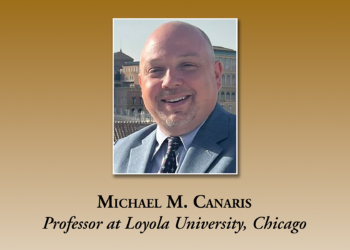
Collingswood native Michael M. Canaris, Ph.D., Pontifical University of St. Thomas (Angelicum), Rome.



 at the bottom and then tap “Add to Home Screen”