





“O how our hearts beat high with joy, whene’er we hear that glorious Word.”
So closes the first stanza of F.W. Faber’s hymn Faith of Our Fathers, originally honoring the 16th century Catholic martyrs in Ireland and England. With the recent release of the film “Silence,” the related glory and suffering of Christian witness in the face of trial has been in the forefront of conversation in Catholic circles recently. And standing silently in the church of the Gesu in Rome at the tomb of Pedro Arrupe, S.J. this week, I felt the words resonate within myself, as my own heart beat high with joy in marking his contribution to Catholic education.
Father Pedro Arrupe, the leader of the Jesuits from 1965-83 is buried steps away from his predecessor Saint Ignatius of Loyola. The painting above his resting place is striking, as it shows Father Arrupe, along with Joseph Pignatelli, S.J. (1737-1811) and Jan Roothaan, S.J. (1785-1853), helping Joseph of Arimathea remove Jesus’s corpse from the cross. Father Arrupe is the lowest figure in the masterpiece, closest to the viewer’s eye-level, his gaunt frame literally shouldering the weight of the dead Lord of Life who bore the sins and shortcomings of a fractured world.
And yet like so many sung and unsung heroes, Father Arrupe’s life provides “teachable moments” manifesting a commitment to emulating and learning from the Great Teacher, the one Mary Magdalene called “Rabboni.”
After being imprisoned in Japan in the wake of Pearl Harbor, Arrupe was ministering within the blast zone in Hiroshima when the nuclear bomb was dropped there in 1945. He survived, but was profoundly transformed by the suffering he witnessed in those days. He eventually went on to become nominated as the Superior General of the Jesuits, recommitting the order to education and social justice, and inspiring a generation of activists and “men and women for others.”
He founded Jesuit Refugee Services and guided the order through the massacre of its priests working amidst the impoverished people of El Salvador in the 1980s. After a debilitating stroke, he prayed in paralyzed silence for almost 10 years, feeling himself “more than ever, in the hands of God.”
Loyola University Chicago has a two-year college dedicated to underprivileged, financially challenged, and at-risk youth, who likely could not attend a university without its groundbreaking model of accessibility and affordability. It is called Arrupe College in his honor.
Father Arrupe’s most famous prayer can often be found posted in classrooms, offices, and retreat centers, where Catholic educators tirelessly strive to form hearts and minds. I have long had a copy on my own desk.
“Nothing is more practical than finding God, that is, than falling in a love in a quite absolute, final way. What you are in love with, what seizes your imagination will affect everything. It will decide what will get you out of bed in the mornings, what you will do with your evenings, how you spend your weekends, what you read, who you know, what breaks your heart, and what amazes you with joy and gratitude. Fall in love, stay in love, and it will decide everything.”
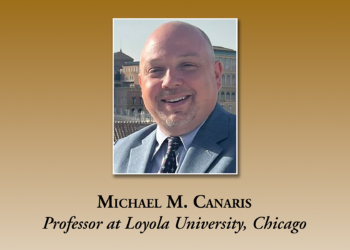
Collingswood native Michael M. Canaris, Ph.D., teaches at Loyola University, Chicago.



 at the bottom and then tap “Add to Home Screen”
