





“When you wake up on Christmas morning, who are you going to be? And in the four weeks of Advent, who did you encounter?”
Such are the questions Donna Ottaviano-Britt, the Diocese’s head of the Secretariat for Pastoral Outreach, asks all to consider as they prepare to celebrate the second coming of the Savior.
“These weeks in front of us are a time for hope and a time to prepare. It’s an opportunity to really be embraced by the burning heart of Jesus because his heart really does burn for us,” she says.
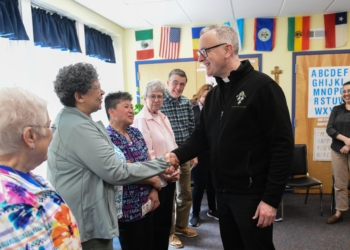
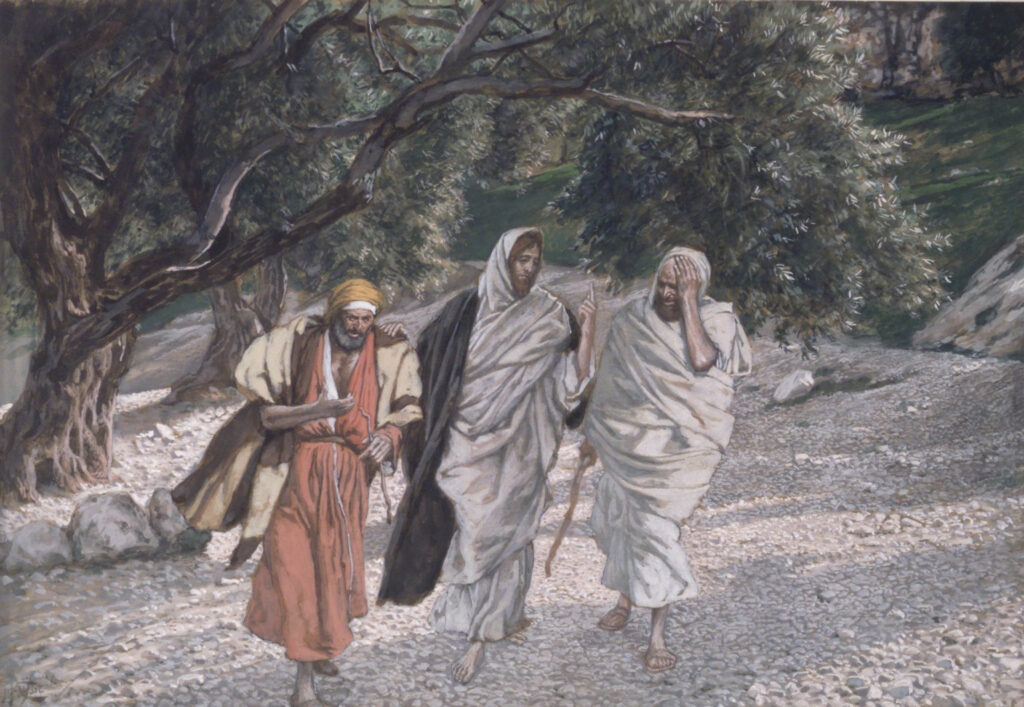
Ottaviano-Britt, who recently led an Advent retreat titled “Embraced by the Burning Heart of Jesus: Emmaus to Bethlehem” at Saint Elizabeth Ann Seton Church, Absecon, encourages reflection on the imagery found in Luke 24:13-35.
She says, “Meditate on the Scripture passage and take your own personal journey. Go to Mass and receive the Eucharist, deepening your belief in the real presence, and arrive at the manger with Jesus and be embraced with a burning heart.”
“If you know the story of the Road to Emmaus, the two disciples are leaving on Easter Sunday, and they’re heading seven miles outside of Jerusalem because everything that they thought about Jesus didn’t seem to be coming to fruition,” she says. “But Jesus comes along and walks alongside them. He talks to them, he asks questions, he teaches and he listens. And while that happens, their hearts begin to burn. At the end, they actually sit at table, and Jesus reveals himself in the breaking of the bread.”
“This is the road we, too, take to meet Jesus in the manger at Christmas. It’s a journey we take as individuals, but one we also take with our families, friends, co-workers and strangers,” she says.
What might this road look like? It can be one of hope, joy, preparation and prayer, if “we can fight the urge to be drawn into the noise and commercialization that bombards our souls and spirits. How do we find silence? How do we find time for God? And how might we create that for other people?” she asks.
One solution: Renewing one’s belief in the Real Presence of the Eucharist.
“He blessed, he broke and he gave, and that was how they recognized him,” Ottaviano-Britt reflects on Luke’s Gospel and the Eucharist. “Think about that as you receive Jesus, Body, Blood, Soul and Divinity. Because what he does in this passage is exactly what happens in Mass.”
Similarly, she encourages others to be missionary disciples. Like Jesus walked the Road to Emmaus with two followers, so, too, “are we expected to make other disciples for him.”
One way to accomplish this is through a real encounter with others and the building up of community. “We are the living Church now. Whose lives will we touch in these weeks of Advent? In whose lives can we be the light? Whose questions can we answer?”
She continues, “Be Jesus for somebody else. So many people don’t know what it is like to be embraced by the burning heart of Jesus. How do we help them? They can have that experience through us. As we prepare for Christmas, think about taking your heart and wrapping it around somebody else’s.”
“The world is a mess, and it always has been. It isn’t like Jesus doesn’t know. He knows. But ask yourself, ‘What are some of the ways that I can help people who are truly alone?’
“That is thinking about all the ways we are living our baptismal call,” she says.
Along the way, ponder personal vocation. Whether it’s being called to marriage, parenthood, single life, the priesthood or consecrated life, every single person is a child of God born at a particular time for a reason.
“Personal vocation is really discipleship and how we live it out. Reflect on what that looks like for you and share your stories. How do we build connection, and how do we know intimacy? We share ourselves with other people. Our stories matter,” she says.
As a way to find one’s story, Ottaviano-Britt offers an exercise: Take a long piece of paper – such as contact paper taped to a wall – and draw a horizontal line. Then draw lines above and below, and write life events that hold particular meaning – sad, happy, major and minor.
“You’ll start to see a thread of God’s work,” she says. “Look back at that timeline, and find a fulfillment story. They matter. They tell you a lot about how God created you and where to find your joy.”
Along the Road to Emmaus, in the Eucharist and through the stories one can share – and elicit from others – arriving in Bethlehem this Christmas can be different than years’ past, Ottaviano-Britt believes.
“Ask yourself, ‘What kind of spiritual work would be necessary for me to be a little bit different than before?’”
Discover your fulfillment stories
Fulfillment stories are activities from any part of your life that you enjoyed doing, did well and found deeply satisfying. In these stories, you are the protagonist/doer of the action.
Elements of a fulfillment story:
• Write a short summary/statement/title of your story
• What prompted you to get involved?
• What did you do?
• What was most satisfying to you?
Share these stories, and encourage others to share theirs with you, to create a culture of calling and encounter.




 at the bottom and then tap “Add to Home Screen”
