




Though most of the earliest Christians, including many of the first popes, spoke dialects of Greek (think of the curving Eastern Mediterranean cultural arc from Greece and Turkey to Syria and Lebanon to Egypt), the first famous Latin theologian was the second-century Tertullian, from the then-Roman province of Carthage in modern day Tunisia.
He is perhaps most famous for his claim that “the blood of the martyrs is the seed of the church.” He means here that the more the violent forces trying to eradicate the faith put people to death for their beliefs, the more others became curious about what message could possibly inspire such devotion. This inspired people to learn more, thereby propagating Christianity farther around the region and eventually the world. Not everything Tertullian offers is helpful; he is one of the few early Fathers not to be canonized due to some of his more outlandish claims, many of which are incredibly sexist. But he is on point about this claim.
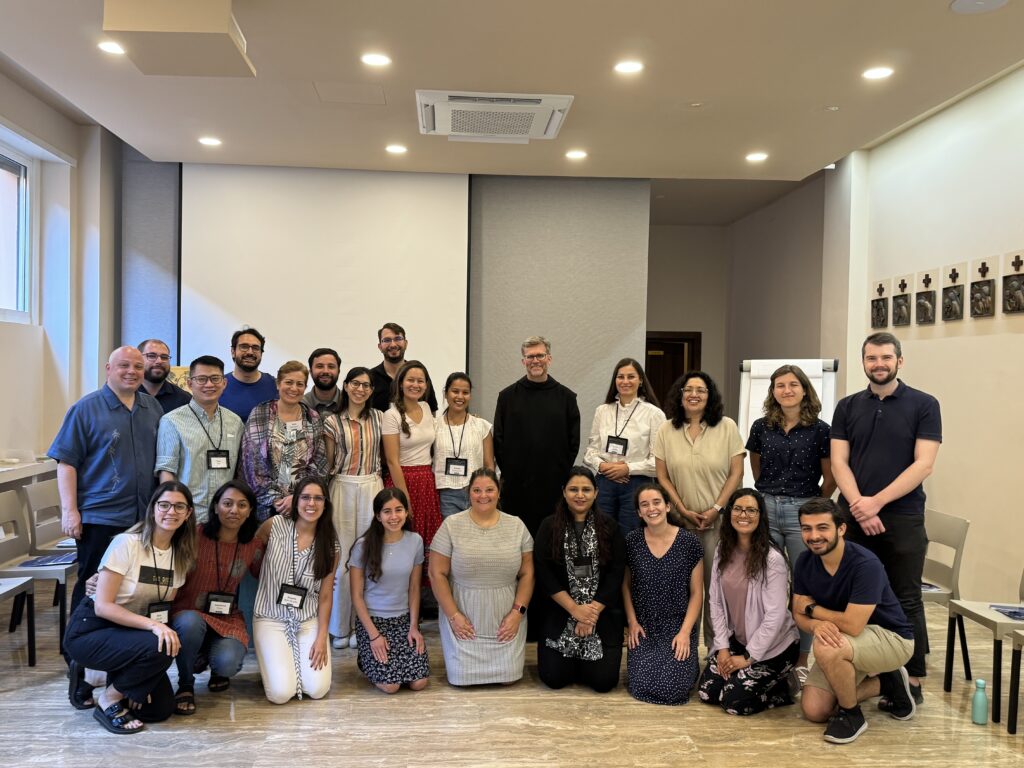
I was invited to Rome this week to participate in a formation program held at the Lay Centre on the Caelian Hill overlooking the Colosseum for 21 young leaders from diverse locations including Colombia, Guatemala, Germany, Hungary, India, Italy, Latvia, Lebanon, Portugal, Russia, Slovenia, Spain, Vietnam and the USA. Inspired by Tertullian’s assertion, I decided to structure my dialogical session on “Martyrdom as an Essential Element of Servant Leadership.”
Of course, it was imperative to point out first and foremost what martyrdom is not: accepting unacceptable behavior, an empty vessel approach to spirituality devoid of protagonism and agency, or masochistic tendencies – that as one contemporary writer put it – is too quick to “roll around in the entrails” of the slaughtered.
Where martyrdom becomes an indispensable dimension to authentic leadership, particularly in Christian contexts, is when we focus on the themes of public witness (from which we get the word “martyr”) and death to our own imagined self-sufficiency or ego-driven careerism.
As preparation for our time together, I had the participants read a powerful speech by Saint Oscar Romero, himself a recipient of the palm and crown of giving one’s life for the faith. But much more impactful than any of my own meager reflections was a joint visit we arranged to the “Sanctuary of the New Martyrs” in Rome’s church of San Bartolomeo al’Isola, dedicated to the apostle known in English as Bartholomew, or Nathaniel. Tradition says that Saint Bartholomew was flayed alive; that’s the reason he’s the patron saint of tanners and leather workers, and also the occasion for Michelangelo’s self-portrait on the sagging, shedding skin the saint holds up as a sign of victory in the Sistine Chapel’s Last Judgement scene.
The shrine is an ongoing work of the Sant’Egidio community, whose spiritual and pastoral outreach I have extolled in these pages in the past. Our host was my good friend, Dr. Paolo Mancinelli, a Roman church historian and active member of the community. It was Saint Pope John Paul II who entrusted this likely oldest religious site in Rome, originally an island temple to the Greek god of medicine Asclepius, to the community to establish a memorial for those countless figures who had died for their faith in the 20th and 21st centuries. Relics from figures like Maximilian Kolbe, Pino Puglisi, Titus Brandsma, Jacques Hamel, the 2019 Easter bombing victims in Sri Lanka, and Romero himself are venerated there. Martyrs killed because of communism, Nazism, missionary work, persecution in the Middle East, Africa and Asia, and even the Mafia are included.
Martyrdom is not an archaic remembrance of people being eaten by lions or thrown off cliffs or burnt at the stake in some faraway time and place. Some estimates claim that the last 150 years saw more than double the number of martyrs from the first 19 centuries of Christianity combined. This is one of the reasons that “religious freedom” and the human right to practice one’s own spiritual inclinations and explorations are such important touchstones in the modern public discourse.
Systematic killing continues to take place in many quarters of the globe for those who preach or convert to Christianity. Author David Neff claims that our experience of Christianity in the Global North is actually somewhat anomalous: “The typical Christian lives in a developing country, speaks a non-European language, and exists under the constant threat of persecution – of murder, imprisonment, torture or rape.”
Thus, if we are to cultivate genuine leadership in the public arena of pluralism, debate and global citizenship, we must all recognize our call to stand in solidarity with those who suffer and to model an authentic approach to compassionate and just human fraternity, all of which demands a commitment to honoring – and sometimes exhibiting – martyrdom in our personal and professional lives.
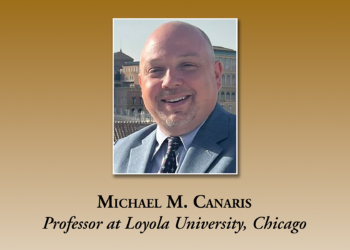
An alumnus of Camden Catholic High School, Cherry Hill, Michael M. Canaris, Ph.D., teaches at Loyola University, Chicago.



 at the bottom and then tap “Add to Home Screen”
