




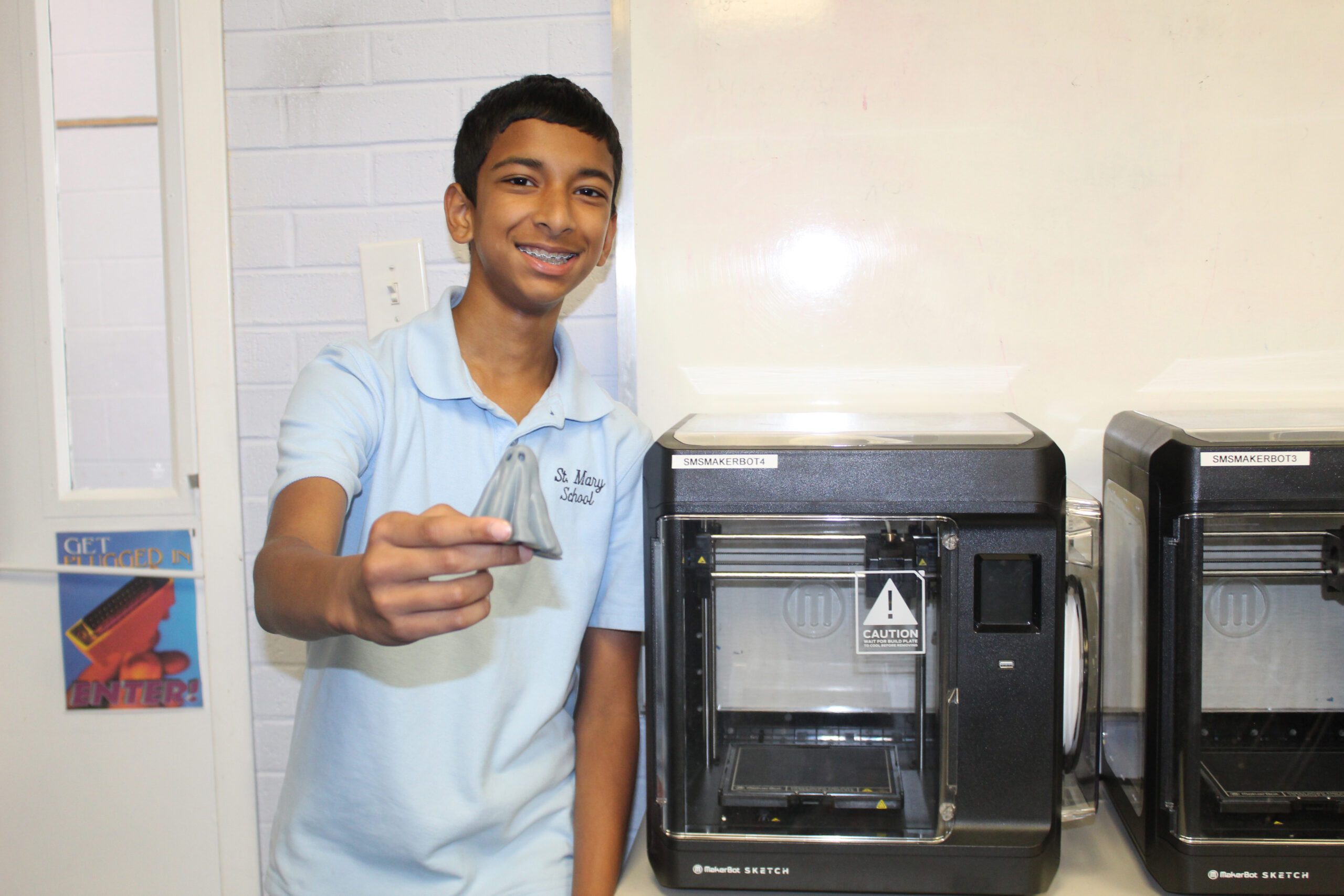
When students of Saint Mary School, Williamstown, came into his classroom for their lessons last year, Chris May saw the future hopes of his pupils.
“They would see the 3-D printers working, and they couldn’t wait to be able to use them,” the school’s technology coordinator said.
Available to those in grades six through eight, the printers were part of the school’s first year of a computer-assisted design initiative led by May, courtesy of a grant derived from the Inter-Parochial Catholic School Fund (ICSF) and Catholic Strong monies to provide such cutting-edge opportunities for the Diocese’s elementary school youth.
“Students were amazed at what the printer could do,” May says of the first days, adding that the students were quick learners for the CAD software and printer programs. For their final assignments, the sixth- and seventh-graders created their own nameplates, while the eighth-graders could use the printer to create anything they wished.
“These students are learning skills that they’ll take with them,” May continued, mentioning that 3-D printing technology is being utilized in the engineering, aerospace and medical fields.
The grants available to Saint Mary, and other elementary schools in the Diocese, allow educators “to be innovative in their programming and create initiatives that they might not be able to do through an everyday operating budget,” said Dr. Robert Lockwood, director of curriculum and assessment for South Jersey Catholic Schools in the Diocese of Camden.
In its inception in summer 2022, the program distributed a total of $200,000 to 12 elementary schools. The monies are generated from parish contributions to ICSF (a pooled resource for schools), and the Diocese’s Catholic Strong campaign; a committee composed of diocesan school and finance members as well as those from the ICSF board decide where the funds are best served.
When discussing where to focus their grant applications, Saint Mary Principal Patricia Mancuso and others “asked ourselves what would benefit our students the most,” she said.
After receiving $6,500 for four 3-D printers, monitors, parts, software and filaments, May set up the equipment and introduced it to the school. This upcoming year, his 3-D printing class will be expanded to include fourth- through sixth-graders.
As the grant program is designed to help schools “identify and serve the needs of their community,” Dr. Lockwood said, the allotments support the various desires of diocesan schools.
In Woodbury Heights, the $14,000 Saint Margaret Regional School received enabled staff to purchase new laptops for teachers, state-of-the-art wireless technology and smartboards, all of which will help students and teachers interact with one other seamlessly and in-real time for assignments and presentations.
“Our teachers greatly benefited from the high-speed, larger memory laptops to create digital content presentations for their lessons. Along with the laptops, the new wireless access points, supplied by the grant, created a network environment that was safe and efficient,” noted Sister Michele De Gregorio, FMIJ, principal.
“Since our students are growing up in a very digital world, they were very receptive and appreciative of having technology that connected them to the content in various ways. Middle school students, of all learning modalities and all subject classes, were able to benefit from this opportunity and were able to show what they know,” she continued.
“We cannot thank South Jersey Schools enough for the opportunity to bring this technology to our community,” she said.
At Galloway’s Assumption Regional School, an old computer lab was repurposed into a MakerSpace lab, courtesy of a $29,600 grant.
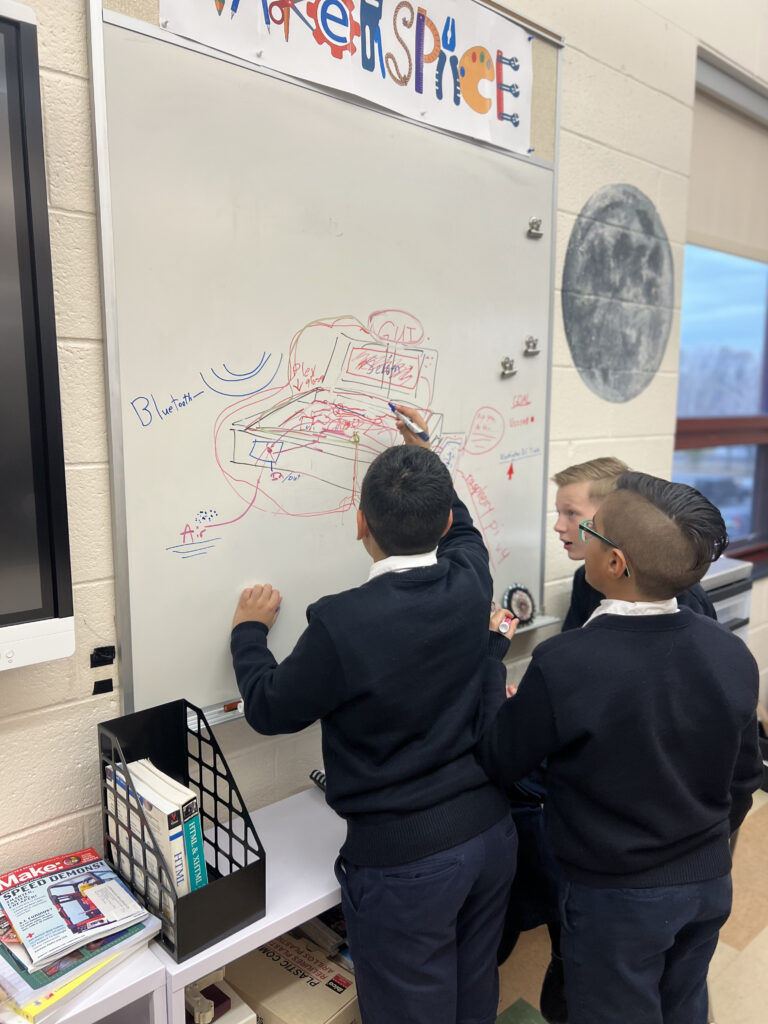
The program, which began last spring for the Pre-K through eighth-graders, allows students to engage “in hands-on activities to find solutions to real-world problems,” said Maddie Giardina, the school’s technology teacher.
In working with concepts such as 3-D printing and electromagnetism, and through creations such as geodesic domes and marbles mazes, students are able to “learn, think and solve,” she said. “Students are begging for more time in the lab, asking questions and applying what they are discovering to other academic disciplines. They are loving the learning process.”
“I have seen students who would normally be lackadaisical in their approach to learning change completely when given the opportunity to use their own thoughts and creativity on how to achieve the goal before them,” she added.
As well, collaboration on projects like robotics or creating the strongest suspension bridge breeds new ideas and thinking through evaluation and modification.
“Students are learning that [their peers] think differently; it’s not just me teaching them, it’s them teaching each other.”
In Blackwood, at Our Lady of Hope Regional School, the $12,000 in funds allowed the school to raise its pre-school cap above 20 students.
A new three-days-a-week PreK4 class joined the pre-existing one, bringing the student total to 30, along with a new classroom and teacher, furniture, cubbies for personal belongings and a formal creative curriculum.
Because of this increased opportunity for families, Principal Elizabeth Martino has seen growth in the school for this upcoming year, as “most of the students stayed onto kindergarten,” she said. Indeed, the kindergarten class is Our Lady of Hope’s largest for the 2023-2024 academic year, at 46 students.
As well, one of this year’s PreK4 classes will go five days a week and have a teacher’s aide.
The funds also allowed a faculty retreat day last spring to help the school’s teachers and staff “take time for quiet, and take stock of where they are, what they are doing and why they are doing it,” Martino said. The retreat also fostered “more creative thinking for the school and communication between teachers and administration, which is beneficial.”
Plans were set to continue these faith-based gatherings through future retreats, and times for morning prayer at the start of school days.
All told, the ICSF and Catholic Strong grants are helping schools and their teachers and staff expand their possibilities, Martino said. “We’re thinking and dreaming bigger.”



 at the bottom and then tap “Add to Home Screen”
