




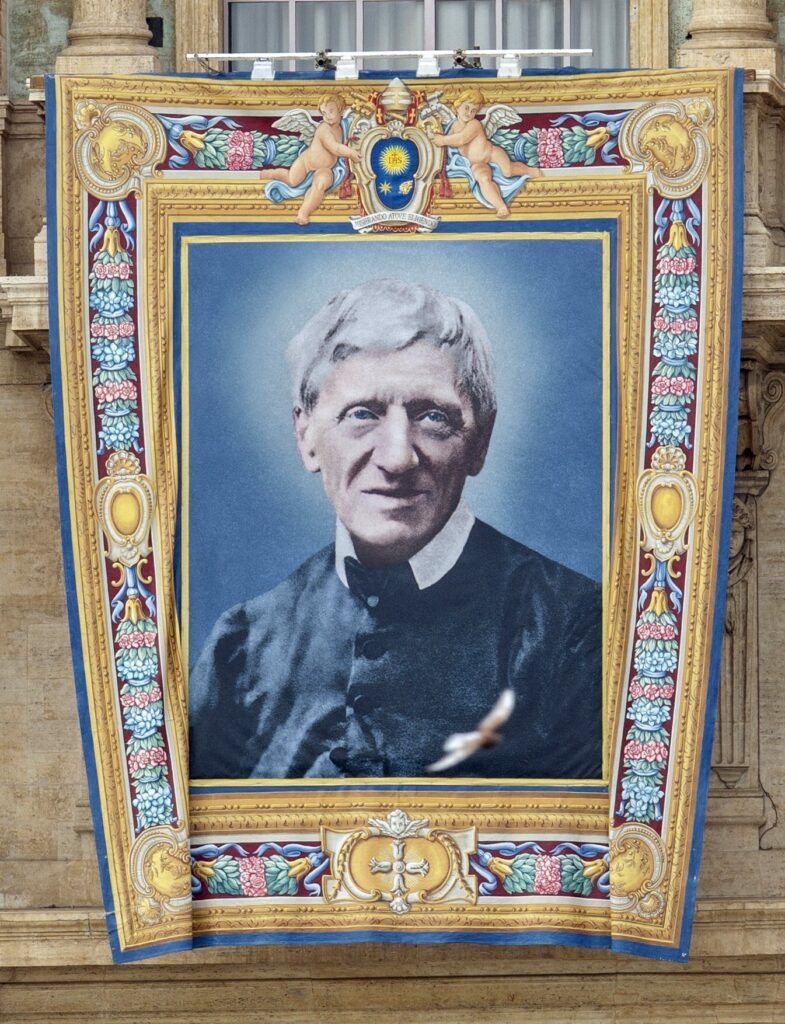
When, on July 31, Pope Leo XIV formally prepared the way for English Cardinal John Henry Newman to be declared a doctor of the Church, he was adding to his predecessors’ long history of recognizing particularly influential voices to clarify the Gospel for the wider people of God.
The saint is a uniquely unifying figure, as contemporary believers across diverse ideological perspectives value his contributions and reflections. Frankly, it’s hard to find a contemporary Christian who isn’t touched by his writing in some way, from more traditionalist believers enamored with his Oxford Movement days to those who so connect him with the currents that led to Vatican II that it’s frequently been called “Newman’s Council,” though he died more than 70 years before it began. As so many do, he planted seeds that continue to bear fruit long after the end of his earthly life.
The venerable tradition of referring to certain esteemed figures in the Catholic tradition as a “Doctor Ecclesiae Universalis,” or Doctor of the Universal Church, is a longstanding one. In fact, while Saint Paul is not so named, the base of the enormous statue outside his tomb in Rome refers to him as the Doctor Gentium, the “Teacher of the Nations.”
But the more traditional formal list of now 38 such figures began with the four Great Latin Fathers: Jerome, Ambrose, Augustine and Gregory the Great. These are complemented by the four Great Doctors of the East: Athanasius, Gregory of Nazianzus, Basil and John Chrysostom. Others throughout the centuries are given descriptive adjectives: the “Angelic Doctor,” Thomas Aquinas; the “Seraphic Doctor, Saint Bonaventure; the “Magnificent Doctor,” Anselm of Canterbury; the “Mellifluous Doctor,” Bernard of Clairvaux; and Pope Leo’s original namesake, usually referred to as the “Church Unifying Doctor.” Other familiar names include early Church fathers like Peter Chrysologus, Hilary of Poitiers and Cyril of Jerusalem.
Those closer to the modern world on the list are Robert Bellarmine, Alphonsus Liguori, Francis de Sales, Lawrence of Brindisi and Peter Canisius. Sometimes mysticism rather than pure scholarship warrants the distinction, as with John of the Cross and John of Ávila. The first woman was named in 1970; today there are four such Mothers of the Faith included: Teresa of Ávila, Catherine of Siena, Thérèse of Lisieux and Hildegard of Bingen. Pope Francis added two thinkers to the ranks, both from the Church’s first millennium: Gregory of Narek and Irenaeus of Lyon.
The title doctor originally had very little to do with medicine or the healing arts, beyond a wide interpretation of being skilled in a learning profession, as it is etymologically related to the Latin word “docere,” which means to “teach, show or cause others to come to know.” It wasn’t until the eve of the Reformation that it became more connected to those duly licensed to practice medicine or focus on physical well-being. As is clear, the figures above train their attention not on the frail and fragile human body, but rather on others’ spiritual health and vigor.
In one of Saint John Henry Newman’s famous prayers, he acknowledges both that God alone can enlighten the darkness of the human mind and that God wishes him to do so. These twin facts, as he puts it, “are sufficient reasons for me to ask.” But that prayer, too, closes with a co-responsibility on the part of us as fellow searchers on the path of true wisdom. “I will embrace whatever I at length feel certain is the truth, if ever I come to be certain. And by Thy grace, I will guard against all self-deceit, which may lead me to take what nature would have, rather than what reason approves.”
Perhaps more than any other prayer, this sets the context for what it means for the newly named doctor to “teach, show or cause others to come to know” the living God.
An alumnus of Camden Catholic High School, Cherry Hill, Michael M. Canaris, Ph.D., teaches at Loyola University, Chicago.




 at the bottom and then tap “Add to Home Screen”
