






Mid-July is home to the feast of Saint Benedict of Nursia in the post-Vatican II calendar. Benedictine spirituality famously offers a summarizing microcosm of the entire Christian life in three Latin words: “Ora et Labora”: usually translated into English as “Pray and Work.”
For those following the sixth-century Italian monk’s famous Rule of Life, these two elements of existence are inseparable from each other. In a sense, all that we offer to God with the inclinations of our hearts and the sweat of our brows serves as a testimonial to the unmerited gracious gift of existence of the cosmos itself, bestowed upon us by a loving Creator. We must be wary of those who wish to separate these two, divorcing inner commitments from public practices. The conjunctive “et” (“and”) has been claimed by some to be the hermeneutical and interpretive key to living such a charism validly, vividly and vibrantly. It is perhaps for this reason that some estimates say the Benedictine tradition has six times as many canonized saints as any other religious order in the Catholic Church.
Saint Benedict was quite clear that our whole person was involved in authentic work – everything from our posture to our mental acuity and “presence” to our breathing plays a role. Today, practitioners of mindfulness and casual yoga fitness buffs follow the monks’ lead on recognizing the intrinsic connections between body and spirit, especially in terms of overall wellness.
A canon lawyer friend of mine recently told me that she discerned naming a potential daughter Scholastica, but ended up with three boys. This most famous disciple of Benedict’s vision was his biological twin sister, who founded her own religious community about five miles from his. She was eventually entombed with him. Though from the same womb, she is then with him also an unofficial patron of “spiritual friendships,” those life-giving realities that enable us to develop the intrinsically social dimension of our human personhood beyond those which providence, chance or human decision have either blessed or saddled us with in terms of family life.
C.S. Lewis famously wrote that friendship arises out of companionship, and crosses that mysterious frontier with a first sensation of something like “What? You too? I thought I was the only one!”
Lifelong friendships, particularly those rooted in spiritual and affective foundational experiences, are one of the greatest gifts bestowed upon humanity and sources of authentic joy in our lives. All too often in the contemporary world, we also know well the acute and agonizing pain that arises from the loss of such connections and bonds for all sorts of reasons.
In his Rule, Saint Benedict describes the zeal we should have for maintaining healthy and productive relationships with one another: “Just as there is an evil zeal of bitterness which separates from God and leads to hell, so there is a good zeal which separates from vices and leads to God and to life eternal. By most fervent love therefore, let monks exercise this zeal, that is, let them see to it that in honor they prefer one another. Let them most patiently tolerate their infirmities, whether physical or of character; let them compete in yielding obedience; let none follow what he judges convenient to himself, but rather what he judges convenient to another; in chaste love, let them exercise fraternal charity; let them fear God; let them love their abbot with sincere and humble affection; on no account let them exalt anything above Christ; and may He bring us all alike to eternal life.” (Rule, LXXII)
While most of us are not called to obedience under an abbot in ordinary daily life, we should still learn lessons on how to treat one another, and particularly those we cherish as close acquaintances, from such a rich spiritual patrimony.
My favorite Benedictine axiom is often quoted in Latin: “Venit Hospes, Venit Christus.” The English is usually translated as: “When a guest arrives, Christ arrives.” Building on Matthew 25, Benedict is unwavering in his admonition that we are to extend real friendship to all who seek shelter and arrive at our doors, whether physically or interpersonally, with one unexpected exception regarding “special” guests: “And above all, let care be scrupulously shewn in receiving the poor and strangers; for in them specially is Christ received.” (Rule, LIII)
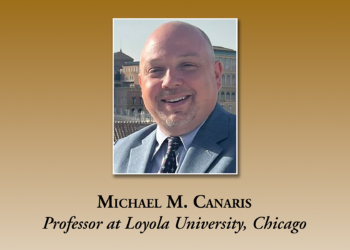
An alumnus of Camden Catholic High School, Cherry Hill, Michael M. Canaris, Ph.D., teaches at Loyola University, Chicago.




 at the bottom and then tap “Add to Home Screen”
