




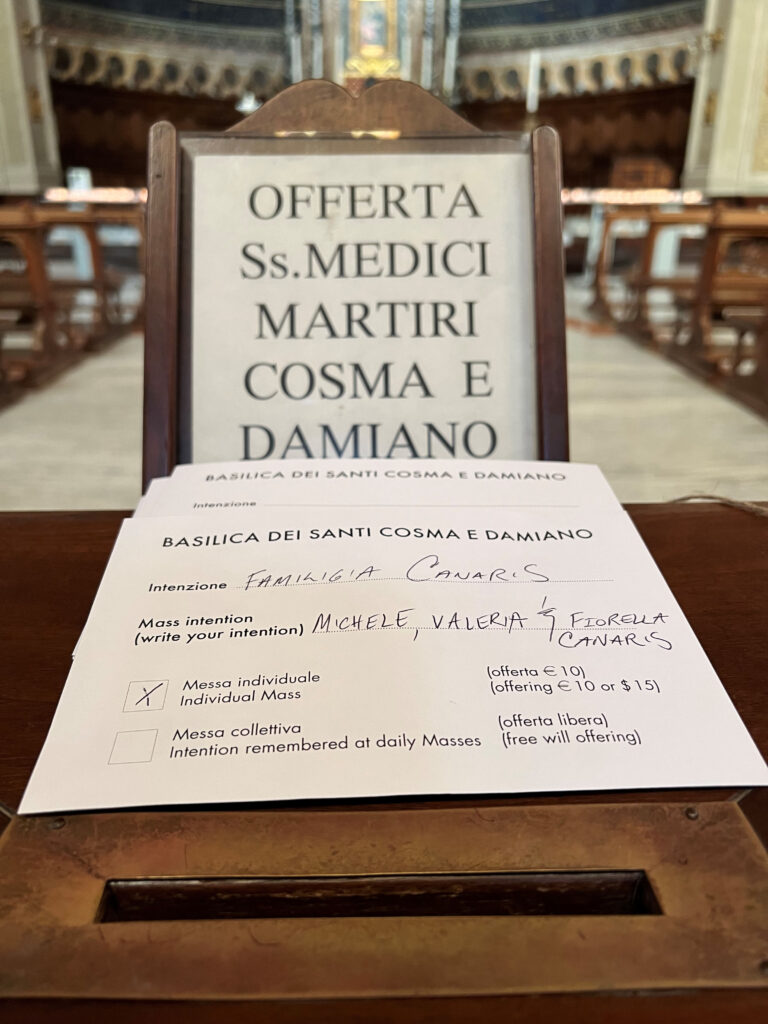
Our entire extended family recently joined us in celebrating the birth of our second daughter, Damiana Canaris. Of course, this joyous time of life connects us profoundly with the abundance of God’s ongoing grace and presence in our lives, found in the tender moments of embrace with a gift so innocent and full of promise.
But yet, we know she is arriving into a moment in human history simultaneously defined by immense potential and grave peril. As an ecclesiologist, it is the communion of saints, the inter-generational cloud of witnesses that I pray will always intercede for her and all my loved ones long after I have shuffled off this mortal coil.
The name Damiana comes from a Latinized form of the Greek word for conquering or overcoming. A number of figures of blessed memory exist in the tradition with related monikers – people like the Benedictine Doctor of the Church Saint Peter Damian, and Saint Damien De Veuster of Molokai (in whose namesake parish in Ocean City I have prayed countless times). A female martyr with a similar name also exists in Coptic Christianity. But for us, the choice was a nod to both the Syrian medical doctor saints Cosmas and Damian, brothers who were martyred under the Emperor Diocletian in the 280s, and the crucifix that spoke to Saint Francis of Assisi almost a millennium later, commonly known as the Cross of San Damiano.
Cosmas and Damian are familiar to many of us from the Roman Canon of the Mass, where they appear after the Twelve Apostles. The basilica bearing their name and their relics in Rome has some of the most stunning and venerated mosaics in the entire world, dating from the fifth century, along with a spectacular Nativity scene with hundreds of pieces. They are venerated both as “un-mercenaries” because of their service to the poor and as patrons to the famous Medici family, due to an Italian play on the fact they were “medics.” A marvelous recent book by physician and medical historian Jacalyn Duffin – published by Oxford University Press – traces their heritage in the postmodern world, especially among those in the healing industries, among which I personally count pastoral ministry and theological formation.
Centuries later, the Cross of San Damiano – which once hung in an abandoned chapel named for Saint Damian near Assisi – today adorns the resting place of Saint Clare of Assisi (in whose namesake parish in Swedesboro I have prayed countless times, and in which we took our wedding vows). Tradition holds that the divine figure on the cross once spoke to a young Francis of Assisi, urging him to, “Go and repair my Church, which has fallen into ruin.” Originally mistaking the plea to refer to the physical stones around him, the future saint came eventually to realize that the message had universal significance for the entire People of God and institutional body of believers. The characteristic love of poverty and care for creation associated with Franciscan spirituality was first germinated in front of that special icon, in a country church dedicated to one of those Middle Eastern twin doctors.
No name is perfect. It may not trip easily and effortlessly off the tongue for some Americans or mean the same thing to everyone who will address my daughter affectionately and adoringly by it. But it speaks a word to us that amor vincit omnia (“love conquers all”), that riches in relationships are as important in life as financial wealth, and that she brings in her petite and cherubic little form hope and happiness and Hallelujah’s – and in some very real sense – Heaven into our home.
With her name, our story continues. San Damiano, prega per noi peccatori (“Saint Damian, Pray for us sinners”).
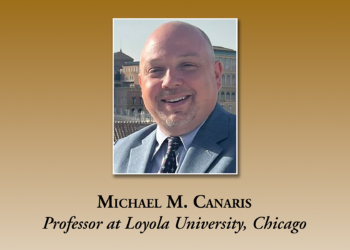
An alumnus of Camden Catholic High School, Cherry Hill, Michael M. Canaris, Ph.D., teaches at Loyola University, Chicago.



 at the bottom and then tap “Add to Home Screen”
