






There seems to me to be a slight but important difference between being faithful and faith-filled in our care for souls, whether of ourselves or of others. The two are obviously not unrelated. But the former tends to have resonances with loyalty, fidelity and regular ongoing commitment, which are all obviously good things. However, the latter brings to my mind a more zealous, ardent and passionate energy, which goes beyond the bare minimum of duty. As an example, a faithful marriage may not necessarily be a faith-filled relationship – exuding joy, satisfaction and mutual fulfillment. Let’s hope that most are both.
This distinction arose in my mind recently as I pondered the upcoming celebration of Blessed Caius of Korea, who was martyred 400 years ago this week, on Nov. 15, 1624. Interestingly, his literal burning at the stake occurred in the same place that another conflagration took place hundreds of years later – in Nagasaki, a city that will also mark a tragic anniversary in August 2025. In that month, it will be 80 years since the atomic bomb was dropped there.
Caius was a onetime Korean Buddhist monk who fled the monastery for a stricter life as an ascetic hermit. When Japan invaded Korea in 1592 under Toyotomi Hideyoshi – in what are commonly referred to as the Imjin Wars – Caius was taken prisoner. He was then shipwrecked on Tsushima Island and eventually brought to Kyoto.
Saint Alphonsus Liguori wrote about what happened next: “One day during sleep, it seemed to him that the house was on fire: a little while afterward, a young child of ravishing beauty appeared to him and announced to him that he would soon meet what he had long desired.”
He soon pursued baptism under the Jesuit missionaries to Japan and converted to Christianity. When eventually shown images of Jesus, he claimed to have had previous visions of just such a man calling him to continue to seek a deeper sense of truth in the midst of his restless pursuit of peace and wisdom.
Caius’ faith-filled vocation led him to live in close proximity to the sick and excluded, particularly lepers. He eventually went to the Philippines, then colonized by Spain, where he continued in his study of the faith. He returned to Japan and became a lay catechist. He worked with both sides in the Japanese-Korean conflicts, trying to use his language skills to bring as many to Jesus Christ as possible.
Eventually, he was discovered for housing and abetting missionaries. Like so many others in waves of persecution, he was pressured to renounce his newfound beliefs. He refused and was eventually martyred, being sent to the pyre alongside James Koichi, a fellow Catholic. Pope Pius IX beatified Caius in 1867.
The global Church, long overly focused on the European-North American cultural corridor, is looking in our day with increasing attention to what some call the Majority World, and particularly to Latin America given the current pontificate. But that glance has turned southward and eastward as well, toward explosions in both religious vocations and lay conversions in Africa and Asia in recent decades. The expression of the faith in those settings foregrounds different dialogues than in ours. Instead of secularization and de-conversion, the faith in those locales must co-exist in close contact with Islamic and animist traditions in Africa; and Buddhist, Hindu and Confucian – sometimes along with formally Communist ones – in Asia. In neither place do Christians hold the central public role that they do in Europe or our country.
Yet, we see another example here that the story of fervent witnesses to Christianity is not new to other places. Hopefully what Caius apparently heard from the very mouth of Christ will hold true for each of us as well: “Fear no more, for you are close to obtaining the ultimate happiness you desire.” May God and his intercession help us to be faithful and faith-filled in its pursuit.
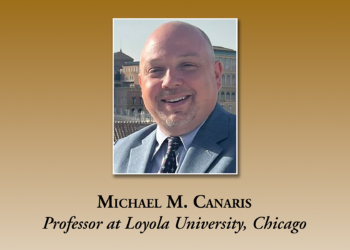
An alumnus of Camden Catholic High School, Cherry Hill, Michael M. Canaris, Ph.D., teaches at Loyola University, Chicago.




 at the bottom and then tap “Add to Home Screen”
