






During a recent meeting with Cardinal Semeraro, prefect of the Congregation for the Causes of Saints, Pope Francis approved and advanced the canonization of Bishop John Baptist Scalabrini. The northern Italian bishop’s life’s work lies at the heart of what is undoubtedly one of the central planks of the Francis pontificate: ministry to migrants.
Scalabrini visited the United States at the turn of the 20th century, meeting with President Theodore Roosevelt about the plight of Italian migrants after traveling more than 10,000 miles around the country to assess their struggles and experiences in their adopted homeland. Both Roosevelt and eventually Pope Pius X were effusive in their praise of Scalabrini’s mission. His collaboration with Mother Cabrini would eventually impact the lives of countless newcomers to the United States.
Today, the Scalabrinian men and woman religious – or, more officially, the Congregation of the Missionaries of Saint Charles Borromeo – work in 32 countries on five continents, prioritizing pastoral care of migrants and refugees from all cultures, ethnicities and backgrounds.
According to every conceivable objective metric, contemporary migrants are more religious than native-born populations, both in Christian and Muslim contexts. If you doubt this, visit the closest parish serving Spanish (or Vietnamese, Haitian, Nigerian or Indian) populations on any particular weekend, and note the vibrancy of the faith and the ebullient welcome you are likely to receive. Accordingly, the idea that migration somehow dilutes the inherited spiritual and moral culture of a particular nation is precisely backward. In many ways, it is migration that has slowed, or even in places reversed, the steep trends of secularization – and the related declining birth rates – in many Western nations.
A healthy civic structure is one that promotes and integrates migrants and their cultures and customs, still as true in the United States today as it was for the ancient Roman Empire, whose inhabitants parenthetically weren’t eating familiar staples to the Mediterranean diet like tomatoes, hot peppers or chocolate, as they only arrived centuries later via cultural migration from the New World. Thus, most contemporary “Italian” food is really Latino food exported to Italy.
The Catholic tradition is unambiguous on both the ineradicable right of people to migrate, and the related right of people not to have to migrate – that is to say, to promote a just global economy where all can find security, employment and social mobility in the nations of their birth. Pope Pius XII made clear in his apostolic constitution “Exsul Familia Nazarethana” that “the émigré Holy Family of Nazareth, fleeing into Egypt, is the archetype of every refugee family,” and called on the Church to look after them “with special care and unremitting aid.” An entire section of the text is dedicated to the Catholic Church’s “motherly solicitude for migrants.”
The soon-to-be-Saint John Baptist Scalabrini is frequently called the Apostle to Migrants. He always rooted this practical activity in prayer, once commenting, “When scholars search through the ruins of antiquity and dig down into the ground where powerful cities once stood, what do they find? Remains of temples, traces of buildings intended for prayer. ‘You will find cities without walls,’ said Plutarch, the ancient Greek historian, ‘without government, without laws, but in no corner of the earth do you find a people without an altar, without prayer, without God.’ In one place with solemn pomp, in another with rough simplicity, the human race has always prayed, always believed that it needs God’s help, always felt that it needs this help in all its actions, from the smallest to the greatest, in order to think, act, love, suffer and win, and that prayer is the only means of obtaining this. Prayer is an inborn, instinctive, irresistible need for us rational creatures.”
Contemporary Scalabrinian spirituality recognizes this prayer is in fact addressed in the Christian tradition to the “God of the tent,” the sojourner deity who travels with us through our shared history and individual wanderings. “Yahweh is not a static, sedentary God, but a migrant God who is always present in the journey of the people of Israel.” And this same God is the one who Saint John tells us in the original language “pitched his tent” among us in the person of Jesus Christ. (John 1:14) As the writings of the Missionaries of Saint Charles make clear, “fidelity to God will then mean to go wherever the God of the tent goes. The greatest temptation against fidelity to God and our Scalabrinian mission, especially in the field of parish ministry, is to settle down, to become used to stability, to become static ministers, and to be content with routinary sacramental ministry.”
Our relationship with God is then in essence a centuries-long migration as a people on the move through history.
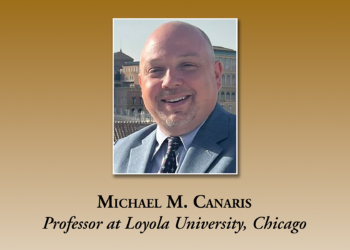
Originally from Collingswood, Michael M. Canaris, Ph.D., teaches at Loyola University, Chicago.




 at the bottom and then tap “Add to Home Screen”
