




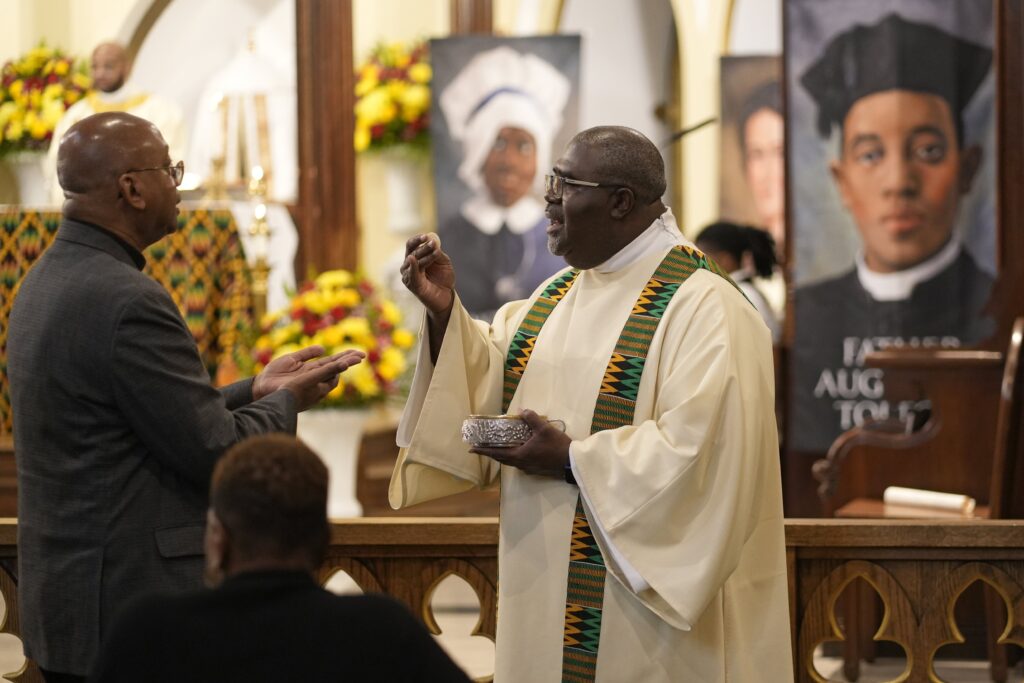
In 1965, the council fathers at Vatican II reiterated the Church’s longstanding condemnation of insulting, assaulting, or excluding someone based on the color of their skin. “[W]ith respect to the fundamental rights of the person, every type of discrimination, whether social or cultural, whether based on sex, race, color, social condition, language or religion, is to be overcome and eradicated as contrary to God’s intent. For in truth, it must still be regretted that fundamental personal rights are still not being universally honored.” (“Gaudium et Spes,” 29)
In addition, documents like the U.S. bishops’ “Pastoral Letter on Racism” (published in 1979) and “Open Wide Our Hearts” (2018) emphasize how in the American context, the Black experience has been consistently marred by this perduring evil. Yet, an older priest friend once said to me that in the 50 years he’s listened to confessions, he’s heard every conceivable sexual sin that you can imagine (and many that you can’t), but never once has he heard a penitent confess the sin of being racist. This elucidates what theologian M. Shawn Copeland famously claims, that racism “seeps, like an odorless, colorless gas into our institutions, even those charged with our human development and flourishing. There it deforms our ideas, attitudes, dispositions and practices – even religious ones.
It is all too apparent, then, that while the Gospel and theological doctrines are clear and unambiguous, the Church’s response to the neuralgic issues involving race have been anemic at best, particularly in the United States. Something has obviously gone awry in the reception process involving this consistent and intelligible teaching.
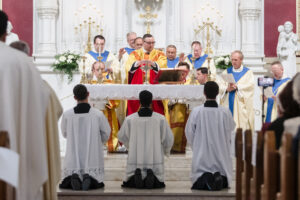
The advance of the Servant of God, Sister Thea Bowman, took one step closer to a potential canonization last week in Jackson, Miss., where the diocesan phase of the process came to completion. The many news stories about this event, though substantially fewer than those about the Super Bowl halftime show, seemed to imply that work still needs to be done to healthily integrate diverse non-White Catholic experience into the United States ecclesial ethos.
Born in 1937 as the granddaughter of slaves, Sister Thea Bowman converted to Catholicism when she was 9 and eventually entered the Franciscan Sisters of Perpetual Adoration. She earned a doctorate from the Catholic University of America, founded the National Black Sisters Conference, and become a prominent teacher and lecturer before her cancer diagnosis in the 1980s.
Caribbean-American theologian Nat Samuel, who is originally from Saint Lucia but has studied and taught in the United States for many years, recently told me that “Thea Bowman taught us to love God with all that we are. She worked tirelessly for justice and racial reconciliation, strengthened Black Catholic education, and served a Church that too often failed to recognize the uniqueness and dignity of Black life and faith – doing it all inspiringly with boldness, grace and contagious joy.”
In 1989, about nine months before her death, Sister Thea told the U.S. bishops: “What does it mean to be Black and Catholic? It means that I come to my Church fully functioning. That doesn’t frighten you, does it? … I bring myself; my Black self, all that I am, all that I have, all that I hope to become. I bring my whole history, my traditions, my experience, my culture, my African-American song and dance and gesture and movement and teaching and preaching and healing and responsibility – as gifts to the Church. I bring a spirituality that … is contemplative and biblical and holistic, bringing to religion a totality of mind and imagination, of memory, of feeling and passion, and emotion and intensity. A faith that is embodied incarnate praise – a spirituality that knows how to find joy even in the time of sorrow – that steps out on faith that leans on the Lord. A spirituality that is commoner – that tries to walk and talk and work and pray and play together.”
She went on to claim: “To be Black and Catholic still, though, often feels like being a second- or third-class citizen of the Holy City.”
Lamentably, I remain unconvinced that she would feel differently almost four decades after she prepared and shared these sentiments to a room full of Church leaders. In fact, she may very well feel worse about the state of affairs.
Join me, then, in praying that Sister Thea intercedes now and always for the Church in our country, to which she dedicated her life, whether or not she is one day publicly recognized by it as the first African-American saint.
An alumnus of Camden Catholic High School, Cherry Hill, Michael M. Canaris, Ph.D., teaches at Loyola University, Chicago.



 at the bottom and then tap “Add to Home Screen”
