






Throughout elementary and middle school, I had the same bus driver: Mrs. Harris. My memory sees her as a much older woman, though through the eyes of a child, she was probably a lot younger than I remember.
She had a gravelly, smokers’ voice with surprisingly strong lungs, especially when we, who were sitting in the back, got a bit too loud and rowdy.
The ability to sit in the back of the bus was decided by pecking order. You were either older, bigger or cooler. Suffice it to say, I never made it to the very back seat, but, in eighth grade, I sat in the second to last seat. This spot often put me in peril because, even when I didn’t do anything wrong, I would still get reprimanded when things got a bit unruly in the back – guilty by proximity.
Right or wrong, we are often judged by the company we keep.
Even Jesus was often under scrutiny for the company he kept. “Why does your teacher eat with tax collectors and sinners?” the Pharisees ask Jesus’ disciples in Matthew’s Gospel.
In the book “Good to Great,” author James Collins tells a story about the finance company Fannie Mae. At one point, the company was losing more than $1 million every day. So, it hired a new CEO. Their board asked him what he was going to do first to turn the company around. The new CEO said that “what” was the wrong question. The first question he would address is “who.”
Collins suggests that a great leader looks at people first. The author uses the metaphor of a bus with the bus driver as leader. Before the bus goes anywhere, the driver decides who belongs on the bus and in what seat.
Let’s look at just a few people riding on Jesus’ bus.
First he has Peter, who is known to have a quick and harsh temper. He has Matthew, a tax collector, seen as traitorous to the Jews for working with the occupying Roman army. He has Thomas, who is doubtful. He has James and John, who are the most likely to sit in the back of the bus because Jesus nicknames them Sons Of Thunder.
Simon was known to be a Zealot – most likely a revolutionary, an instigator, part of a group of people who wanted the Messiah to be a Warrior King, defeat Rome and restore Israel. Jude, who many scholars suggest was probably also a Zealot, wants Jesus to take the world by storm.
These weren’t your highbrow, well-behaved, sit-in-the-front-of-the-bus kind of people, so imagine how they must have felt being chosen out of all of Jesus’ disciples?
In Jesus’ time, boys were taught by rabbis until they were 14 years old. Then they would either be told to go home and pick up their father’s trade, or asked by the rabbi to “Come follow me,” that is, to become his disciple, his student, to leave everything and follow their rabbi.
They would spend years learning theological lessons, but also, they would learn to love what the rabbi loved, to reject what the rabbi rejected; they would learn by watching the actions of the rabbi and they would mirror his behavior.
Who knows, maybe when the apostles were 14, they may have wanted to be picked by the rabbi, but they were told to go home and work their father’s trade.
I remember being in school when teams would be picked on the playground or in gym class. I had always hoped to be one of the first chosen. Alas, as a less-than-athletic child, I was always one of the last picked, and even then, that was often followed by a groan from the rest of the team.
So, the apostles would have already been passed over once by a teacher, and yet, here is another, the greatest teacher of all, calling them to “Come follow me,” wanting them on his team, welcoming them onto his bus.
No matter how flawed we believe ourselves to be, no matter what bad habits or bad tempers we might have, no matter what poor decisions we may have made in the past, we, like the apostles, have not been looked over or passed by.
God has picked each of us and called us on a bus ride that will bring us closer to Him.
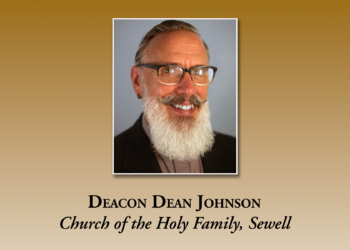
Deacon Dean Johnson serves at Church of the Holy Family, Sewell.




 at the bottom and then tap “Add to Home Screen”
