




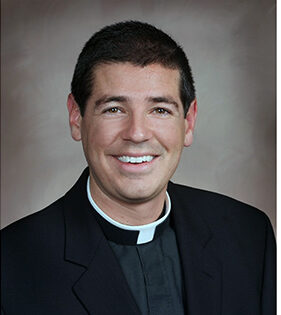
Vicar General
While serving in my first parish assignment, a widow asked me at her husband’s viewing whether I was old enough to be a priest.
The Diocese had recently issued its priests cards to prove we are in good standing, and now I had a reason to show mine. She laughed when I removed it from my wallet and, satisfied, I proceeded to celebrate the funeral Mass. Fifteen years later, I don’t hear that comment anymore!
Although she was not really serious, we do expect wisdom from spiritual leaders, and wisdom usually comes with age.
Now, imagine the usual Nativity scene. It’s busy, populated by Mary and Joseph, animals and angels, shepherds and Wise Men. But the center of their attention? A baby!
What wisdom could this baby possibly have to merit such attention? Mary and Joseph naturally look upon the child with the hope of parents, wondering what joy will this child bring to their lives. They also see the Christ Child with the eyes of faith, remembering the words of Gabriel that the child is the Son of God. The shepherds, too, know the angel’s message that this baby is their Savior and Lord. Even the Wise Men from the east, studying the movement of the stars, know that he is a king.
Two thousand years later, busyness is still part of Christmas, but the Christ Child is rarely the center of attention. It is not that he is too young; no, he is too old! How can an ancient faith possibly be relevant to today’s challenges? What can Christianity say about artificial intelligence’s threat to jobs, social media’s role in polarization, the gig economy’s erosion of economic safety nets, or the instability of de-globalization?
In one of the great books of Western civilization, Saint Augustine addresses God, “O Beauty so ancient and so new.” (“Confessions,” Book X, Chapter 27) Yes, an old story about a newborn does offer fresh answers to today’s questions. The Trans-Siberian Orchestra’s complex version of “What Child is This?” puts it this way: “Tell me how many times can this story be told / After all of these years it should all sound so old / But it somehow rings true in the back of my mind.”
The Nativity, like other truths of our faith, is a mystery with inexhaustible layers of meaning. Human dignity is affirmed by directing our attention to humanity in its weakest stage, the newborn, not the self-made man of modern myth. Physical gathering is prioritized, as the angel tells the shepherds to leave their work to celebrate God’s work. Even foreigners are included in the gathering. The place for the gathering – a feeding trough – is not as important as the people there.
In Haddonfield, I will bless a Nativity scene at Library Point, a highly visible location along Haddon Avenue. Symbols of faith in the public square are a great way to invite people to turn to
Christ for answers. But we can hardly do better than explicitly sharing the answers we’ve found. What is my place in what Catholic author Sherry Weddell calls “the Great Story of Jesus”?
Every Monday evening, I gather with half-a-dozen parishioners to reflect on the Sunday Gospel. We come prepared, having read some commentary on the passage. But we understand the “text” for our discussion is really our lives. The biblical message is the key to making sense of our lives. Scripture equips us to read our story with eyes of faith. Where others see coincidence, we see providence; where others see suffering, we see redemption; where others find themselves in the rat race, we hear the “upward call of God in Christ Jesus.” (Philippians 3:14)
All of us – young Christians or old – can demonstrate the relevance of a story that “should all sound so old” by sharing how the “Beauty so ancient and so new” has filled our lives with light and joy.
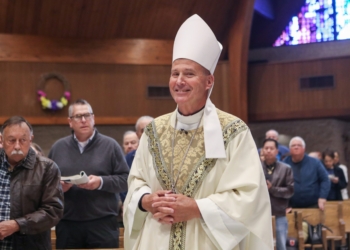
Father Jon Thomas is the vicar general of the Diocese of Camden and pastor of Christ the King Parish, Haddonfield.




 at the bottom and then tap “Add to Home Screen”
