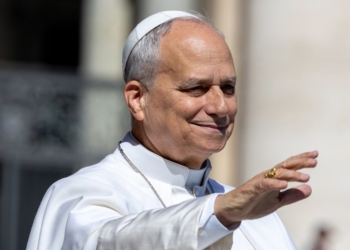




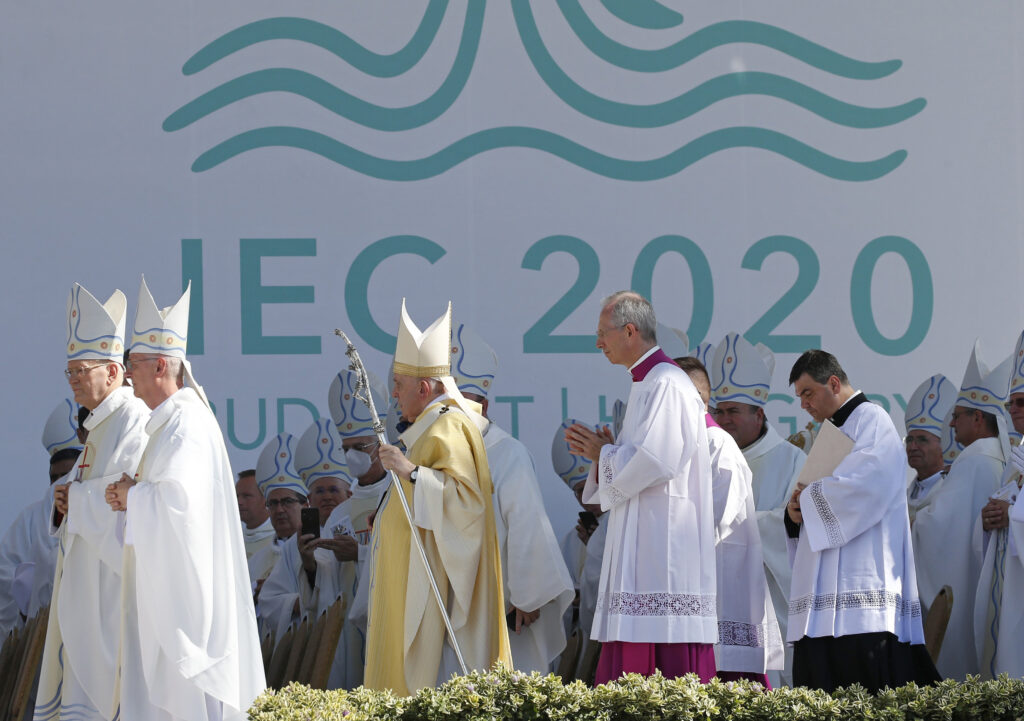
Pope Francis’s visit to Hungary has been in the news quite a bit, especially given the prominence of Viktor Orbán, the nation’s outspoken prime minister, with whom the pope met for a little under an hour.
Though Orbán is a Calvinist Protestant, he was in the front row of Mass Sept. 12, which was Pope Francis’s primary reason for the visit. He had been invited to close the 52nd International Eucharistic Congress in Budapest. Hungary had last hosted the event in 1938 on the eve of the Second World War, which eventually devastated the landlocked nation as more Hungarians died at Auschwitz than any other population. It had been more than 20 years since a pope presided at a Mass during a Eucharistic Congress, and over 100,000 people showed up to participate at Budapest’s Heroes’ Square.
The first International Eucharistic Conference was held in Lille, France, at the urging of a laywoman, Marie-Marthe-Baptistine Tamisier, who had been organizing pilgrimages to sites of Eucharistic miracles throughout the 1870s. In 1881, she was able to convince the relevant Church authorities to hold a mass gathering dedicated to emphasizing the Real Presence of Christ in the Eucharist.
In the early years, these events came to be held annually. In the 20th century, they moved to every two or four years, depending on circumstances. The last was held in 2016 in Cebu City, Philippines, and the next will be held in Quito, Ecuador, in 2024. In 1926, a million people reportedly attended the closing Mass at Saint Mary of the Lake in Mundelein, when the Congress was held in Chicago. It was connected to the bicentennial events held in Philadelphia in 1976, where Mother Teresa, Dorothy Day and President Ford participated.
The event is coordinated by the Pontifical Committee for International Eucharistic Congresses, an arm of the Roman Curia. Today its president is Archbishop Piero Marini, the master of Pontifical Liturgical Celebrations for the bulk of Pope John Paul II’s papacy. Other notable Church officials to lead this effort were the Slovakian Jozef Tomko, the Canadian Édouard Gagnon, and the American-born Italian Opilio Rossi.
The purpose of the committee is to “make ever better known, loved and served Our Lord Jesus Christ in his Eucharistic Mystery, as the center of the life of the Church and its mission for the salvation of the world.”
In the pope’s homily on Sept. 12, he remarked, “The Lord looks at each one of us personally and asks, ‘Who am I – in fact – for you? Who am I for you? This question, addressed to each of us, calls for more than a quick answer straight out of the catechism; it requires a vital, personal response. That response renews us as disciples.”
He said that our answer ought to follow three steps: proclaiming Jesus, discerning alongside Jesus and walking behind Jesus. He alluded to the “encounter” that took place in the worship and then the lives of local Hungarian heroes Saint Stephen and Saint Elizabeth, saying, “like them, may we never be satisfied with little; may we never resign ourselves to a faith based on ritual and repetition, but be ever more open to the scandalous newness of the crucified and risen God, the Bread broken to give life to the world.”
Originally from Collingswood, Michael M. Canaris, Ph.D., teaches at Loyola University, Chicago.



 at the bottom and then tap “Add to Home Screen”
