





Recently Pope Francis made a change to the Catechism of the Catholic Church which demands exactly such profound moral thinking. Part of the previous §2267 read:
“Today, in fact, as a consequence of the possibilities which the state has for effectively preventing crime, by rendering one who has committed an offense incapable of doing harm — without definitely taking away from him the possibility of redeeming himself — the cases in which the execution of the offender is an absolute necessity are very rare, if not practically nonexistent.”
Pope Francis instructed that the full section now read as follows:
“Recourse to the death penalty on the part of legitimate authority, following a fair trial, was long considered an appropriate response to the gravity of certain crimes and an acceptable, albeit extreme, means of safeguarding the common good. Today, however, there is an increasing awareness that the dignity of the person is not lost even after the commission of very serious crimes. In addition, a new understanding has emerged of the significance of penal sanctions imposed by the state. Lastly, more effective systems of detention have been developed, which ensure the due protection of citizens but, at the same time, do not definitively deprive the guilty of the possibility of redemption. Consequently, the Church teaches, in the light of the Gospel, that the death penalty is inadmissible because it is an attack on the inviolability and dignity of the person and she works with determination for its abolition worldwide.”
Both Popes John Paul II and Benedict XVI spoke out for the practical eradication of capital punishment, though both maintained that it was not “in principle” in opposition to the Catholic perspectives on life, death, and judgement. It’s obvious that the widespread use of the death penalty in history contained countless examples of Christians executing other Christians.
Cardinal Avery Dulles famously argued that “the mounting opposition to the death penalty in Europe since the Enlightenment has gone hand in hand with a decline of faith in eternal life. … While this change may be viewed as moral progress, it is probably due, in part, to the evaporation of the sense of sin, guilt, and retributive justice, all of which are essential to biblical religion and Catholic faith.”
It is for him “secular humanism” and not a “deeper penetration of the Gospel” from which the most full-throated protests to the death penalty have come.
He elsewhere said that heinous lawbreakers “when condemned to imprisonment or death, retain their human dignity, which entitles even the worst offenders to be treated with respect and not wantonly abused.”
However, he also importantly claimed “Catholics, in seeking to form their judgment as to whether the death penalty is to be supported as a general policy, should be attentive to the guidance of the pope and the bishops.”
Pope Francis has offered us a differing perspective, claiming a development has occurred not just in historical circumstances (e.g. more secure prisons able to protect society from abhorrent behavior), but also in doctrinal and pastoral respect for the dignity of life from conception to natural death.
One of the most important, albeit seemingly passing, lines in CDF Prefect Cardinal Ladaria’s explanation of the Catechism’s alteration states: “Furthermore, [capital punishment] is to be rejected due to the defective selectivity of the criminal justice system and in the face of the possibility of judicial error.
Here we have an admission not only that error does in fact have rights, but that the very means of determining the culpability of the one apparently manifesting that error is often deeply flawed. The signs of our times allow us in this country to realize that realities of race, social exclusion, and poverty are not unrelated to the situations of the vast majority of inmates on death row. Inadequate or uncommitted representation can and does often contribute to the “defective selectivity of the criminal justice system” to which Ladaria alludes, as does mental disability.
In my opinion, and I know others will disagree, Cardinal Dulles — who was incidentally among the most important mentors in my own life — perhaps did not give enough recognition to the questions of socio-economics, race and privilege that inexorably lead certain types of persons in certain types of places to receive radically different sentences, and the impact that has to have on Catholic thinking and duty in this sphere.
I am not naïve enough to believe that the debate about this issue will peter out after the pope’s decision. And I recognize the inherent dignity, not only of the condemned in question, but also of those who support positions contrary to my own, who I trust also sincerely have the church’s and society’s best interests in mind. But my own Catholic education from kindergarten through doctorate has prepared me to think through such difficult questions (hopefully) with at least the modest if imperfectly realized goal of both clarity and charity, and to draw conclusions so as to act accordingly.
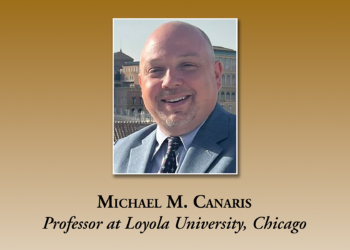
Originally from Collingswood, Michael M. Canaris, Ph.D., teaches at Loyola University, Chicago.



 at the bottom and then tap “Add to Home Screen”
