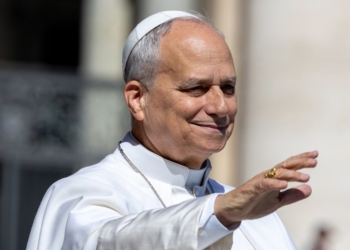





Pope Francis is laughing heartily, but it isn’t clear why. What has caused his spontaneous expression of joy? Not just what but who. The pope is facing a man holding his granddaughter, a little girl in a pink shirt.
The moment I am speaking of from 2017 was caught in a photo; it’s just after the pope gave the youngster a kiss, and the pint-sized blonde reached over and pulled the zucchetto off the papal head.
“When I was a child, I had those who taught me to smile, but now that I am old, children are often my mentors,” Pope Francis wrote in an essay headlined, “Pope Francis: There Is Faith in Humor,” for the New York Times last year.
The spontaneity of the children is a reminder, he explained, that adults can become so calloused to the world that they lose the ability to “to cry seriously or to laugh passionately.”
“We become anesthetized, and anesthetized adults do nothing good for themselves, nor for society, nor for the Church,” he wrote.
Pope Francis would have been delighted at Elton Trueblood’s experience with his young son. Trueblood, a Quaker who served as a presidential adviser and a chaplain at Harvard, was reading aloud from Saint Matthew’s Gospel and “feeling very serious” when his 4-year-old suddenly started laughing. The theologian explained, “He laughed because he saw how preposterous it would be for a man to be so deeply concerned about a speck in another person’s eye, that he was unconscious of the fact that his own eye had a beam in it.”
Aware that sometimes clergymen are perceived, in his words, as “more supercilious than joyful,” Pope Francis would have appreciated the exchange Groucho Marx once had with a priest.
“I want to thank you for all the joy you’ve put into this world,” Groucho recalled the cleric saying to him. He continued, “And I shook his hand, and I said, ‘And I want to thank you for all the joy you’ve taken out of this world.’”
But the pope consistently emphasized that good humor is compatible with the ordained life and with Christianity in general.
Last June, simply to give them his encouragement, Pope Francis invited more than 100 comedians from 15 countries to the Vatican. “In the midst of so much gloomy news, immersed as we are in many social and even personal emergencies,” he told them, “you have the power to spread peace and smiles.”
He shared with his audience Saint Thomas More’s Prayer for Good Humor that he has prayed daily for 40 years. It is a prayer not just for a sense of humor but for balance in one’s life, for freedom from self-importance and openness to joy.
“Continue to cheer people up,” the pope told the comics, “especially those who have the hardest time looking at life with hope.”
In the 2018 documentary “Pope Francis: A Man of His Word,” the pope said, if asked for an example of beauty – “simple everyday beauty with which we can help others feel better and be happier” – he would name two things: a smile and a sense of humor.
Sir Arthur Thomas Quiller-Couch once mused about what an average man of his age would answer if asked what helped him more, religion or a sense of humor, to bear life’s troubles. The Cambridge professor concluded an ordinary person, if he was being honest, would be hard-pressed to decide.
Pope Francis, who took the name of the saint who called himself the “Jongleur de Dieu” – the troubadour, or jester, of God – might have denied such a choice, or perhaps even such a distinction.
Pope Francis is not the only bishop of Rome known for his sense of humor. Stories about Saint John XXIII, in particular, abound. One concerns the boy who said he wanted to grow up to be either a policeman or a pope. Pope John encouraged him to set his goal on being a cop. “Anyone can become a pope,” he explained. “Look at me!”
Indeed, everyone – Catholics and non-Catholics alike – look at the pope. His example cannot be underestimated.
Pope Francis’ own laughter has fallen silent in this world, and commentators are speculating on who will be the next successor to Saint Peter, and what qualities he should possess. Holiness always tops the list, of course. Plus, he will need to possess wisdom, learning, vision … the list is long.
But ideally, the next Holy Father, like Pope Francis, will have a good sense of humor.
Carl Peters is former managing editor of the Catholic Star Herald.



 at the bottom and then tap “Add to Home Screen”
