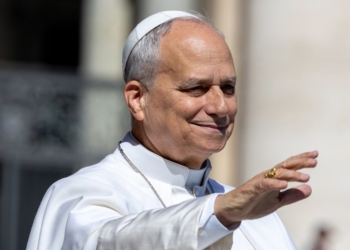




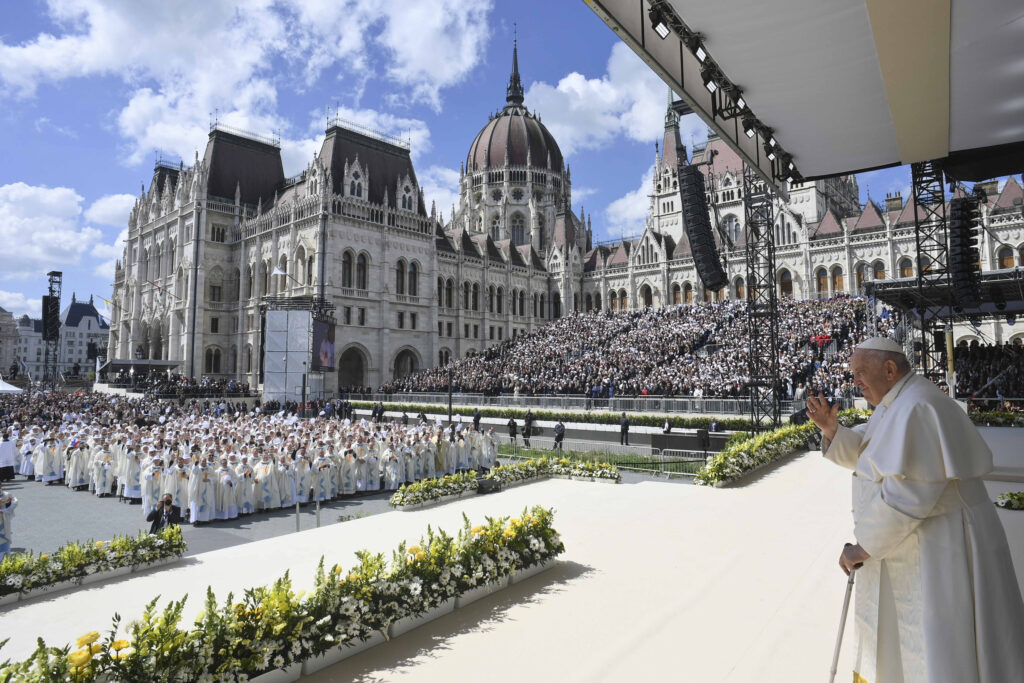
During Pope Francis’ recent apostolic journey to Hungary at the end of April, he tackled a number of important, yet vexing, issues.
First on his agenda was addressing the ongoing war in Ukraine. And let us not forget that Budapest is only a three-hour drive from Ukraine. His visit to Hungary brought to the forefront the similarities between the Holy See and the Hungarian government in advocating the need for peace talks and an immediate cease-fire. This approach differs from many of the other European countries, as well as the United States, which are providing weapons to the war and unhelpful rhetoric. Pope Francis spoke boldly and plainly that this terrible war must end, and he has offered his service as a mediator to reach a peaceful solution.
Pope Francis said during his first speech in Hungary, “I ask myself, thinking not least of war-torn Ukraine, where are creative efforts for peace?” And again, at the end of his three-day visit, he called upon Mary, the Theotokos, “In a special way, watch over the neighboring, beleaguered Ukrainian people and the Russian people.”
He also highlighted the need for European nations to be more welcoming of refugees and migrants in their countries. Hungary, under the leadership of Prime Minister Viktor Orbán, has been criticized over anti-immigration policies and other xenophobic tendencies. In his closing remarks during the visit, Pope Francis plainly said, “How sad and painful it is to see closed doors, the closed doors of our indifference towards the underprivileged and those who suffer; the doors we close towards those who are foreign or unlike us, towards migrants or the poor.”
He added, “Please, brothers and sisters, let us open those doors! Let us try to be – in our words, deeds and daily activities – like Jesus, an open door: a door that is never shut in anyone’s face, a door that enables everyone to enter and experience the beauty of the Lord’s love and forgiveness.”
“Be open and inclusive, then, and in this way, help Hungary to grow in fraternity, which is the path of peace,” he concluded.
While in Hungary, Pope Francis had an opportunity to meet privately with Metropolitan Hilarion of Budapest. This meeting was significant on several levels. Metropolitan Hilarion was the second in command in the Russian Orthodox Church in Moscow and served as head of External Church Relations for Patriarch Kirill, head of the Church. That is until last year, when he was suddenly removed from this post and moved – or some would say exiled – to Budapest, where there is a rather small community of Russian Orthodox believers. He was removed from his post by Patriarch Kirill because he publicly criticized the war in Ukraine.
Pope Francis did not share his conversation with Metropolitan Hilarion; the Vatican would only say that the pope met with the metropolitan at the papal nunciature in Budapest for approximately 20 minutes and that the conversation was cordial. While there is much speculation about what the two may have talked about, however, many speculate that it was certainly concerning the war. Perhaps sending a message to Vladimir Putin to pursue peace talks. Pope Francis said, “I believe that peace is always made by opening channels. Never can peace be made by closure.”
These ecumenical encounters are especially important during such papal visits. Speaking of the importance of ecumenical dialogue, Pope Francis said that ecumenism is all about maintaining relationships. He explained, “We have an outstretched hand with everyone, even receiving the hand of God.”
Pope Francis has only really spoken to the head of the Russian Orthodox Church, Patriarch Kirill, once in the past. Most of his correspondence with Patriarch Kirill is through third-party persons, such as an Italian bishop friend of the pope who knows his way around Russian diplomacy. Pope Francis said, “The relationship with the Russians is mainly with this ambassador of Russia to the Holy See. Everyone is interested in the road to peace; I am willing to do whatever needs to be done. Even now, there is a mission going on, but it is not public yet.”
Pope Francis praised the Hungarian people for their “generosity and enthusiasm” in their acceptance of refugees from neighboring Ukraine. Since the beginning of the war in 2022, Hungarians have taken into their homes some 35,000 Ukrainian refugees and have allowed another one million refugees to pass safely through their borders toward safe havens elsewhere. The pope also praised the efforts of the Hungarian government to foster Christian values and heritage and their aid toward persecuted Christian minorities in other countries.
Father Joseph D. Wallace is diocesan director of Ecumenical and Inter-religious Affairs and pastor of Christ the Redeemer Parish, Atco.




 at the bottom and then tap “Add to Home Screen”
