




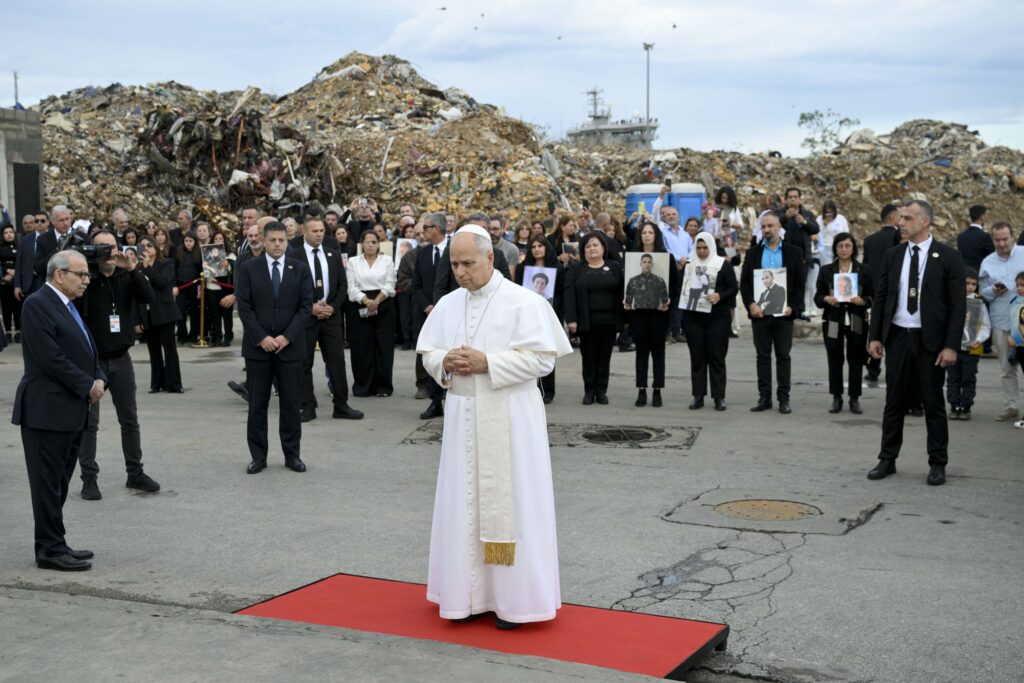
The first major trip of the current Leonine pontificate might have felt to some as a remote, or even exotic, trek into foreign cultural contexts with a primary focus on inter-religious dialogue given the current sociopolitical and religious composition of Türkiye and Lebanon. Even the newly adopted English spelling of the country, recently adopted by the United Nations and the U.S. Department of State, may feel unfamiliar. And yet for Christians, this wasn’t an excursion into an alien land, but rather a return to the very roots of the Christian faith itself.
First and foremost, the eastern shores of the Mediterranean were of course the setting for that most dramatic and axial of human affairs, the Incarnation. Scripture makes clear that one of the most important figures in the early Church, the apostle Paul, originally hailed from Tarsus in Cilicia, located in what is today the Mersin province of Türkiye. Lebanon’s Phoenician culture gave rise to the outpost of Carthage, which was home to early Christians like Tertullian, Cyprian, Perpetua and Felicity, Quodvultdeus and others. It is from these types of places – not England, France and Poland – that the faith first took hold of people’s hearts and imaginations.
Before the 7th century, much of what is today home to majority Muslim populations were great centers of Christian learning: Antioch (near the modern-day Syrian-Turkish border), Alexandria (Egypt), Carthage (Tunisia), Tangier (Morocco), and others, not to mention uniquely multicultural and multireligious sites like Byzantium/Constantinople/ Istanbul, Baghdad and Jerusalem. For people overly steeped in a focus on Western European-North American corridors of influence, this pervasive and indispensable complementary narrative may still feel unconnected to “our” Christian history. Yet we must remember that some traditions argue that the Church founded by the apostle Thomas in India predated even that of Peter and Paul in Rome. So, Pope Leo’s travels East are more a witness to our shared common heritage, as opposed to an expedition into unknown and potentially hostile lands.
Of course, the primary purpose and timing of the trip, in which he was fulfilling commitments made by Pope Francis before his death, was to mark the 1700th anniversary of the Council of Nicaea, which took place in what was then called Asia Minor in A.D. 325. Convoked by the Emperor Constantine, notably not by an ecclesial figure, the gathering sought to wrestle with the Arian controversy, and thus the divinity and salvific mission of Jesus Christ. Its chief product – with subsequent modifications made at another council and the important exception of a clause that Roman Catholics came to profess centuries later (the Filioque) – still represents the beating heart of the faith, which believers give voice to in what we now usually call the Nicene-Constantinopolitan Creed.
As with all developments of doctrine, the cultural milieux, historical circumstances, theological debates and pastoral needs of the moment impacted the articulations that were formed in such defining stages of our community. Thus, what happened in Türkiye 17 centuries ago continues to have significance for us today, as does what is unfolding there (and everywhere else) in the contemporary world in these times in which we try to live out the Gospel meaningfully on a shrinking planet with more people in closer proximity than ever before.
It is for this reason that so many representatives from non-Latin rite and other Christian families joined him, including Maronite, Armenian, Syriac, Melkite, Chaldean and Coptic Catholics, along with Armenian, Oriental and Greek Orthodox leaders. Notably absent, however, were Russian and Coptic Orthodox figures.
In addition to the inter-religious and ecumenical, cross-Christian elements of the trip, Pope Leo urged a consistent message to all peoples that he has since he walked out on the loggia upon his election: actively cultivating peace. In these places, particularly Lebanon, this plea is an urgent, concrete one, not something ethereal or philosophical. In these regions where the Christian message was first preached and heard, let us hope these pleadings do not now fall on willfully deaf ears.
An alumnus of Camden Catholic High School, Cherry Hill, Michael M. Canaris, Ph.D., teaches at Loyola University, Chicago.



 at the bottom and then tap “Add to Home Screen”
