




Next week from June 22-29 the world will commemorate Religious Freedom Week. The U.S. Conference of Catholic Bishops (USCCB) is encouraging Catholics “to pray, reflect and act to promote religious freedom.” The theme for the week is, “Solidarity in Freedom.”
The bishops have emphasized that “solidarity means more than engaging in sporadic acts of generosity. It means thinking and acting in terms of community.” Pope Francis further clarified what this means in his encyclical “Fratelli Tutti,” when he said, “Religious freedom allows the church, and all religious communities, to live out their faith in public and to serve the good of all.”
The bishops have laid out different religious liberty topics for each day of the Religious Freedom Week. The USCCB issued resources to be used, titled, “Pray — Reflect — Act.” The themes for the week are as follows:
June 22 — Adoption and foster care, “Pray that children waiting to be placed in a loving home and the caregivers who serve those children will find strength and support from the Church.”
June 23 — Catholic social services during the pandemic, “Pray that God would continue to grant Catholic institutions the wisdom and courage to serve a world suffering the effects of the COVID pandemic.”
June 24 – The Equality Act, “Pray that the dignity of all people will be respected in country.”
June 25 — Church Vandalism, “Pray that Christian witness in the face of attacks on our Churches will convert hearts to faith in Jesus Christ.”
June 26 — Catholics in Nicaragua, “Pray for our Catholic sisters and brothers who are suffering in Nicaragua.”
June 27 — Conscience rights for medical professionals, “Pray that governments would respect the consciences of all people who care for the sick and vulnerable.”
June 28 — Pope Francis’s solidarity with beleaguered Christians in Iraq, “Pray for Christians in Iraq and that people of all faiths in the land of Abraham may live in peace.”
June 29 — Free speech, “Pray that Christians will have the courage to speak the truth with kindness and clarity, even in the face of adversity.”
In a recent survey conducted by the Becket Fund for Religious Liberty found that most Americans believe that the law should offer broad protections to churches, religious organizations and all people of faith. The survey reported, “We saw public support well above 70% on many issues, indicating that the concept of religious freedom maintains its place as a core American cultural value.”
Results are based on responses from a nationally representative sample of 1,000 U.S. adults. On the 16 survey questions conducted online this past October, asking what religious freedom laws should be guaranteed, results only dropped below 70% agreement three times, concerning religious communities’ involvement in political elections. They concluded that Americans support in high levels religious freedoms even in the midst of the cultural wars involving battles over birth control, abortion and LGBTQ rights.
Last month, Secretary of State Anthony Blinken released the U.S. State Department’s 2020 Annual Report on International Religious Freedom. This report provides a snapshot of the religious freedom situation in nearly 200 countries around the world, as well as U.S. government responses to these concerns over the past year. The report found that: “Repressive government restrictions include criminalizing religious exercise or expression through blasphemy laws, such as Pakistan and Egypt, or regulations on religious attire or other forms of religious practice. Discriminatory regulation of religious life, such as registration laws, can be weaponized, such as Christians and other minorities in Algeria from legally forming religious institutions of houses of worship. Escalating religious discrimination that takes the form of hate crimes or incendiary rhetoric that often promotes exclusivist nationalist themes that fuel violence against certain communities, such as anti-Semitism, anti-Muslim, or anti-Christian rhetoric. Religious freedom violations as an early warning indicator of mass atrocities, as seen in recent years with the genocide committed against Yazidis, Christians and other minorities in the Middle East, Burma, China, Ethiopia and Nigeria.”
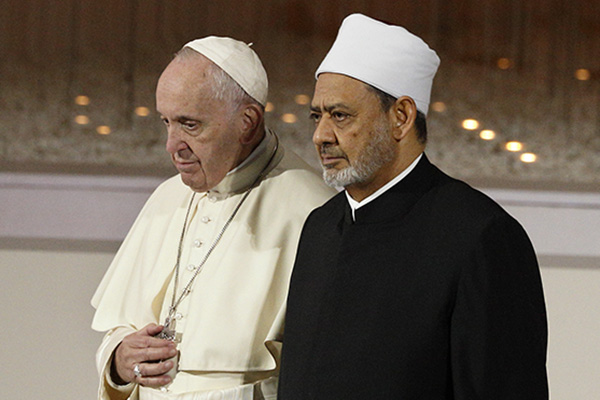
Two years ago when Pope Francis visited the United Arab Emirates, he made a statement that captures the need for religious freedom, when he said, “No violence can be justified in the name of religion. We need to be vigilant lest religion be instrumentalized and deny itself by allowing violence and terrorism. I would like to emphasize religious freedom. Without freedom, we are no longer children of God but slaves. One cannot proclaim fraternity and then act in the opposite way.”



 at the bottom and then tap “Add to Home Screen”
