




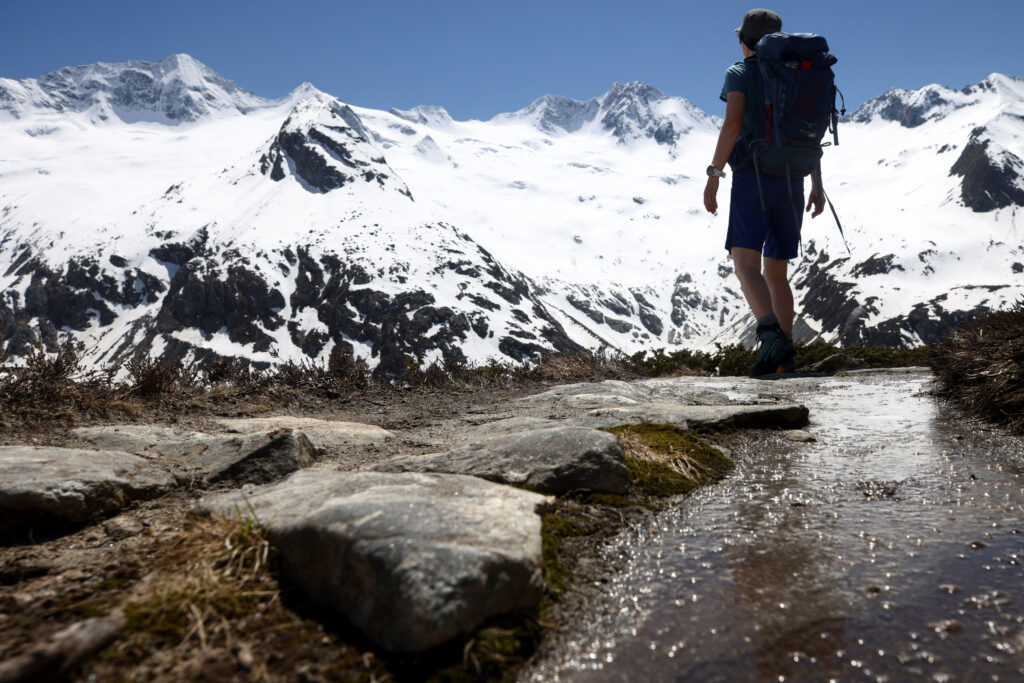
In an era when action movies and true life documentaries dominate our streaming services, the adventures of Sir Ernest Shackleton remain an underappreciated tale of staggering tenacity and rousing exhilaration to most contemporary Americans.
I’ve read a number of books on Shackleton’s quest to save his men from certain death when the 28 crewmembers of his ship, the Endurance, were stranded in unbearable conditions in Antarctica in 1915. He powerfully stated to his closest confidant, Frank Worsley, that he felt a mysterious fourth person was accompanying the three-man team as they eventually made their way back to civilization to save the others.
The other two confessed that they felt the same strange sensation and that providence had guided them on their almost unfathomable tale of survival, where they sailed 800 miles in a makeshift raft over stormy seas and then hiked 36 hours without sleep over the treacherous mountains of South Georgia island to a sparsely populated whaling station.
The riveting autobiographies of these men led me to ask whether and how Christ’s “Great Commission” to proclaim the Gospel to all the world had reached these frigid regions that truly represent the ends of the earth. Out of sheer curiosity, I did a little research to see what, if any, missions existed on that still-mystifying continent, which contains 90% of the world’s ice, though trillions of tons have melted over the last quarter-century due to manmade climate change (the gendered language there is intentional).
It turns out that one of Shackleton’s crew on the Imperial Trans-Antarctic Expedition, the Anglican priest Arnold Spencer-Smith, is widely believed to be the first clergyman of any denomination to set foot on Antarctica. A number of permanent settlements – mostly for military and research facilities –have been staffed by rotations of chaplains in the century since.
The beautiful Holy Trinity Church, a Russian Orthodox chapel with miniature onion domes distinctive to the architecture of the East, was constructed in Siberia and then shipped and re-assembled near the Bellingshausen Station. The Chapel of the Snows is a non-denominational chapel on the campus of the United States’ McMurdo Station on Ross Island. A few Catholic churches, mostly staffed by Chilean or Argentinian priests, exist: San Francisco de Asis, Santa Maria Reina de la Paz and Santisima Virgen de Lujan. Most striking to me were the images of the Capilla de Nuestra Señora de las Nieves, or the Chapel of Our Lady of the Snows. This permanent excavated ice cavern is the southernmost place of worship of any religion in the world.
When the prophet Daniel describes his vision of the heavenly court, he refers to the “Ancient of Days” as sitting on a throne ablaze with fire, dressed in garments white as snow (7:9). Similar language is used in the Gospel of Matthew to describe the Angel reposing on the stone in front of the empty tomb: “whose countenance was like lightning and his raiment white as snow” (28:3). When God explodes out of the whirlwind to interrogate the presumptuous Job, he asks him if he has ever “entered the storehouses of snow or observed the treasury of hail,” or if he knows “from whose womb does the ice emerge? Who gives birth to the frost from heaven, when the waters become hard as stone and the surface of the deep is frozen?” (38:22, 29-30).
Every Lent, we, too, pray that we may be cleansed with hyssop, washed and made whiter than snow (Ps 51:7). All of these statements make clear the purchase on the imagination that snow and ice held for the ancient Mediterranean writers of the Scriptures. But even they could likely never have imagined the variety of places where humanity has created refuges of prayer amidst the seemingly inhospitable landscapes that today house sites of worship to God in the most extreme conditions on this intimate planet that we all share.
There is a reason that Shackleton was knighted but not canonized, for he was no saint. Even those closest to and most in awe of him recognized his many flaws. But his adventures opened the door to the capacity for humanity to cross new frontiers, as is the case with the abysses of the depths of the sea and the stony surface of the moon and everything in-between. Whatever explorations humanity undertakes, they carry with them the fascination of the Transcendent – whose presence has somehow always already preceded them there and sanctified the holy ground, oceans or ice on which they find themselves.
Originally from Collingswood, Michael M. Canaris, Ph.D., teaches at Loyola University, Chicago. He was recently featured on the Diocese’s “Talking Catholic” show. Check out the episode by visiting https://talking.catholicstarherald.org/show/talking-catholic



 at the bottom and then tap “Add to Home Screen”
