



Since Jesus didn’t leave any autobiographical writings or serve as a wealthy patron of the arts to capture his countenance in marble or mosaic, every generation of Christians after the apostles has used imagination to fill in the gaps of his life, ministry and Passion to depict scenes and stories from the Gospels artistically.
But his followers and family members did witness his public life and execution. And so the Church finds itself on relatively firm footing in re-presenting those elements of his life, albeit in infinite variety.
Think, for example, of every crucifix you’ve ever encountered. There are endless variations of the suffering Christ: in priestly robes or tattered loincloths, with feet overlaid pierced by a single nail or separated with two, displaying regal authority or utterly battered and broken. But we have some general sense of what might have happened on Golgotha, and what theological perspectives are being presented by each artist revisiting the scene for millennia.
This is altogether different from the Resurrection, which not even those closest to Christ witnessed. What precisely happened in that sealed tomb remains a mystery to the human race, and the Church prostrates itself in somewhat apophatic silence before it. Most artistic images of Easter are really in fact post-Resurrection scenes, which is perhaps one reason for the longstanding fascination with the Shroud of Turin; whether or not it is historically verifiable by science, its claim to be a visual cue from inside the tomb makes it relatively unique (comparable perhaps only to various claimants to the sudario, or head-cloth, like that in Oviedo, Spain).
But faithful believers have long been fascinated with the moment of Christ’s victory over the grave, dating back to the early pilgrim etchings and graffiti in the catacombs, which often depict the scene through Jonah imagery, referencing Jesus’ own allusion to the prophet in Matthew 12 and Luke 11, and his time in the “belly of the earth.”
Two, among countless of these mystifying Easter scenes, in particular spoke to me over this Holiest of Weeks.
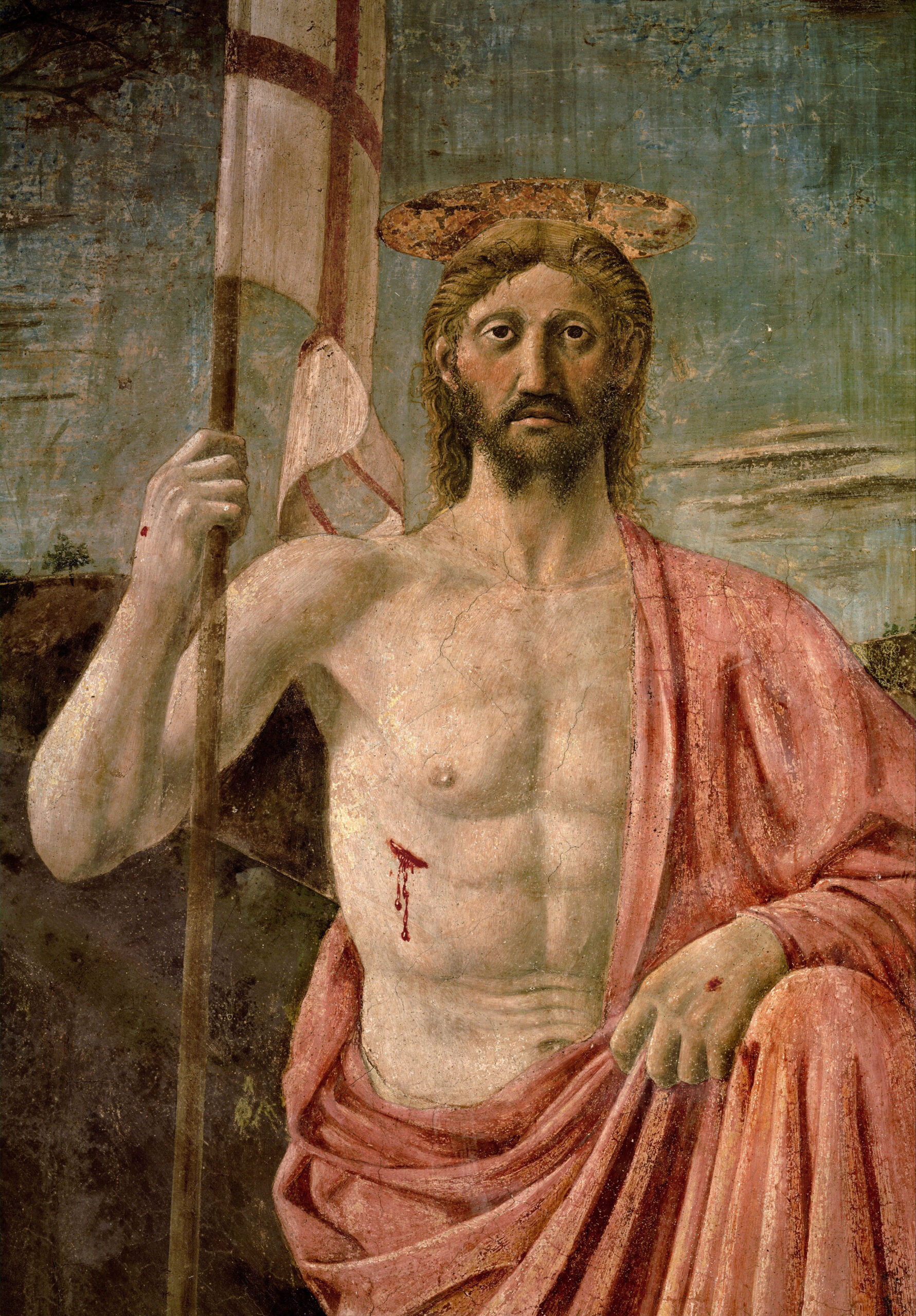
The first, Piero della Francesca’s fresco of the scene, is still in the artist’s native Borgo Santo Sepolcro in eastern Tuscany. He created this stunning masterpiece in 1465 for the town’s city hall, which is today the Museo Civico. Christ climbs out of the grave, staring straight ahead into the future with one leg raised on the ledge between life and death. He arises not out of a rock-hewn cave, but rather from a neoclassical sarcophagus amidst sleeping sentinels. We see a testament to their Roman heritage on one’s shield, with the first letters peeking through of the famous S.P.Q.R. (Senatus Populusque Romanus; the Senate and People of Rome). Christ’s face, an early example of Renaissance realism and perspective, stares intently at the viewer, bringing to mind countless royal pantocrator images but with an interpersonal intensity impossible to achieve on a vaulted mosaic ceiling somewhere.
I recently read an account of a British troop commander, Tony Clarke, who refused to shell San Sepolcro during the Second World War in the Allies’ liberation efforts because he happened to remember that Aldous Huxley had once referred to Piero’s painting as the “greatest picture in the world.” Clarke’s principled unwillingness to follow military orders and thus be responsible for the destruction of one of Christianity’s great treasures was rewarded, as his regiment learned the next day that the Nazis had already fled, making the bombardment gratuitous. Humanity remains in his debt.
The second work is a recognizable one for anyone who has watched a papal event from the Paul VI Aula, where the pope often holds his Wednesday general audiences. The 6,300 seat audience hall is dominated by an 80-ton, 66-foot tall bronze/copper sculpture, “La Resurrezione,” by Italian artist Pericle Fazzini. The somewhat controversial piece commissioned by the hall’s namesake attempts to highlight the atrocities of war, with Jesus rising from a nuclear wasteland, amidst knotty and tangled images as Gethsemane explodes in a fiery hellscape, though Christ rises above (or out of) the tumult. The artist actually suffered blood clots in his lungs from inhaling fumes during its production. The sculpture’s commentary on the Resurrection in an age when humanity has the capacity to destroy itself remains relevant in our day, as does the constant reframing of the story attuned to ever-changing historical contexts. Piero’s – or Michelangelo’s or Caravaggio’s or Leonardo’s – more “familiar” pieces are no less adapted to their own day’s styles, issues and creative retellings, and were controversial in the novelty of their approach almost without exception. (They didn’t all sit on one side of the Last Supper table, or even on chairs, as a silly and obvious example.)
As we mark Christ’s subjugation of evil and darkness, and confess his role as the “firstborn from the dead,” once more in this Easter season, let us ponder such a conquest anew in images both ancient and contemporary, and in our vocation to reimagine unceasingly our lives as informed always by that night “when Christ broke the prison-bars of death and rose victorious from the underworld … when things of heaven are wed to those of earth, and divine to the human … the night that dispels wickedness, washes faults away, restores innocence to the fallen, and joy to mourners, drives out hatred, fosters concord and brings down the mighty.”
Originally from Collingswood, Michael M. Canaris, Ph.D., teaches at Loyola University, Chicago.



 at the bottom and then tap “Add to Home Screen”
