




In his announcement that Sept. 29, 2024, would mark the annual World Day of Migrants and Refugees, the pope chose as a theme “God walks with his people.” Part of this choice can be understood to reflect a widening of the lens of people on the move to include internally displaced persons.
As most people are aware, there are technical distinctions beyond the legal/undocumented binary that dominates much of our national political discourse. Asylum-seekers, refugees, economic migrants, stateless individuals and cyclical agricultural workers (or seasonal migrant farmworkers) all have specific qualifying factors that distinguish one from the other; they are not interchangeable categories of people. An internally displaced person, for example, is one of the more than 50 million people on the planet who have been forced to flee their home because of legitimate fear for their lives, but have not crossed formal national boundaries. This category is a descriptive rather than an international legal category, therefore, they often have different or less rights than some of the other categories.
In the Gospel of Matthew, we read that Mary and Joseph followed the counsel that the family patriarch received in a dream, and took the young family to Egypt. Given the physical proximity to Palestine, many figures of the Hebrew Scriptures fled to the region during difficult moments. The Hebrews themselves were in bondage there before their liberation in the Exodus experience. And in the relatively early post-Resurrection community, the great city of Alexandria became one of the most preeminent magnets for those preaching the faith and sites of Christian thinking. Thus, God has “traveled” along with his people who are forced to live in places that are not their native lands, chief among them His son’s own exile experience.
Like virtually all migrant mothers, Mary likely did not want to uproot her family, leave her support networks and travel to an unknown new land. This is the reason that the flight to Egypt is listed on “equal footing” with the Crucifixion and burial of Jesus as one of the seven swords that pierced her heart as Our Lady of Sorrows. But as Catholic social teaching and numerous writings of popes for hundreds of years have made clear, human beings have both a right to migrate and a right to not to have to migrate – that is to say, to live in a just word where violence, poverty and oppression are not threats to their families, their dignity or their full human flourishing.
It is clear that along with his commitment to synodality, popular piety and inter-religious dialogue, migration has been one of the cornerstone elements of the Francis pontificate and ecclesial agenda. We know well that this issue and this “world day” is of particular concern to the individual man who holds the Petrine Office.
Our era, which many experts refer to as the Age of Migration, will be remembered by historians as one of the most important inflection points of human history, as more people change physical locales than in any previous point in the long, complicated annals of our species. This will only become exacerbated in future decades as environmental degradation makes various places on the planet uninhabitable. Caring about this theme, or more precisely about our brothers and sisters experiencing this reality, will no longer be a niche specialization for certain ministries or demographic populations. Rather, it will become part and parcel of what it means to be an active, believing person in a shrinking world. To play with a familiar axiom, “The Christian of the future will be part of a migrant church, or nothing at all.”
As we turn our attention to those in via, we are in a sense returning to ponder our own “passing through” this life. What the pope says about migrants in this year’s message can be applied to all of us banished children in exile, mourning and weeping in this valley of tears: “[They/we] experience God as their traveling companion, guide and anchor of salvation. They entrust themselves to him before setting out and seek him in times of need. In him, they find consolation in moments of discouragement. Thanks to him, there are good Samaritans along the way. In prayer, they confide their hopes to him. How many Bibles, copies of the Gospels, prayer books and rosaries accompany migrants on their journeys across deserts, rivers, seas and the borders of every continent!
“God not only walks with his people, but also within them, in the sense that he identifies himself with men and women on their journey through history, particularly with the least, the poor and the marginalized. In this, we see an extension of the mystery of the Incarnation.”
In this light, migrants are not “those” other people, they are us and we are them.
This year, the World Day of Migrants and Refugees coincides with the feast of Saint Michael, whom many Catholics like to venerate after Masses. Hopefully, Pope Francis’ prayer will trip off our tongues just as easily:
God, Almighty Father,
we are your pilgrim Church journeying towards the Kingdom of heaven.
We live in our homeland,
but as if we were foreigners.
Every foreign place is our home,
yet every native land is foreign to us.
Though we live on earth,
our true citizenship is in heaven.
Do not let us become possessive of
the portion of the world you have given us as a temporary home.
Help us to keep walking, together
with our migrant brothers and sisters,
toward the eternal dwelling
you have prepared for us.
Open our eyes and our hearts so that every encounter with those in need
becomes an encounter with Jesus,
your Son and our Lord.
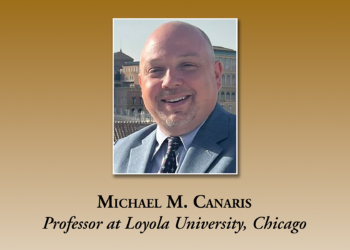
An alumnus of Camden Catholic High School, Cherry Hill, Michael M. Canaris, Ph.D., teaches at Loyola University, Chicago.



 at the bottom and then tap “Add to Home Screen”
