




By Ines San Martin, Paulina Guzik, OSV News
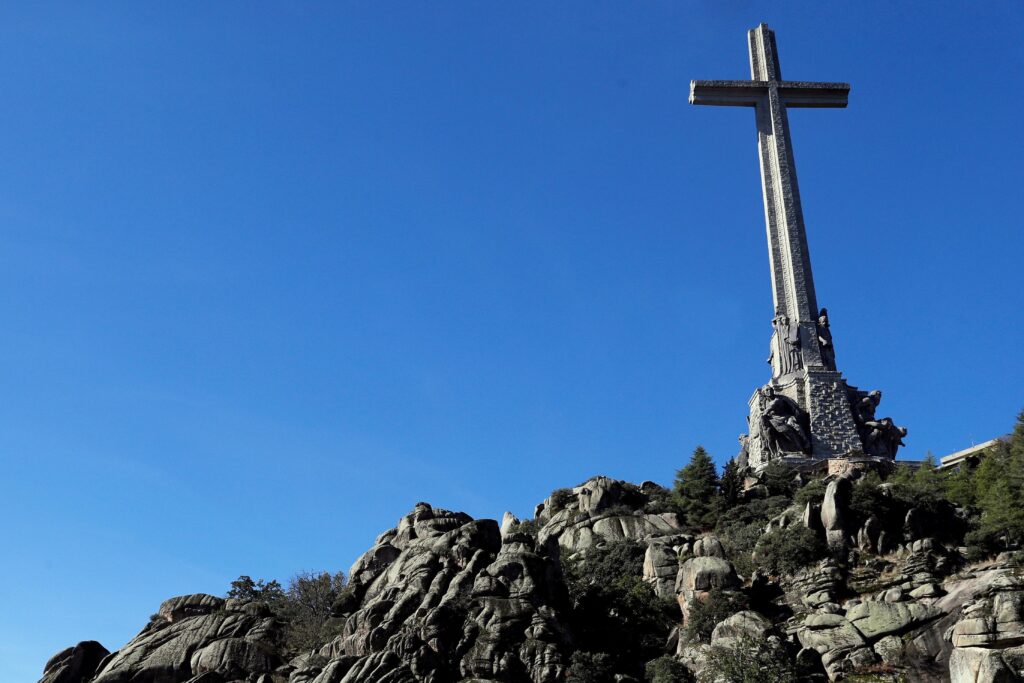
MADRID (OSV News) — As Pope Leo XIV descends toward Madrid June 6, one landmark likely to catch his eye is a towering cross rising above the cemetery at Paracuellos del Jarama, on the outskirts of the Spanish capital.
Visible from the air, the monument marks one of Spain’s best-known burial grounds for victims of the violence that scarred the nation in the 1930s. Yet for Spaniards, the cemetery is much more than a historic and symbolic place. Despite the decades that have passed since its end, the Spanish Civil War is a wound that continues to bleed within the society, fueling polarization.
Nightmares of the Spanish Civil War
The Spanish Civil War (1936–1939) grew out of deep political and social divisions, as a left-wing Republican government faced a military uprising led by General Francisco Franco.
The conflict quickly took on international significance, with the Soviet Union backing the Republicans, and Nazi Germany and Fascist Italy supporting the Nationalists. In many ways, Spain became a preview of the ideological battles that would soon erupt in World War II.
During the war, the Catholic Church endured severe and systematic persecution from the hands of Republican forces dubbed one of the most violent since the Roman empire.
Fueled by anti-clericalism and revolutionary ideology, the “Red Terror” targeted bishops, priests, religious and lay Catholics. Supported in part by Soviet influence and communist factions, this violence led to the death of almost 7,000 priests and religious, thousands of lay people, and the destruction of thousands of churches, with entire dioceses nearly wiped out.
Franco’s victory in 1939 brought decades of dictatorship, shaping Spain’s political and religious life until 1975 and leaving a lasting, complex legacy for the Church.
It also left the country traumatized, with the veil of silence put on the topic for decades.
Tragedy in every single family
Alberto Ruiz-Gallardón, a lawyer and former mayor of Madrid, lost his uncle — his father’s brother — to the Red Terror. But his uncle’s fate was a well kept secret of the elders in the family for decades. This uncle was even Ruiz-Gallardón’s namesake, a fact the lawyer did not know until he was a young adult.
“I believe that a civil war, which is the greatest tragedy that can befall a country, is never overcome by the victory of one side over the other. In a civil war, everyone loses,” Ruiz-Gallardón told OSV News.
Yago de la Cierva, the layman coordinating Pope Leo’s trip to Spain, has his own grandfather buried at Paracuellos cemetery. A lawyer and politician of the political right, Ricardo de la Cierva was arrested after an informer in his law firm revealed his whereabouts to authorities.
Ricardo had the chance to escape from prison, his grandson said, but refused — because he was the only link between prisoners and the outside world, and he would not abandon those who depended on him for medicines and basic supplies. He was executed, and is in a group of 44 martyrs from the Diocese of Alcalá de Henares whose sainthood cause was opened a decade ago.
“There were dead people in every single family,” de la Cierva said of the tragedy of the Spanish Civil War. “Many families tried to hide this because it would be very divisive.”
His family story is far from unique, de la Cierva pointed out. “There was a big effort in Spanish society to forgive and to forget — to put society together, not looking back but looking forward, not opening the very deep wounds that every family had,” he told OSV News in Madrid.
Wounds reopened
But in the early 2000s, Prime Minister José Luis Rodríguez Zapatero — a socialist who served as prime minister from 2004 to 2011 and is now being investigated in a massive corruption case — reopened old wounds, thinking it would benefit his electoral campaign.
“It was a complete disaster,” de la Cierva pointed out. “We are suffering the consequences of this move to this day. I can say this is the origin of the present polarization in Spanish society.”
Ruiz-Gallardón agrees: “Bringing the 20th-century Civil War into the 21st century,” he said, was “the biggest historical mistake regarding coexistence that we Spaniards have made lately.”
The solution, he said, “isn’t for one person to impose their discourse on others. The solution isn’t arguing about whether reason favors some systems more than others. The solution is reconciliation, and more reconciliation.”
And this is the place where many hope Pope Leo can help, and where the recent recognition of martyrs of the Red Terror persecution could be read as a milestone prior to the apostolic trip.
For Spain, “Peace is the essential axis of Pope Leo’s discourse,” Ruiz-Gallardón told OSV News.
“Therefore, I’m sure his visit will contribute to us finally achieving that reconciliation.”
Martyrs of violent Catholic persecution
For Lourdes Grosso García, director of the Office for the Causes of Saints of the Spanish bishops’ conference, the significance of Paracuellos extends beyond a single cemetery — and beyond the Spanish Civil War itself.
“We are working very hard so that people do not speak about the ‘martyrs of the Spanish Civil War,'” Grosso told OSV News. “Wars do not have martyrs; they have victims.”
Instead, Grosso said, the men and women recognized by the Catholic Church as martyrs belong to what she calls “the religious persecution of the 20th century in Spain,” a persecution that unfolded between 1931 and 1939 and claimed the lives of thousands of Catholics.
For the Church, martyrdom requires more than a violent death. It must be demonstrated that a person was killed out of hatred for the faith — “in odium fidei” in Latin — and that the victim accepted death rather than renounce Christ.
“It has to be proven that these people were murdered because of hatred for the faith and that they gave their lives for defending their faith in Christ,” Grosso said.
The Church’s recognition of Spain’s martyrs has accelerated over the past several decades.
According to Grosso, by the end of 2026, a total of 2,395 martyrs from the religious persecution in Spain will have been beatified, including a group of 80 killed in the Diocese of Santander whose martyrdom was recently recognized by Pope Leo XIV.
The number represents only a fraction of those whose stories have been documented. When the Spanish bishops established the Office for the Causes of Saints 25 years ago, one of its primary purposes was to coordinate the growing number of martyrdom causes emerging from dioceses and religious orders throughout the country.
Grosso said that nearly 8,000 names were submitted by Spanish dioceses when St. John Paul II requested information on witnesses to the faith around the world ahead of the Great Jubilee of 2000. Subsequent historical investigations expanded that number to more than 10,000 documented cases, though not all of these cases advanced.
Many of those who have been recognized as martyrs were priests, religious sisters, seminarians and lay faithful. Others were young people, elderly Catholics and ordinary believers with no involvement in politics.
“There were people of all ages — young people, children, women, the elderly,” Grosso said. “Many had nothing to do with politics.”
Some of their remains were buried in cemeteries such as Paracuellos. Others were laid to rest elsewhere, also in Valle de los Caídos, or Valley of the Fallen, in Spain’s central Sierra de Guadarrama. In many cases, however, their bodies were never recovered.
Augustinians among Red Terror martyrs
Among those who suffered during that period were members of the Augustinian family, the religious order to which Pope Leo belongs. In October 2007, Benedict XVI beatified 498 martyrs of the religious persecution in Spain, including Blessed Avelino Rodríguez and 97 fellow Augustinians. Speaking after the ceremony, Pope Benedict stressed that the newly beatified were not partisans in a political struggle, but Christians who remained faithful to Christ in the face of persecution.
“They did not involve themselves in political or ideological struggles or seek to enter into them,” Pope Benedict said.
The Augustinians were among the hardest-hit religious families during the persecution. More than 200 members of the order perished, including some 70 buried at Paracuellos — among them 17 underage seminarians who, according to Father Miguel Ángel Orcasitas, an Augustinian historian, “had no contact with the outside world and were completely removed from any political involvement, but were killed simply for being religious.”
“These religious left behind a testimony of strength, reconciliation and forgiveness that is precisely what was highlighted with their beatification,” Father Orcasitas said. “Martyrs are above the political circumstances that led to their deaths. They followed Christ, and gave witness with their own blood.”
The witness of the Augustinian martyrs forms part of the spiritual heritage of Pope Leo, who spent more than a decade as prior general of the Order of St. Augustine before becoming bishop of Rome, and who visited Spain more than 50 times throughout his life.
For Grosso, the martyrs’ enduring importance lies not in their deaths but in the example they offer to a society still wrestling with division and polarization. Many of the testimonies gathered during beatification investigations describe martyrs forgiving their persecutors before they were killed.
“They died forgiving those who were killing them,” she said.
Silent heroes of reconciliation
That spirit of forgiveness, for some families, came at great personal cost.
After being widowed, the papal trip organizer’s grandmother eventually learned the identity of the man who had betrayed her husband to his death. When her sons — including de la Cierva’s father — found out she knew, told her plainly they wanted the name so they could kill him. She refused, and took the secret to her grave.
“The one who is going to be beatified is my grandfather,” de la Cierva told OSV News, “but the one who truly deserves it, because of this effort in reconciliation, is my grandmother,” whose name was Pilar de Hoces. He said he hopes his grandfather’s cause will be finalized in Rome this year.
The Church’s remembrance of the martyrs, Grosso said, is not intended to revive old hostilities or deepen historical wounds. Rather, it offers an example of reconciliation rooted in truth.
“The martyrs cannot be witnesses to evil,” Grosso said. “They are witnesses to the love of God.”
“Today, when people speak about persecution, many continue speaking about confrontation and hatred,” she said. “We must turn that around. We must speak about forgiveness and reconciliation.”
Hope that pope’s visit a healing balm
Many hope Pope Leo’s June 6-12 visit to Spain will act as a healing balm for a wounded nation.
“What we need from the pope is to say, ‘Hey, again, move forward.’ What is in the past is in the past. Look for ways to try to create this environment in which everybody can contribute to the common good.”
“The only way to overcome a civil war is through reconciliation,” Ruiz-Gallardón said.
“I believe that the convergence of will that has emerged in Spain regarding the pope’s reception, both from the left-wing government and the center-right opposition, is one of the few points of convergence we have had in politics in recent years in our country,” he continued. “And we must certainly take advantage of it.”
He added: “If anyone at this time can, with spiritual and moral authority, ask for and demand the reconciliation of all Spaniards, it is precisely the head of the Catholic Church.”
Ines San Martin writes for OSV News from Madrid. She is the editor of Mission Magazine, a publication of the Pontifical Mission Societies USA. Paulina Guzik is international editor for OSV News. Follow her on X @Guzik_Paulina



 at the bottom and then tap “Add to Home Screen”
