


Hope is a fragile thing.
Sometimes we get so caught up in our own minds and emotions, we forget people around us are going through the same things, or worse. Anxiety, depression, illness, loss, insecurity, pressure, responsibilities, a new stage in life – any of which could lead to feeling an absence of God in our life – a dark night of the soul.
This past year was the Jubilee Year of Hope in the Catholic Church. Some people didn’t even know we were in a Jubilee Year of Hope 2025. Others fought to hold onto hope, even with the word front and center for an entire year.
Why? Why is it so hard to have – or hold on to – hope?
I can’t answer that, because unlike the other columnists on these pages, I’m not a theologian. However, over the past month (fittingly during Advent and Christmas), I heard some messages, some repeated themes on hope that spoke to my heart. One specifically was about the recent conclave that opened the doors for Robert Francis Prevost to become Pope Leo XIV.
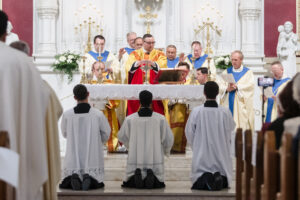
During December homilies, Bishop Joseph Williams related that he had two conversations with cardinals who were at the conclave, one of whom was Cardinal Christophe Pierre, apostolic nuncio to the United States. Both briefly shared how “something happened” between the third and fourth ballot that could be felt by all of the cardinals gathered in the Sistine Chapel.
Bishop Williams explained how Charles Péguy, a French poet, wrote a poem on the “Little Sister of Hope.” “The bigger sisters, the older sisters, are Faith and Love,” Bishop explained. “Hope is this little sister. That’s how fragile she is, and we have to take great care of her because without her, Faith and Charity can’t become strong.”
Building upon that theme, he explained how Cardinal Pierre quoted Péguy to describe what happened at the conclave – specifically, this quote: “In the world, things normally proceed from mystic to politick.”
“Cardinal Pierre said the conclave moved from politick to mystic. The cardinals came in with their ideas, with their candidate, with their groups, their politics, their battles. He said, ‘Only when we laid down our arms, surrendered our control, could the Holy Spirit come in and give us Robert Prevost.’
“And then it went like that,” Bishop Williams said, snapping his fingers. “Everyone saw. Everyone knew that was God’s choice.”
“Isn’t that hopeful?” the Bishop asked. “That in a polarized, violent, disagreeable world, there is a place where leaders of high importance can surrender control and let the Holy Spirit do something marvelous. That’s hopeful, that’s the Jubilee of Hope.”
This brief story resonates with me for two reasons: First, it’s relieving to know I’m not the only one who thinks hope is fragile. For hundreds of years, others have thought the same. (That really takes some of the self-imposed pressure off!) Second, it’s not unusual – or difficult, even – to let our spirituality become overshadowed by politics. Politics, by the way, can take a variety of forms, even, as Bishop Williams explained, “when the lack of resources becomes a fight for those resources.”
I’m not alone! We’re not alone! We are all feeling the weight of the world in our own ways – including our clergy, our cardinals, our women and men religious.
In this new year, I want to move away from mystic to politick and toward politick to mystic, away from control over my own life and toward surrender and God’s will, tending to hope like a little sister, so that my charity and faith – and for those going through anxiety, depression, illness, loss, insecurity, pressure, responsibilities, a new stage in life or a dark night of the soul – may be strengthened.
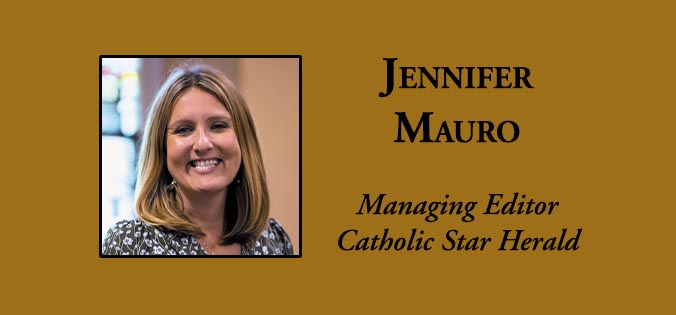
Jennifer Mauro is managing editor of the Catholic Star Herald.



 at the bottom and then tap “Add to Home Screen”
