




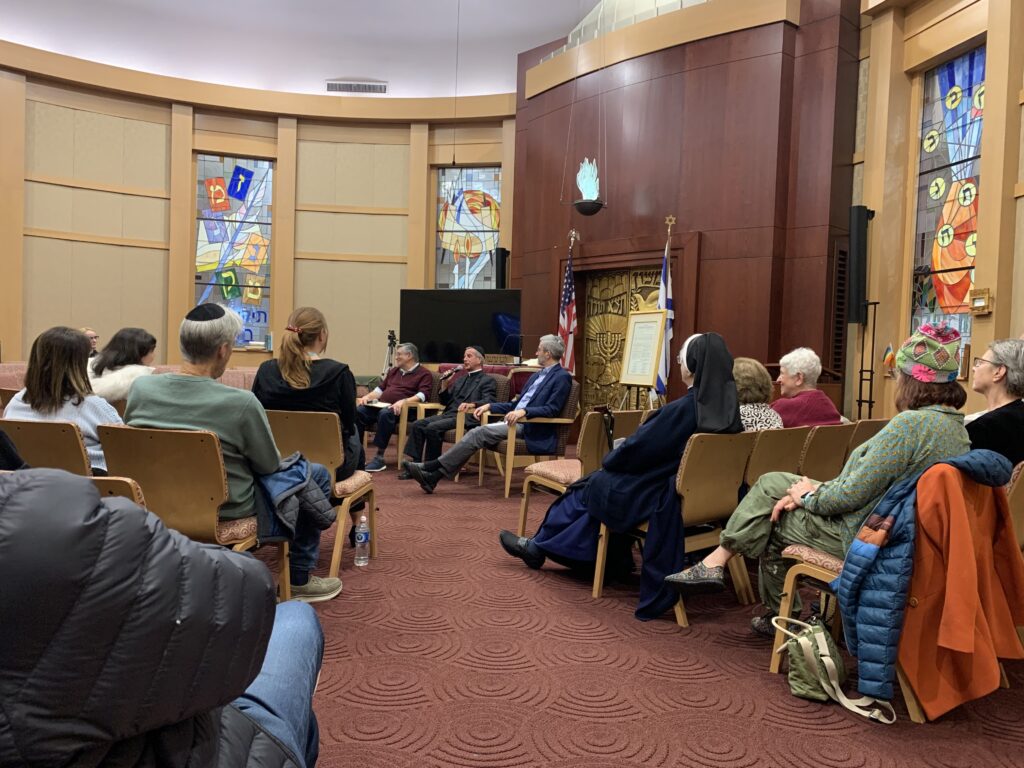
VOORHEES – The Catholic and Jewish communities of South Jersey gathered Oct. 28, which was 60 years to the day of the release of “Nostra Aetate” (In Our Time), to celebrate the groundbreaking Church document that revolutionized Catholic-Jewish relations.
Promulgated on Oct. 28, 1965, by Pope Paul VI during the Second Vatican Council, the ecumenical declaration redefined the Catholic Church’s relationship to other religions, promoting “a more positive engagement with the modern world … [and marking] a pivotal shift from a more defensive posture to one of dialogue and renewal,” Father Joseph Wallace said to those gathered at Congregation Beth El.
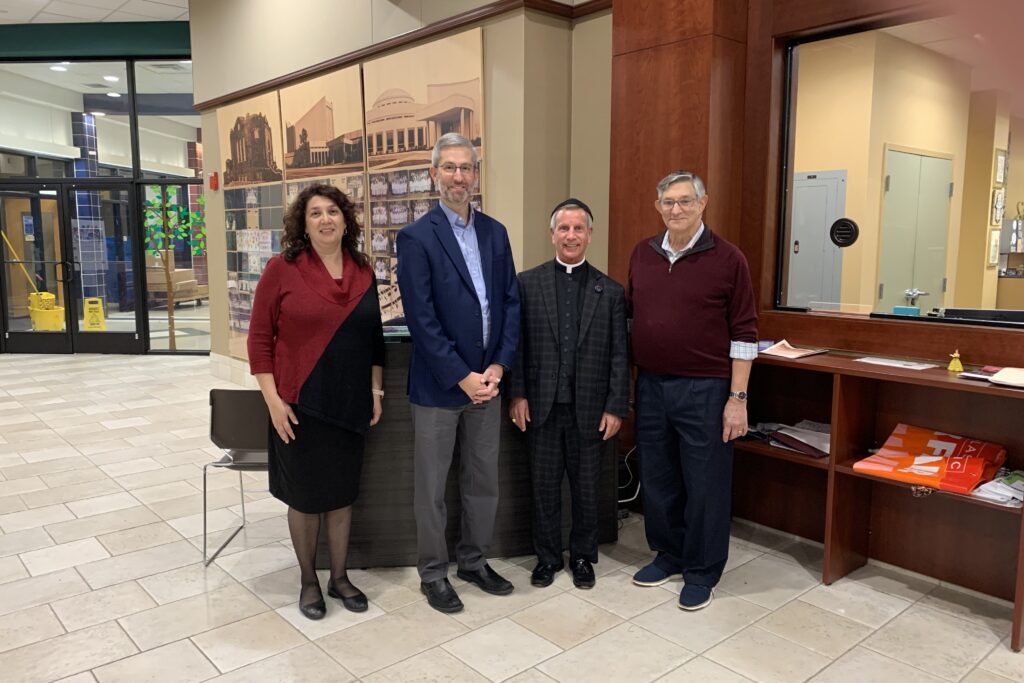
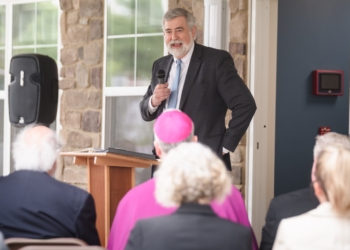
Father Wallace, director of Ecumenical and Inter-religious Affairs for the Diocese of Camden, and pastor of Christ the Redeemer Parish in Atco, was one of the guest speakers along with Dr. Steve Chervin, co-chair of the Jewish Community Relations Council (JCRC) of Southern New Jersey Intergroup and Interfaith Relations Committee.
Introducing them to the more than 60 people in attendance was Sabrina Spector, JCRC of Southern New Jersey executive director.
Dr. Chervin noted the main points of “Nostra Aetate” as it related to Catholic-Jewish relations, which before the Second Vatican Council, had been marked by negative stereotypes. The document rejected the charge of deicide (the collective Jewish guilt for the Death of Jesus); condemned antisemitism; affirmed the continuing validity of the Jewish covenant; and established a foundation for continuing Catholic-Jewish dialogue and collaboration.
Dr. Chervin made mention of those individuals who were influential in “Nostra Aetate,” including Pope John XXIII, who initiated Vatican II; Jules Isaac, a leading French historian who decried what he called the “teaching of contempt” toward the Jewish community by Catholic theologians; Cardinal Augustin Bea, the Secretariat for Promoting Christian Unity at the time who helped draft the initial document; Rabbi Abraham Joshua Heschel, theological consultant of the American Jewish Committee; and Pope Paul VI, who continued the work of Pope John XXIII in renewing the Church with Vatican II.
The dialogue and thought of these men produced a declaration that still inspires and motivates today, “as antisemitism unfortunately bursts forth again in our society,” he said.
The celebration on the evening of Oct. 28 allowed all to gather and “acknowledge the pain and suffering, to celebrate the changes wrought by Vatican II, and to chart the next steps that our communities need to take in order to build a relationship on mutual understanding, trust and friendship … emphasizing shared moral values, concern for the needy and oppressed and protection of the democratic traditions of our country,” he said.
Dr. Chervin also unpacked the document itself, and the Church’s remembrance of “the bond that spiritually ties the people of the New Covenant to Abraham’s stock,” as the text states.
“The Church, therefore, cannot forget that she received the revelation of the Old Testament through the people with whom God in His inexpressible mercy concluded the Ancient Covenant. Nor can she forget that she draws sustenance from the root of that well-cultivated olive tree onto which have been grafted the wild shoots, the Gentiles. Indeed, the Church believes that by His cross Christ, Our Peace, reconciled Jews and Gentiles. Making both one in Himself.”
The cross, then, “Nostra Aetate” continues, is a sign of “God’s all-embracing love and as the fountain from which every grace flows.”
Father Wallace noted the fruits that have come from this transformative text, including Pope John Paul II becoming the first pontiff to visit a synagogue since Saint Peter, in Rome 1986; the 1974 establishment of the Vatican’s Commission for Religious Relations with the Jews; various statements and documents from the Vatican and United States Conference of Catholic Bishops; and condemnations of antisemitism.
In the Diocese of Camden, as well, he mentioned the shared activities between the two faiths on educational endeavors, commemorations, celebrations and trips to Israel; the establishment of the Catholic-Jewish Commission; and the signing of the formal agreement of understanding by the Diocese of Camden, the Jewish Federation of Southern New Jersey, the Jewish Community Relations Council and the Tri-County Board of Rabbis, which was signed in 2001.
“Through our shared community service, prayer and ongoing dialogue, both communities have built bridges to one another that contribute to a wider and more inclusive and respectful society,” Father Wallace said. “As this good work continues, may the foundation laid by decades of cooperation ensure that Catholic-Jewish relations in South Jersey may remain a model for others to follow.”
After their presentations, a lively question-and-answer period followed, led by Rabbi David Englander, senior rabbi of Congregation Beth El.
“It’s an important day that represents the good and growing relationship of the Jewish community and the Catholic Church, and our commitment to interfaith work,” he said. “Any chance we get to do something that is productive, cooperative and friendly between our faiths, we view as a positive opportunity.”



 at the bottom and then tap “Add to Home Screen”
