





Earlier this month, President Donald Trump announced at the National Prayer Breakfast in Washington, D.C., the establishment of a task force focused on addressing concerns regarding a perceived “anti-Christian bias” within the federal government.
Appointing U.S. Attorney General Pam Bondi to lead the effort, he said, “The mission of this task force will be to immediately hold all forms of anti-Christian targeting and discrimination within the federal government, including at the Department of Justice, which was absolutely terrible, the IRS, the FBI and other agencies.”
As to the task ahead for Bondi, the president said she would work to “fully prosecute anti-Christian violence and vandalism in our society and to move heaven and earth to defend the rights of Christians and religious believers nationwide.” He also urged Americans to “bring God back” into their lives.
In addition to the new task force, he also established a commission on religious liberty. He said, “If we don’t have religious liberty, then we don’t have a free country.”
At the breakfast, President Trump said that the two attempts on his life had changed him. “I feel stronger, I believe in God, but I feel, I feel more strongly about it. Something happened.” His religious background is Presbyterian, but he currently identifies as a nondenominational Christian.
He also claimed – when asked at a second prayer breakfast he attended later that day – that “it was God that saved me.”
His announcement of the task force drew mixed reviews from various religious leaders. The Rev. Jack Graham, a Baptist pastor of a large congregation, supported President Trump’s efforts. He also lauded the appointment of a fellow Baptist minister and former NFL player, Scott Turner, to lead the Department of Housing and Urban Development. Turner stated that he expects to address several housing issues relevant to the Christian community.
The leader of the White House Faith Office, Paula White-Cain, has been instrumental in reinforcing President Trump’s focus on Christian priorities, including initiatives targeting anti-Christian bias and supporting religious rights.
Other religious leaders were not as supportive. The Episcopal Bishop Mariann Edgar Budde of Washington, D.C., has been a vocal critic of the administration’s policies, particularly concerning immigration and LGBTQ rights. She has urged the president to exhibit compassion toward vulnerable communities, emphasizing that current policies conflict with Christian teachings on mercy and justice.
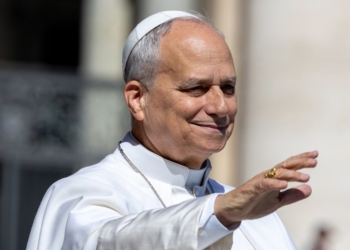
The United States Conference of Catholic Bishops – represented by leaders such as Cardinal Blase J. Cupich, archbishop of Chicago; Cardinal Joseph W. Tobin, C.Ss.R., archbishop of Newark, N.J.; and Cardinal Robert McElroy, archbishop of Washington – has expressed opposition to the administration’s immigration policies. They argue that these policies are incompatible with Catholic doctrine, which emphasizes the dignity and rights of immigrants.
While the president gave few concrete examples of anti-Christian bias, his announcement unleashed a chorus of criticism from those concerned about the separation of church and state. Under the First Amendment of the U.S. Constitution, the government protects freedom of religion. One example that the president did posit was criticism of his predecessor, former President Biden. President Trump accused him of “persecution’ for his administration’s prosecution of pro-life advocates accused of blockading abortion clinics. Americans United for Separation of Church and State denounced the creation of the task force, suggesting it exploits religious freedom to justify discrimination and asserting that it undermines the separation of church and state.
Certain religious leaders endorse President Trump’s task force aimed at protecting Christian rights, whereas others criticize it for being potentially politicized and marginalizing other faiths.
Father Joseph D. Wallace is diocesan director of Ecumenical and Inter-religious Affairs and pastor of Christ the Redeemer Parish, Atco.




 at the bottom and then tap “Add to Home Screen”
