






People of the Book – John the Baptist
During this Advent season, it is particularly appropriate to examine the life and ministry of John the Baptist, largely seen as a figure bridging the Hebrew prophetic tradition in the Old Testament and the covenant achieved through the blood of Jesus Christ in the New.
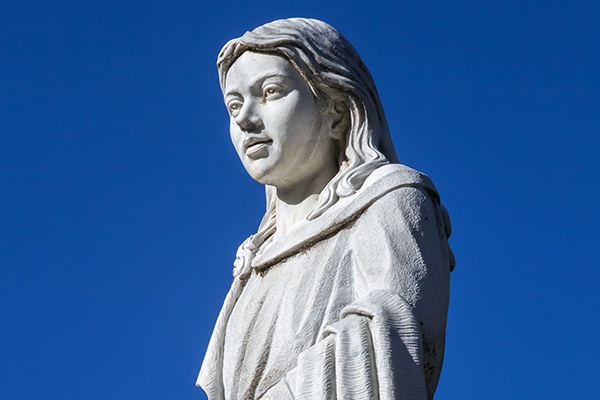
The Baptist, often portrayed in Christian iconography and sculpture with his arm extended metaphorically pointing to the coming Messiah, could unofficially be seen as the patron saint of Advent, the season of preparation for the Lord’s coming. It is he who serves as the last precursor to the Incarnation, exhorting all of his followers to “Prepare the way of the Lord, make straight his paths.” This is a clearly imperative statement. Its syntax is in the second person, and like the “you” in Matthew’s judgment scene (“When I was hungry you gave me to eat, when I was thirsty you gave me to drink”) it is in the plural. It is addressed to us as a community. In addition to first-century peasants and Pharisees, it speaks to us, here, now.
The son of Mary’s kinswoman Elizabeth and her aged husband Zechariah, John has an undeniably important and developing role in the Gospels. The earliest Gospel, that of Mark (c. 70 AD), does not include a birth narrative of Jesus in Bethlehem, but rather opens with the preaching of John and his baptism of the adult Jesus in the Jordan. Both John’s ascetical diet of locusts and wild honey and his memorable clothing, that of maddeningly itchy camel hair resembling a penitent’s hairshirt as a sign of mortification of the flesh and self-denial, were reminiscent of the prophet Elijah described in 2 Kgs 1:8.
The biblical description of the role and relationship of John to Jesus is not a static recapitulation of a set narrative, but rather a fluid reflection through the decades surrounding the authorship of the remaining three Gospels. In the succeeding writings, we begin to see more details emerge about John’s conception and birth and an emphasis on the superiority of Jesus to John, which remains latent in the Markan account.
Matthew includes John’s hesitancy to baptize Jesus as an allusion to this relationship and the nonparallel status of the protagonists (Mt 3:13-7). The Baptist’s “diminishing” role is further solidified by the time of the composition of the last Gospel (c. 90 AD, after the destruction of the Temple by the Romans).
The Johannine text includes John the Baptist explicitly proclaiming, “This was he of whom I said ‘The one who is coming after me ranks ahead of me because he existed before me’” (Jn 1:15). Any sibling rivalry between the followers of John and those of Jesus (which was a rather likely occurrence in the early decades of Christianity) was thus laid to rest by this time.
The Baptist’s cry, “Behold the Lamb of God, who takes away the sin of the world” (Jn 1:29), should sound familiar to regular Catholic churchgoers. The Baptist uses this term to describe Jesus’ divine role as a personal embodiment of a number of theological references. The tamid lamb of Exodus 29 and its memorial of the Passover sacrifice, the scapegoat of Leviticus 16, the “gentle lamb” of Jeremiah 11:19, and the “lamb led to the slaughter” in the Suffering Servant motif of Isaiah 53 all demonstrate spiritual connections between the intrinsically Jewish Christ’s salvific mission and the purification, restoration and glorification of his people.
As with so many prophets (both ecclesiastical and secular), the Baptist’s call for the community to examine their actions and motives and to reorient their lives around God’s demands and the cry of the most marginalized in society does not end well for him from the perspective of this world. When he eventually condemned the behavior of Herod Antipas, the tetrarch and his wife Herodias had John imprisoned and quickly beheaded.
He is one of only three figures, along with Mary and Jesus, to have his nativity celebrated during the liturgical year on June 24 and his martyrdom is commemorated on Aug. 29. He is the patron saint of both Florence, Italy and Puerto Rico, and remains celebrated throughout the world especially in the days before Christmas as the immediate forerunner to the coming Lord of History.
Michael M. Canaris of Collingswood is an administrator at Fairfield University’s Center for Faith and Public Life and is on the faculty for the Department of Philosophy, Theology, and Religious Studies at Sacred Heart University.






 at the bottom and then tap “Add to Home Screen”