





Editor’s Note: The feast of the Exaltation of the Holy Cross is September 14.
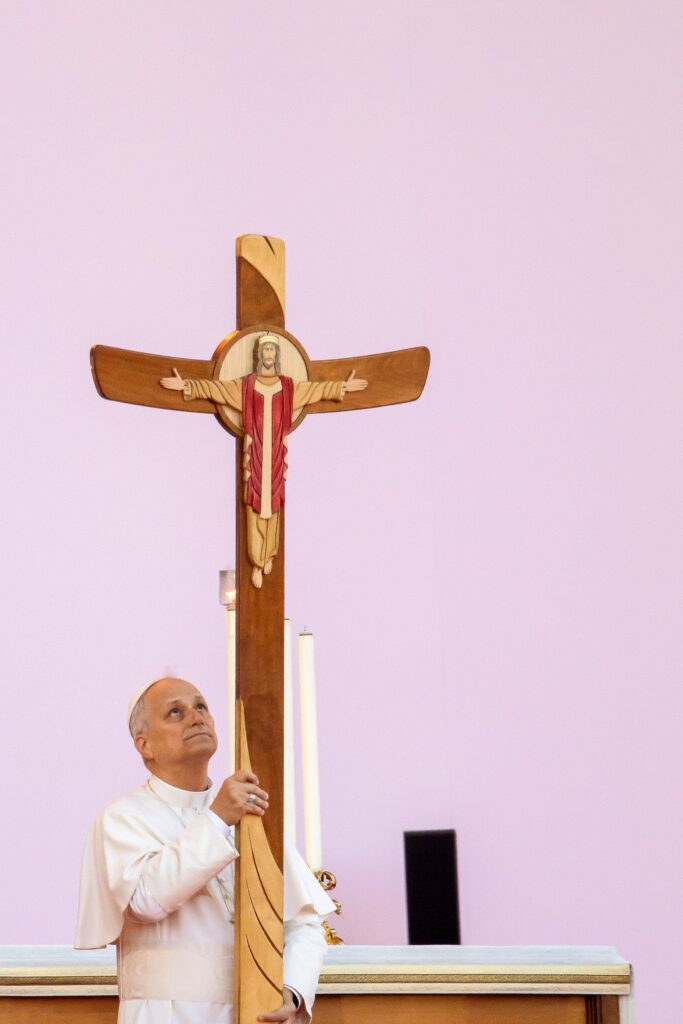
Every year on Sept. 14, the Church celebrates the feast of the Exaltation of the Holy Cross. It was discovered in Jerusalem by Saint Helena, mother of the emperor Constantine, in 320. Constantine then erected a shrine on Mount Calvary to house the precious relic, as well as two churches on either side of it.
In 614, the shrine and churches were destroyed by the invading Persians, and they took the Holy Cross away with them. However, in 629, it was recovered by the imperial army, and on Sept. 14, the Emperor Heraclius carried it on his shoulders in a majestic ceremony back into Jerusalem. He was clothed in brilliant garments adorned with precious stones.
Pious tradition says when Emperor Heraclius reached the foot of Mount Calvary, try as hard as he could, he could go on no farther. Bishop Zacharias, Patriarch of Jerusalem, said to the astonished monarch that he should carefully consider, dressed in splendid, triumphal attire, how far he was from the poor, suffering Jesus carrying his Cross. Exchanging his rich imperial clothing for a simple penitential garb, Heraclius was able to complete the climb.
This particular feast stands in stark contrast with the somber tones of Good Friday and completes the theology of the Holy Cross. The joyfulness of the celebration of the feast is reflected in the liturgical texts for the Mass. The entrance antiphon, which sets the tone for the liturgy, begins by expanding on the words of Saint Paul: “We should glory in the Cross of our Lord Jesus Christ, in whom is our salvation, life and resurrection, through whom we are saved and delivered.” (Gal. 6:14) On the other hand, consider the words of the responsorial psalm referring to the Crucified One for the liturgy of Good Friday: “I am an object of reproach, a dread to my friends. I am forgotten like the unremembered dead. I am like a dish that is broken.” (Ps. 31:12-13)
Many of the saints knew and lived that duality of the Cross in a special way. They embraced its sorrow and its joy, its powerlessness and its power. The Apostle Paul was among the earliest to do so.
Acknowledging that the Cross is foolishness to many, Saint Paul said it is “to us who are being saved, the power of God.” (1 Cor. 1:18) In other words, that shameful instrument of death for the worst of criminals has become the portal to eternal glory. Through it, poor, powerless sinners, once doomed to eternal death, become powerful saints in heaven. Christ has made it so by suffering Death on the Cross for the salvation of sinners and then rising to new and perfect life.
Many of the saints spoke about the power of the Cross in their lives. For Saint Francis of Assisi, it was “the book of wisdom.” For Saint Rose of Lima, it was “the ladder to heaven.” Saint Bernadette, the poor seer of Lourdes, said the most important thing the Blessed Virgin Mary taught her was how to make the Sign of the Cross reverently and prayerfully. When a young sister asked her what she needed to do to get to heaven, Bernadette said, “Make the Sign of the Cross well.”
For some saints, the power of the Cross was so central to their spirituality and identity that they made it part of their religious name. They include Saint John of the Cross, Saint Paul of the Cross and Saint Teresa Benedicta of the Cross.
Saint Teresa Benedicta of the Cross, known in the world as Edith Stein, was a Jewish atheist, brilliant philosopher, convert to the Catholic faith and martyr of Auschwitz. Her favorite professor, Adolf Reinach, and his wife, Anna, were Jewish converts to Christianity. He was killed in battle in World War I, and Anna later asked Edith if she would help her put her husband’s papers in order. She consented but dreaded the task, certain that she would find a broken widow in despair. Instead, she found a hopeful woman with firm faith in eternal life.
“This was my first encounter with the Cross and the divine power it imparts to those who bear it,” Edith said. “It was the moment my unbelief collapsed and Christ began to shine his light on me, Christ in the mystery of the Cross.”
It was a major breakthrough in Edith’s conversion, as well as preparation for her own cross, which she would one day have to bear.
Alone, Anna Reinach was powerless in dealing with the death of her husband. But considering it in the light of the Cross of Christ, her own cross became meaningful and powerful. Edith, too, was powerless to stop her persecution by the Nazis. Through perseverance, however, in bearing that cross, she was able to find power and hope in the light of the final victory of the Cross of Christ.
When an unexpected cross comes our way, our first reaction is often fear and confusion. We feel utterly powerless in our ability to deal with it. If we hold a crucifix in our hands, however, and meditate on Christ’s supreme act of love for us, we realize that He who made Himself powerless in the hands of men has become all powerful in his triumph over sin and death on the Cross and has thereby opened to us the gates of heaven.
This is the reason why we celebrate the feast of the Exaltation of the Holy Cross. So we, too, can become powerful in uniting our crosses with Christ’s and can say with Saint Paul, “When I am weak, then I am strong, for power is made perfect in weakness.” (2 Cor. 12:9f)
Father Edward Kolla is a retired priest of the Diocese.




 at the bottom and then tap “Add to Home Screen”
