
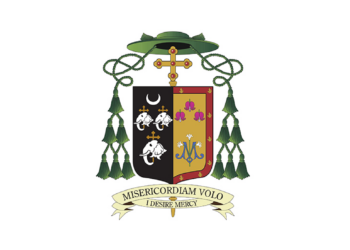





Pope Francis recently named a friend of our Institute of Pastoral Studies, Auxiliary Bishop Ron Hicks, the next bishop of the Diocese of Joliet in Illinois.
As I was looking for where to send Bishop Hicks a little note of congratulations, I was surprised to learn that the Cathedral in his new diocese is named for the little-known Catalan priest, Saint Raymond Nonnatus. I’ve come across the devotion to this particular San Ramon a few times in Spain, and he also gives his name to a diocese in Brazil, but have not found many references to him in North American Catholic culture.
“Nonnatus” is not a surname, but rather taken from the Latin for “not born,” because he was delivered via Caesarean section and his mother did not survive the procedure. Thus, pregnant women and midwives have long venerated him and sought his intercession for health during complicated childbirths.
Raymond joined the Order of Our Lady of Mercy, the Mercedarians, founded by Saint Peter Nolasco in the 1200s. One of the order’s primary charitable works was to care for and work to ransom Christians held in captivity. He eventually was named to the position of Chief Ransomer for the Mercedarians, which demanded that he travel to hostile lands to negotiate the release of slaves and prisoners. While in Algeria and Tunisia, he was rewarded for his efforts by having his lips pierced with a hot iron and padlocked shut to keep him from preaching Christianity. More often than not, the artists who depict him over the following centuries are captivated by the ingenuity of this punishment. It’s a common way to recognize iconography dedicated to him.
Trading his freedom for that of a group of suffering captives, Raymond was for a time a slave himself before being returned to Spain through the efforts of his order. He died in 1240, in Cardona, on the banks of whose river Saint Ignatius Loyola would one day three centuries later have a pivotal mystical divine enlightenment, which led eventually to his “Contemplation on Divine Love.”
According to their mission literature, today the Mercedarians claim to “continue to rescue others from modern types of captivity, such as social, political and psychological forms. They work in jails, marginal neighborhoods, among addicts and in hospitals.”
Pope Francis has repeatedly made the “mercying” (misericoriando) dimension of God the cornerstone of his pontificate. His own coat of arms contains the admittedly difficult-to-translate motto “Miserando Atque Eligendo” — basically “By Having Mercy, He Chose Him,” which is taken from Saint Bede’s reflection on the call of Matthew the tax-collector, immortalized in Caravaggio’s painting, one of the pope’s (and my) favorites. Francis famously once said that divine mercy is “our liberation and happiness; the air that we must breathe.” Along with him and the Mercedarian saint, we should all continue to ask for God’s boundless mercy on our lives and our wider culture, and be quick to model it both toward one another, and toward ourselves.
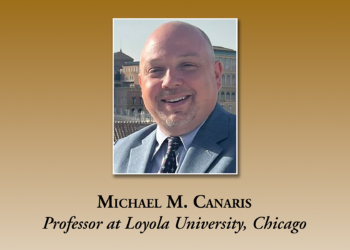
Originally from Collingswood, Michael M. Canaris, Ph.D., teaches at Loyola University, Chicago.



 at the bottom and then tap “Add to Home Screen”
