


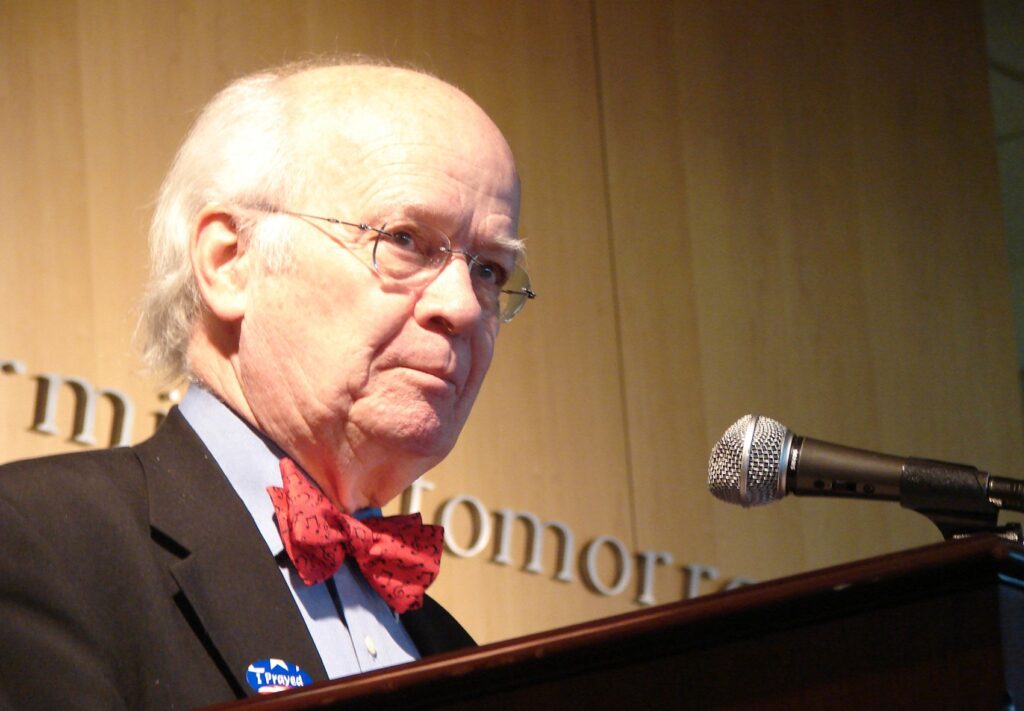
Around 20 years ago, I had the pleasure of meeting and attending a lecture by the Rev. Martin E. Marty at a Workshop on Christian Unity. The Lutheran theologian passed away last month at the ripe old age of 97.
At the workshop, he sat on a panel of speakers who attended the Second Vatican Council. Martin Marty attended the Second Vatican Council as a Protestant observer in 1964. He spent six weeks at the Council in Rome. He also served as president of the American Academy of Religion and the American Society of Church History.
The Rev. Marty was born Feb. 5, 1928, in West Point, Neb., and died Feb. 25 in Minneapolis, Minn. He lived a full and interesting life. He marched for civil rights in Selma, Ala., with the Rev. Martin Luther King Jr. He was founder of the anti-war organization Clergy and Laymen Concerned About Vietnam. He was a friend and mentor to screenwriter Norman Lear in his efforts to challenge religious extremism in American society.
Ordained a minister in 1952 for the Lutheran Church–Missouri Synod, he served as a Lutheran pastor from 1952 to 1967 in the suburbs of Chicago. From 1963 to 1998, he taught at the University of Chicago Divinity School.
In addition to his leadership as president of the American Academy of Religion, the American Society of Church History and the American Catholic Historical Association, he was the founding president of the Park Ridge Center for the Study of Health, Faith and Ethics. Later, he became its George B. Caldwell Scholar-in-Residence. He served on two U.S. presidential commissions and was director of both the Fundamentalism Project of the American Academy of Arts and Sciences and the Public Religion Project at the University of Chicago. He served at Saint Olaf College in Northfield, Minn., in many roles, including as regent, board chairman and interim president. On his 70th birthday, he retired.
As an historian and ecumenist, he penned more than 60 books, thousands of articles and was a much sought-after lecturer. The Rev. Marty’s interpretation of Protestantism and fundamentalism in the United States still influences the view of modern American religion. He was described by the American historian Benjamin Rolsky as “arguably the public intellectual of the 1980s.”
The reverend was a prominent advocate for Christian unity, and a leading scholar of American religion. He believed that ecumenism was a genuine repentance that required a change of heart. He believed that ecumenical efforts between Lutherans and Catholics were a genuine repentance. He believed many of these ecumenical ties should be based upon the conclusions of the New Delhi Statement on Unity in 1961, which called for repentance and a change of heart. He also taught that he thought much of the skepticism and resistance of the acceptance of ecumenical documents were misplaced and unwarranted.
His former student, Professor R. Scott Appleby, a fellow historian at the University of Notre Dame who teaches global affairs, reflected upon the reverend upon hearing of his death. “Only an intellectual giant with Marty’s combination of multidisciplinary fluency and vast erudition could have foreseen the inbreaking of wave upon wave of modern anti-pluralist, anti-modernist assaults upon the liberal worldviews and institutions from the ‘benighted’ margins of Western and westernized societies.”
“Marty stayed true to his instincts to come ‘not to condemn, not to praise, but to understand,’” he added.
May he rest in peace, as his good works go with him.
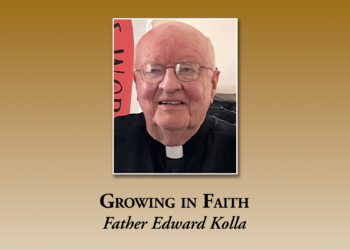
Father Joseph D. Wallace is diocesan director of Ecumenical and Inter-religious Affairs and pastor of Christ the Redeemer Parish, Atco.



 at the bottom and then tap “Add to Home Screen”
