
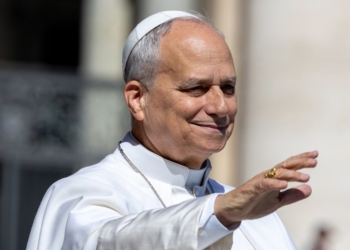




In his first apostolic visit outside of Rome since becoming the Holy Father, Pope Francis travelled to the island of Lampedusa, Italy, this week.
Lampedusa has been called the Ellis Island and the “border-town” of Europe. Much like the Southern states today and New York in the past, it serves as the entryway for immigrants seeking to better their lives in greener pastures.
There is obvious friction between the island’s natives and the thousands of undocumented African and Mediterranean immigrants who use Lampedusa as a springboard into Europe. Francis visited to express solidarity with the downtrodden, to ease tensions, and to grieve publicly at the multitudes of migrants who have drowned on the dangerous sea voyage. He visited a makeshift “boat cemetery” and said a Mass (notably in penitential purple vestments) in honor of those perishing.
The pope called us to critique a culture of wealth and consumerism that despises the poor, powerless and forgotten. He spoke of Cain, responding to God with the cruelest words ever uttered by our race, ones which are scoffingly repeated daily in each of our hearts – “What is that to me? Am I my brother’s keeper?” The pope, dedicated to immigrants and refugees, responds: “These our brothers and sisters seek to leave difficult situations in order to find a little serenity and peace, they seek a better place for themselves and for their families – but they found death. How many times do those who seek this not find understanding, do not find welcome, do not find solidarity! And their voices rise up even to God!”
Francis alluded to one of my favorite novels, Alessandro Manzoni’s I Promessi Sposi (“The Betrothed”), in his speech, mentioning Manzoni’s villain, frighteningly called simply ‘The Unnamed'(la figura dell’Innominato). “The figure of the Unnamed of Manzoni returns. The globalization of indifference makes us all ‘unnamed,’ leaders without names and without faces.”
So often we go about our business with un-Christian attitudes toward those in need. Our mentalities exhibit indifference, disdain or worse.
Francis’ visit was percolating in my mind all week. How appropriate that Sunday’s Gospel contained the parable of the Good Samaritan, a reading which perhaps more than any other interrogates my heart and soul each time I hear it. Too often I find myself playing the part of the priest and Levite in the story, not necessarily out to harm anyone, but still focused on “keeping my appointments downtown,” when conflict arises. We know the parable too well to repeat. But remember in that historical era, the victimized man, a Jew, deeply resented the residents of Samaria. (Elsewhere, it is utterly shocking to his disciples when Jesus even speaks directly to the Samaritan woman at the well). It is the victim’s enemy who thanklessly cares for him, and offers to do so at a financial and social cost. He dares to love, to give the other a face and thereby remove his own featureless mask, to defend and care for those who are radically “other.”
Jesus says that in such action lies the path to salvation and fulfillment. Those who love their life will lose it; those who lose their lives will find it. We should not hear this tremendously demanding charge to love the least of our brothers and sisters “as ourselves,” and then thoughtlessly hop back into our SUVs to be first in line for eggs Benedict at the country club’s Sunday brunch after Mass. I say this with tongue planted firmly in cheek, as I am as guilty of downplaying the radical nature of this duty as anyone. As I said, the passage ruthlessly cross-examines my daily life and assumptions every time I hear or read it.
As Francis puts so eloquently, “Let us ask the Lord for the grace to weep over our indifference, to weep over the cruelty in the world, in ourselves, and even in those who anonymously make socio-economic decisions that open the way to tragedies like this.”
Michael M. Canaris is an administrator at Fairfield University’s Center for Faith and Public Life and is on the faculty for the Department of Philosophy, Theology, and Religious Studies at Sacred Heart University.






 at the bottom and then tap “Add to Home Screen”