





By Michael M. Canaris
My neighborhood (or rione) in Rome is named Celio, and sits on a hill overlooking both the Colosseum and the Circus Maximus. And since my paternal grandparents are named Constantine and Helen (a friend once laughed that I was genetically predisposed to theology), it seems a blessing to me to be within a 10 minute walk of the Arch of Constantine, the Lateran complex where the emperor was reportedly baptized, and Santa Croce in Gerusalemme, which houses the relics brought by St. Helen from the Holy Land, including those said to be of the True Cross.
Santa Croce is just one of over 900 churches in Rome. I bounce around for daily Mass, depending on where I am in the city for the day, and what I have planned. But when my schedule allows, I have been gravitating toward the nearby chapel atop the Scala Santa, the Holy Stairs. The site is maintained by the Passionist Fathers, the order dedicated to Christ’s suffering and death founded by San Paolo della Croce.
Tradition holds that after the conversion of Constantine at the Milvian Bridge, his mother St. Helen (in Italian Sant’Elena) traveled to the Holy Land sometime around 326 AD and ordered many of the sites of Christ’s life being venerated by pilgrims to be either permanently commemorated in Jerusalem, such as the Holy Sepulcher, or brought back to the Empire, such as the cross. Among those carried off by the Roman military were the Santa Scala.
The 28 marble stairs are said to be those which Christ climbed before being condemned by Pontius Pilate, “like a lamb before its shearers.” I have been there at various times of day and night, and have never seen them empty of pilgrims silently praying while ascending them on their knees, as is strictly enforced. Statues at their base memorialize Judas’ betrayal, the condemnation, and the “ecce homo” (“Behold, the man”) announcement which has been so inspiring to artists and sculptors over the years. Everyone from popes to Martin Luther has been known to have engaged in the practice, though it is debated whether the latter actually finished the task or became disillusioned halfway through. I have of course climbed them on my knees, but must confess most days I walk up the “secular” side steps built on either side if I’m rushing to and from Mass between seminars or meetings.
The modern chapel is simple, though it is adjacent to the Sancta Sanctorum (the Holy of Holies) which, as the private sanctuary of the medieval popes, is much more elaborate and ornate. In today’s “active” chapel, there is a monument to Passionist Padre Candido Amantini, the former chief exorcist of Rome who is currently being considered for beatification. The noted preaching of the Passionists, a group so dedicated to the suffering of Jesus, is an apt fit for the moving architectural and historical space.
I have not been to Israel, though I hope to visit someday. But the historical and tangible connection to Christ’s passion here in Rome, as well as to the countless members of the community of his Body who have also been so stirred, are things that I feel privileged to experience here on a daily basis.
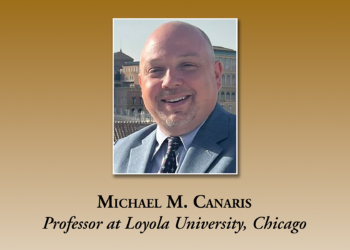
Collingswood native Michael M. Canaris, Ph.D., Pontifical University of St. Thomas (Angelicum), Rome.



 at the bottom and then tap “Add to Home Screen”