




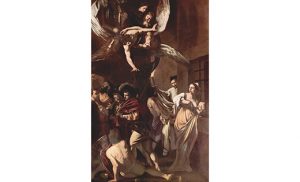
I have spent the last two weeks in the United Kingdom and Rome attending conferences and giving some invited lectures about my new book on Jesuit theologian Francis A. Sullivan. But I was able to carve out the time to accept an invitation with an art historian friend through the Lay Centre to explore the Capitoline Museum’s special exhibit on “Mercy in Art.” Of course, the collection was gathered to coincide with Pope Francis’ current Jubilee Year of Mercy.
The complex of museums sits at the top of Rome’s Capitoline Hill, adjacent to the Vittoriano, the monument which English-speaking tourists (but no Italians) call the “wedding cake,” and the Church of Santa Maria in Aracoeli. The hilltop piazza’s layout was designed by Michelangelo and aesthetically revolves around a bronze statue of Marcus Aurelius astride his horse in the center.
The special exhibit, running through November, details a theme which is not as prevalent in Christian art and iconography as one might expect. Of course, charity is often depicted in countless ways in paintings, sculpture and mosaics. But distinct attention to mercy is not as widely found in the tradition.
Two particular dimensions dominated the short, but moving, exhibit: depictions of Our Lady of Mercy and of the Works of Mercy.
Catholics familiar with the Salve Regina, which I would estimate is sung after 80 percent of all Masses in Rome during the appropriate seasons, have long addressed Mary as Mater Misericordiae, the “mother of mercy.” In the wake of the reforms of lay life inspired by devotion to Clare and Francis of Assisi, artists began to craft images showing Mary welcoming those pleading her intercession for mercy or clemency. Most of these depict her with an outstretched cloak, representing her role as both Mother and in a sense the church itself, harboring beneath these sheltering supports a wide range of people. It is obvious that in the earlier pieces those under the cloak were lay men and women in confraternities committed to pious works and serving the poor.
Unfortunately, as is the case with Seville’s Holy Week processions, an American’s imagination can sometimes have a difficult time dissociating the white hooded figures common in these associations from their hateful corruptions by the Ku Klux Klan. It’s simply impossible (for me at least) to see people depicted in such outfits and not call to mind those parts of American history, though of course these have nothing to do with one another, other than desiring anonymity: one for repentant self-accusation and the other for nefarious crimes.
The later depictions in the series began to include notably more figures beneath the protective folds: popes and aristocrats, as well as men and women of religious orders and artisans and tradesmen. The disguising masks disappear, as these patrons wanted to be identified. The intensification of Marian devotion after the counter-Reformation and Trent can also be traced with more clouds beneath her feet (Assumption) and angels crowning her (Queen of Heaven). There is often a slight bulge in the belly of her red cloak, and so the Christological element is not absent from the works, alluded to in her budding pregnancy and reference to her Son’s blood.
The Works of Mercy pieces, like so many others in Catholic art, are all really references to, imitations of, or inspired by Caravaggio. His “Seven Works of Mercy” for the community at Pio Monte della Misericordia in Naples is a stunning masterpiece. It contains all seven (before Pope Francis’s “complementary” exhortation to think of care for the common home of creation through the lens of Works of Mercy). The most striking is the dual “feeding the hungry” and “visiting the imprisoned,” portrayed by a pregnant and bare-breasted Pero from Roman myth feeding her incarcerated and starving father Cimone. It was often used as a pagan symbol of virtue and compassion, and is thus “baptized” by Caravaggio.
As these images do well to remind us, we continue to “live” mercy in this year especially dedicated to it. As Pope Francis has put it: “God’s mercy can make even the driest land become a garden, can restore life to dry bones (cf. Ez 37:1-14). … Let us be renewed by God’s mercy, let us be loved by Jesus, let us enable the power of his love to transform our lives too; and let us become agents of this mercy, channels through which God can water the earth, protect all creation and make justice and peace flourish.”
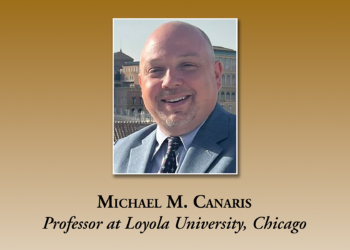
Collingswood native Michael M. Canaris, Ph.D, teaches at Loyola University, Chicago.



 at the bottom and then tap “Add to Home Screen”
