





Far too often, Catholics in the United States tend to truncate the holiday season and miss some of its key elements. Admittedly, this is probably partly because of the praiseworthy inclusion of Thanksgiving in our calendar, which launches things off earlier for us than most other nations.
It comes at a price at the other end of the season, when Epiphany and the Baptism of the Lord tend to be underplayed as Christmas trees lie curbside and stations have moved from seasonal music to football playoff coverage.
As an example, how many of our fellow believers have honestly stopped to ponder what the partridge in the pear tree song is about, and how many days fall between Christmas Eve and Epiphany Eve? We tend to close things out well before the “twelfth night.”
While many other local Churches – particularly Latinos, Poles and Filipinos – revere the visit of the Magi as a central part of the season, we in the United States downplay it entirely. (Though my 4-year-old daughter was fascinated this year that the “camels” drank all the water but dropped some of the half-eaten carrots left on the porch the morning of Jan. 6 when the “magi” came bearing gifts.)
Two churches I regularly frequent, the Chicago cathedral and the church commonly referred to as the Gesù in Rome, are circuitously connected to another Christmas celebration we almost entirely ignore.
I was recently standing in the latter contemplating the artwork behind the central altar. Though I knew the full name of the Baroque church’s dedication was to the Most Holy Name of Jesus “in Argentina” (which has nothing to do with the country), I was struck as to why the central piece of art was a depiction of a Jewish priest holding the baby Jesus between his parents. It took an art historian friend to unlock the mystery for me.
Since the Roman church was dedicated to Jesus’ sacred “Name,” and the bestowal of this name was connected to the circumcision that Saint Luke tells us took place the traditional eight days after birth, it was in fact a yuletide piece. This is in addition to the fact that while other orders like Franciscans, Benedictines, Pallottines and Dominicans took the name of their founders for their orders, the Jesuits – whose mother church it is – are technically titled the Society of Jesus (not the “Ignatians” or “Loyolans”), and so the circumcision/naming of the Lord in early January became an important devotion for them.
A lot of wider Catholic theological literature also has been written connecting this event in Jesus’ life with his eventual Passion, since it was likely when He first spilled blood at the hands of mankind, even if only a few drops.
Holy Name of Camden Ministries builds upon this history locally. Even though the Jesuits realigned their commitments to the labors, and the church was merged with the Cathedral of the Immaculate Conception in 2009, the legacy of their work continues in the Camden area under this venerable ancient devotion, widely popularized by Saint Bernardino of Siena in the 1400s.
Lamentably, the Feast of the Holy Name is another of these seasonal festivities that Americans tend to ignore entirely, even in our parish settings, not to mention in our secular ones. Even though we are liturgically in Ordinary Time, Scripture scholars encourage us to recognize these nativity elements endure even into February with the Feast of the Presentation, or Candlemas, which in turn explains the roots of Groundhog Day. But that is a separate (previous) article!
For now, it is sufficient to recognize that in a global Church, certain cultures and peoples will foreground some rites, traditions and holidays at the expense of others. In the United States, we’ve done an admirable job reminding people to be grateful to God for harvests and blessings bestowed in late November. But we have failed in other areas of our Christian witness, or of passing on our own multilayered history meaningfully and cogently to curious children. Providentially, we can lean on other cultures to instruct us as to what we might have missed.
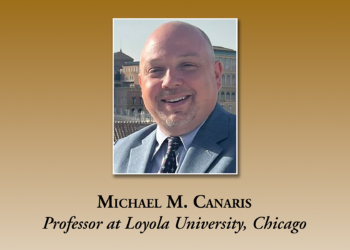
An alumnus of Camden Catholic High School, Cherry Hill, Michael M. Canaris, Ph.D., teaches at Loyola University, Chicago.



 at the bottom and then tap “Add to Home Screen”
