



Click Here to Subscribe

Photo Gallery: OLMA Graduation

Bishop's Schedule

The Bishop’s Schedule, May 26 – June 2

by Staff Reports
May 21, 2026
0
ShareTweet

Featured

New Jerseyans urged to push for nonpublic school security funding

by David Karas, Correspondent
2 days ago
0
ShareTweet

The Ascension, like death, not a departure, but a lifting

by Father Michael A. de Leon, AM
2 days ago
0
ShareTweet

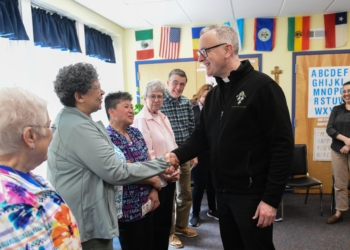
Bishop connects with staff, mission at SSJ Neighborhood Center

by Staff Reports
4 days ago
0
ShareTweet
  • Contact
  • Advertise
  • Subscribe
  • Home
Saturday, May 23, 2026
Catholic Star Herald
  • News
    • From Bishop Williams
    • Parish Life
    • Diocesan News
    • Sports
    • Columns
      • From Bishop Sullivan
    • Obituaries
    • World/Nation
  • Catholic Schools
  • Español
  • Features
    • Special Supplements
      • Thank You Bishop Sullivan
      • Welcome Bishop Williams
      • Jubilarians
    • Entertainment
      • Movie Reviews
    • Photo Galleries
    • Talking Catholic
    • Latest Videos
    • Health and Wellness
  • Advertise
  • More
    • Classified
    • Subscribe
    • Contact Us
  • News
    • From Bishop Williams
    • Parish Life
    • Diocesan News
    • Sports
    • Columns
      • From Bishop Sullivan
    • Obituaries
    • World/Nation
  • Catholic Schools
  • Español
  • Features
    • Special Supplements
      • Thank You Bishop Sullivan
      • Welcome Bishop Williams
      • Jubilarians
    • Entertainment
      • Movie Reviews
    • Photo Galleries
    • Talking Catholic
    • Latest Videos
    • Health and Wellness
  • Advertise
  • More
    • Classified
    • Subscribe
    • Contact Us
No Result
View All Result
Catholic Star Herald
No Result
View All Result
Home Columns

Understanding Gospels reveals concern for social justice

Father Robert J. Gregorio by Father Robert J. Gregorio
June 20, 2019
in Columns, On Behalf of Justice
Reading Time: 4 mins read
0
0
VIEWS
Share on FacebookShare on Twitter

To understand why the Gospels are the authoritative documents on Jesus as champion of social justice, it helps to see where they began. First, to correct a common mistake, they are not histories. Their authors meant them to be faith statements on why the hearer should place the same faith in him as did the authors. They are meant to be recruiter texts for his community of believers (the first generation church), not biographies. Thus, when we spot discrepancies, we know the final editors were well aware of them but did not try to reconcile them. For instance, Matthew, the most Jewish of the evangelists, presented Jesus as the new Moses. So he put him on a mountain since Moses brought the law down from Sinai. But Luke, writing for a gentile (gentile signifies anyone not Jewish) audience made the same occasion the Sermon on the Plain.

On that score, Matthew, Mark and Luke are called the Synoptics (seeing things together). They share 661 identical sentences. In addition, Matthew and Luke share another 300 verses between themselves. If you were a high-school teacher assigning an essay test and three students did this, you would suspect someone copied from someone. Scholars state that Mark, the Gospel first to appear in its final redaction, about the year 70, and the shortest of the four Gospels, was the main but not only source for the other two Synoptics. His immediate audience was the parish community of Christians in Rome, composed of slaves, gentiles and Israel ex-patriots 1,400 miles from where the events took place..

Matthew was writing specifically for Jewish Christians in Israel and did not need to explain the many Judaisms that Mark did. His final redaction came about the same time as Luke’s, in 85. Luke was a traveling companion of Saul of Tarsis (Saint Paul), the heretic with the audacity to defy the sacred Torah’s many injunctions about Jews associating with gentiles.  Paul, about eight years younger than Jesus, had been a super-zealous Pharisee who righteously traveled about the eastern Mediterranean arresting Jewish breakaways following the new Messiah, Jesus. This was before his stunning conversion on the road to Damascus of Syria, punitively “breathing murderous threats.” 

After that life-changing experience, Paul concluded that the message he started preaching about Jesus to fellow Jews outside of Israel could not be kept from gentiles who naturally were curious after hearing about this Jew who had been executed on Calvary by the hated paranoid Romans and then who rose from the dead the following Sunday. It was wrenching for Paul to do this, so foreign was it from his previous thinking. But pragmatist that he was, Paul knew he could not expect gentile converts to accommodate themselves to the 613 specific requirements of the Torah, starting with adult circumcision, a non-starter. This brought him into raging confrontation with the Jewish rabbis not just in Israel but in the nuclear communities of Jews far outside Israel. At that time more Jews lived outside Israel than inside. 

The crisis of whether to allow gentiles into the previous all-Jewish church is narrated in the Acts of the Apostles, the sequel Luke added to his Gospel. Paul also speaks of it painfully in his letters to his parishes he would visit and then leave for the next one.

The early church decided on a mechanism to heal the upheaval, which was threatening to tear apart the newborn church. They called a council of the leaders. In Jerusalem in the year 49, Peter did the unthinkable and sided with Paul and the liberals, the innovators who said the salvation brought about by Jesus’s self-sacrificing death and resurrection could not possibly be confined just to fellow Jews. It was meant for all, he said. At that moment we became catholic, which means all-inclusive, universal, taking in all comers, no longer barring gentiles who, after all, were not descendants of the people God chosen as his covenanted people. The solution was to expand the criteria for membership in this people via baptism, not blood lines. 

So when Matthew’s Gospel concludes with Jesus instructing the apostles to go out to all the world and tell the good news (euangelion in the original Greek), he meant for us all to hear that we have a new commandment, to love one another as he has loved us. And we cannot very well love anyone unless we first render her or him justice, personal and social.
Previous Post

The historical route of the ‘seven churches’

Next Post

Blessing of the river

Related Posts

Columns

When the Spirit sends forth witnesses

May 23, 2026
Columns

Pope Leo positioning the Church for an AI revolution

May 21, 2026
Columns

The Ascension, like death, not a departure, but a lifting

May 21, 2026
Columns

Stuck in a tight spot? Ask Mom, the intercessor

May 18, 2026
Facebook Twitter Instagram LinkedIn Youtube RSS

No Result
View All Result

Latest News

Father Edward Heintzelman, longtime pastor in Mays Landing, dies

Bishop Williams urges Knights of Columbus: Be confident evangelizers

New Jerseyans urged to push for nonpublic school security funding

Faithful gather for spiritual renewal ahead of Pentecost

Father Naticchione celebrates first Mass in Ventnor

Latest Videos

View Ordination of Nickolas B. Naticchione in Cathedral

The legacy of Pope Francis

Pope Leo’s first Easter message

See livestream of Bishop Williams celebrating annual Chrism Mass

Pope Leo XIV’s first Palm Sunday

Around the Diocese

  • The Diocese of Camden
  • Talking Catholic Podcast
  • Catholic Charities
  • Advertise
  • Catholic Cemeteries
  • VITALity Healthcare Services
  • Housing Services
  • Camden Deacon
  • Camden Priest
  • South Jersey Catholic Schools
  • Man Up South Jersey
  • Catholic Business Network

Additional Resources

  • New Jersey Independent Victim Compensation Fund
  • Quick Guide to Reporting Sexual Abuse
  • List of Credibly Accused Priests and Parish Resources
  • Bishop’s Commission Report on Catholic Schools

Reorganization of the Diocese

  • Chapter 11 Claims filing info
  • Chapter 11 Prime Clerk Filing

© All Rights Reserved | May 23, 2026 | Catholic Star Herald of the Diocese of Camden

En español/Sa Tagalog

Add the Catholic Star Herald to your home screen

For Android users(Chrome) tap the at the top right vertical 3 dots then tap “Add to Home Screen”

For iPhone tap:at the bottom and then tap “Add to Home Screen”

  • This field is for validation purposes and should be left unchanged.

If you need assistance with submitting your subscription, please call Neal Cullen at 856-583-6139, or email Neal.Cullen@camdendiocese.org

No Result
View All Result
  • News
    • From Bishop Williams
    • Parish Life
    • Diocesan News
    • Sports
    • Columns
      • From Bishop Sullivan
    • Obituaries
    • World/Nation
  • Catholic Schools
  • Español
  • Features
    • Special Supplements
      • Thank You Bishop Sullivan
      • Welcome Bishop Williams
      • Jubilarians
    • Entertainment
      • Movie Reviews
    • Photo Galleries
    • Talking Catholic
    • Latest Videos
    • Health and Wellness
  • Advertise
  • More
    • Classified
    • Subscribe
    • Contact Us

© All Rights Reserved | May 23, 2026 | Catholic Star Herald of the Diocese of Camden