



Click Here to Subscribe

Photo Gallery: OLMA Graduation

Bishop's Schedule

The Bishop’s Schedule, May 26 – June 2

by Staff Reports
May 21, 2026
0
ShareTweet

Featured

New Jerseyans urged to push for nonpublic school security funding

by David Karas, Correspondent
2 days ago
0
ShareTweet

The Ascension, like death, not a departure, but a lifting

by Father Michael A. de Leon, AM
2 days ago
0
ShareTweet

Bishop connects with staff, mission at SSJ Neighborhood Center

by Staff Reports
4 days ago
0
ShareTweet
  • Contact
  • Advertise
  • Subscribe
  • Home
Saturday, May 23, 2026
Catholic Star Herald
  • News
    • From Bishop Williams
    • Parish Life
    • Diocesan News
    • Sports
    • Columns
      • From Bishop Sullivan
    • Obituaries
    • World/Nation
  • Catholic Schools
  • Español
  • Features
    • Special Supplements
      • Thank You Bishop Sullivan
      • Welcome Bishop Williams
      • Jubilarians
    • Entertainment
      • Movie Reviews
    • Photo Galleries
    • Talking Catholic
    • Latest Videos
    • Health and Wellness
  • Advertise
  • More
    • Classified
    • Subscribe
    • Contact Us
  • News
    • From Bishop Williams
    • Parish Life
    • Diocesan News
    • Sports
    • Columns
      • From Bishop Sullivan
    • Obituaries
    • World/Nation
  • Catholic Schools
  • Español
  • Features
    • Special Supplements
      • Thank You Bishop Sullivan
      • Welcome Bishop Williams
      • Jubilarians
    • Entertainment
      • Movie Reviews
    • Photo Galleries
    • Talking Catholic
    • Latest Videos
    • Health and Wellness
  • Advertise
  • More
    • Classified
    • Subscribe
    • Contact Us
No Result
View All Result
Catholic Star Herald
No Result
View All Result
Home Columns

Vatican Nativity highlights Peruvian contributions to Church

Michael M. Canaris by Michael M. Canaris
December 26, 2021
in Columns
Reading Time: 5 mins read
0
0
VIEWS
Share on FacebookShare on Twitter
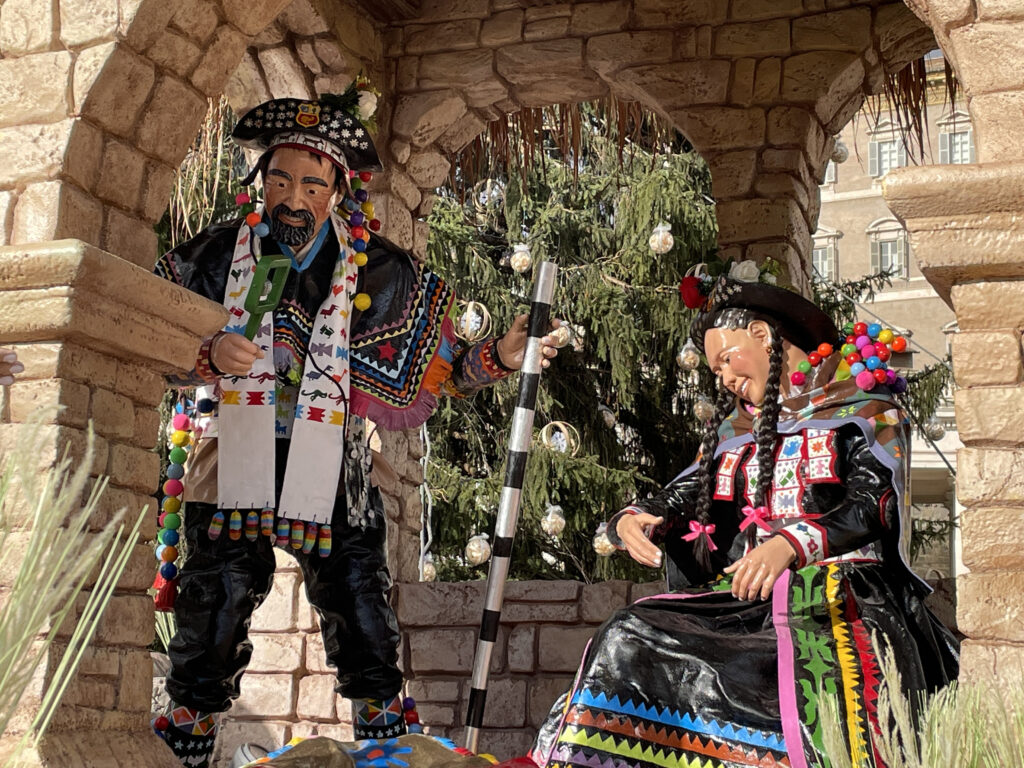
Statues of Joseph and Mary are pictured in the Nativity scene in St. Peter’s Square during a preview for journalists at the Vatican Dec. 9, 2021. The Nativity is from Peru’s Huancavelica region and will be unveiled to the public Dec. 10 during a Christmas tree lighting ceremony. (CNS photo/Junno Arocho Esteves)

The 2021 Vatican Nativity set depicts the familiar figures of the Holy Family in traditional Peruvian attire, complete with Andean Chopcca clothes, local musical instruments, sacks of quinoa, corn and potatoes, all overseen by llamas and a condor. 

First and foremost, it’s important to note that the beloved scene, as we all recognize it, is itself an innovative inculturation, which did not exist for the first 1,000 years of Christianity before it was created by Saint Francis of Assisi in Greccio (which some people think is where the term “crèche” comes from). But of course, the friars in Assisi used Italians, not Jewish Israelites, to depict the characters, and surrounded them with local animals, not imported ones. They were adapting the scene in a creative way to provide theological insight and spiritual benefit to those who were excluded, mostly due to their illiteracy, from connecting with the narrative on a deeper level. There is, in fact, no biblical text that has the shepherds (mentioned only in Luke) and the Magi (mentioned only in Matthew) together anywhere at any time.  And so the scenes that we see around the world are really always conflations of a plurality of narratives about Christ’s birth. 

I love the Nativity scene maybe more than any other religious iconography, but it’s important to be honest about its origins, depictions and assumptions. Artists like Raphael, Gozzoli, Bruegel and Rembrandt offer powerful and profound images of Bethlehem that have touched generations, but which are no more “historically accurate” than a local and indigenous one from any other place or context.

Which brings us back to the Vatican’s decision to highlight a Peruvian artistic interpretation of the Birth narrative. I have been working very closely with the Universidad Antonio Ruiz de Montoya, a Jesuit university in Lima, on a number of initiatives recently, which has led me to a greater appreciation of the contributions that Peruvians have made to the universal Church, and for which they are rightly being recognized in Rome, where so many around the globe turn their attention to the festivities at this time of year.

Chief among these contributions is that of the lay woman Isabel Flores de Oliva, better known as Saint Rose of Lima, the first native-born inhabitant of the Americas to be canonized. Her commitment to the poor and ascetic life have inspired veneration on both sides of the Atlantic and equator for 400 years. She is without a doubt the most famous Peruvian Catholic, and her image is featured on the country’s highest unit of currency, the 200 nuevo sol note.

Another Peruvian hero is Saint Martin de Porres, the son of a Spanish aristocrat and a freed Panamanian slave, whose parents never married. Given his status as a mixed race/Afro-indigenous child born out of wedlock, his social mobility was significantly limited in the 17th century. Based on his race and status, he was barred entry to full membership in the religious orders of the day, though his sanctity interestingly led the Church hierarchy to ignore the law and invite him to take vows as a Third Order Dominican, and so he joined the Order of Preachers as a lay brother. He dedicated his life to the infirmed and suffering, including recently arrived African slaves.

In more contemporary times, the Peruvian theologian Gustavo Gutierrez has influenced a generation of scholars as one of the padrinos (godfathers) of theologies of liberation. He has famously said that his entire corpus and life’s work is really “a love letter to God, to the Church and to the People to which I belong.” His vision of arguing that Christ and his Body the Church are not indifferent to the struggles of the poor and those whom society has deemed expendable was foreshadowed in the Pact of the Catacombs, when 42 bishops, mostly from Latin America, met in the Catacombs of Domitilla and pledged to renounce preferential treatment, extreme wealth and ostentation and “to live according to the ordinary manner of our people, regarding habitation, food, means of transport and all which springs from this.” It is undeniable that Pope Francis’ longing for “a poor Church for the poor” and critiques of clericalist excesses stem from the influences of the Pact, of the Argentine “Theology of the People” and of Gutierrez himself.

It is clear that such Peruvian heroes have much to teach us about how to live more devout and authentic Christian lives, and their culture’s representation in Piazza San Pietro can provide one possible aid in meditating more intentionally upon these realities in this holiday season.

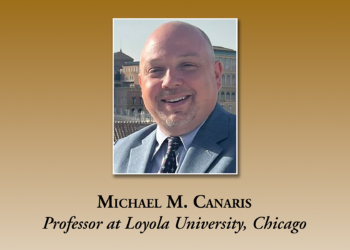
Originally from Collingswood, Michael M. Canaris, Ph.D., teaches at Loyola University, Chicago.
Previous Post

A time to reflect on God’s love for us

Next Post

Interconnectedness of faith, science key to protecting the planet

Related Posts

Columns

When the Spirit sends forth witnesses

May 23, 2026
Columns

Pope Leo positioning the Church for an AI revolution

May 21, 2026
Columns

The Ascension, like death, not a departure, but a lifting

May 21, 2026
Columns

Stuck in a tight spot? Ask Mom, the intercessor

May 18, 2026
Facebook Twitter Instagram LinkedIn Youtube RSS

No Result
View All Result

Latest News

Father Edward Heintzelman, longtime pastor in Mays Landing, dies

Bishop Williams urges Knights of Columbus: Be confident evangelizers

New Jerseyans urged to push for nonpublic school security funding

Faithful gather for spiritual renewal ahead of Pentecost

Father Naticchione celebrates first Mass in Ventnor

Latest Videos

View Ordination of Nickolas B. Naticchione in Cathedral

The legacy of Pope Francis

Pope Leo’s first Easter message

See livestream of Bishop Williams celebrating annual Chrism Mass

Pope Leo XIV’s first Palm Sunday

Around the Diocese

  • The Diocese of Camden
  • Talking Catholic Podcast
  • Catholic Charities
  • Advertise
  • Catholic Cemeteries
  • VITALity Healthcare Services
  • Housing Services
  • Camden Deacon
  • Camden Priest
  • South Jersey Catholic Schools
  • Man Up South Jersey
  • Catholic Business Network

Additional Resources

  • New Jersey Independent Victim Compensation Fund
  • Quick Guide to Reporting Sexual Abuse
  • List of Credibly Accused Priests and Parish Resources
  • Bishop’s Commission Report on Catholic Schools

Reorganization of the Diocese

  • Chapter 11 Claims filing info
  • Chapter 11 Prime Clerk Filing

© All Rights Reserved | May 23, 2026 | Catholic Star Herald of the Diocese of Camden

En español/Sa Tagalog

Add the Catholic Star Herald to your home screen

For Android users(Chrome) tap the at the top right vertical 3 dots then tap “Add to Home Screen”

For iPhone tap:at the bottom and then tap “Add to Home Screen”

  • This field is for validation purposes and should be left unchanged.

If you need assistance with submitting your subscription, please call Neal Cullen at 856-583-6139, or email Neal.Cullen@camdendiocese.org

No Result
View All Result
  • News
    • From Bishop Williams
    • Parish Life
    • Diocesan News
    • Sports
    • Columns
      • From Bishop Sullivan
    • Obituaries
    • World/Nation
  • Catholic Schools
  • Español
  • Features
    • Special Supplements
      • Thank You Bishop Sullivan
      • Welcome Bishop Williams
      • Jubilarians
    • Entertainment
      • Movie Reviews
    • Photo Galleries
    • Talking Catholic
    • Latest Videos
    • Health and Wellness
  • Advertise
  • More
    • Classified
    • Subscribe
    • Contact Us

© All Rights Reserved | May 23, 2026 | Catholic Star Herald of the Diocese of Camden