





The history of each of the world’s cardinals taking on a limited but real protectorate role for an individual church in Rome stems originally from private donations or the capability of “house churches” to serve as sites for sacramental life to be celebrated, both of which usually involved prominent or wealthy leaders in the early Christian community. Today the longstanding tradition has been modernized with the tituli being one of the chief honors a prelate receives when being called to serve the universal church and the pope personally as a cardinal.
On Sunday, April 23, I traveled to the Roman peripheries on the very last stop of the local subway to attend the ceremony where recently named Cardinal Robert McElroy formally took “possession” of his titular church, San Frumenzio ai Prati Fiscali. Cardinal McElroy is, at this point, a national or perhaps international figure of significance. He is closely aligned with Pope Francis’ agenda, re-imagining pastoral theology in our day, foregrounding migration as a topic the Church should care deeply about, and cultivating an approach to synodality across all levels of the Church.
If one explores the documents on the Diocese of Camden’s website for synod resources (camdendiocese.org/synodresources) – particularly the most recent reports from the continental stage at the top of the page – we can see the concerns that Cardinal McElroy prioritizes in his writings and presentations involve intentional listening to people in parishes and settings exactly like those in South Jersey and elsewhere. His ongoing call is for all of us to participate more actively in this process. That is particularly pertinent and important for a community as diverse as the Diocese of Camden, since more than one in five residents in New Jersey are foreign-born, among the highest percentages in the country, along with California, New York and Florida.
The semi-circular parish church that McElroy was granted honorary membership in is a relatively modern one, being raised to the rank of a cardinalatial title in 1988 by Pope John Paul II. It’s dedicated to Frumenzio, the first bishop of Axum in Ethiopia and the founder of Abyssinian Christianity, who is also known as Aba Salama (the “Father of Peace”). Tradition holds that he had been consecrated a bishop by Saint Athanasius of Alexandria, a great defender of the homoousion formulation of the creed, which we still profess (usually translated as “consubstantial” in English, or “della stessa sostanza” in Italian).
Reflecting in two languages on the Gospel where the disciples on the Road to Emmaus recognize the stranger among them as Jesus Christ, newly risen from the dead, Cardinal McElroy said he came to the parish as a stranger on one level, but on another as a brother sharing in the same faith. He said he hopes to begin with this Roman community a new relationship of encounter and grace.
He closed by calling himself “a new parishioner” there and recounted his recent visit to Tyre in Lebanon where Frumenzio was born, making clear he prayed at the shrine there for the people of the Ethiopian church the saint once led, as well as for the active Roman parish known for its social ministries for children, older adults, and the area’s many prostitutes and sex trade workers, who are often the victims of physical and psychological abuse. Cardinal McElroy claimed “As a stranger no more in this place, I happily call [local priest] Fr. Marco my pastor and San Frumenzio my home.”
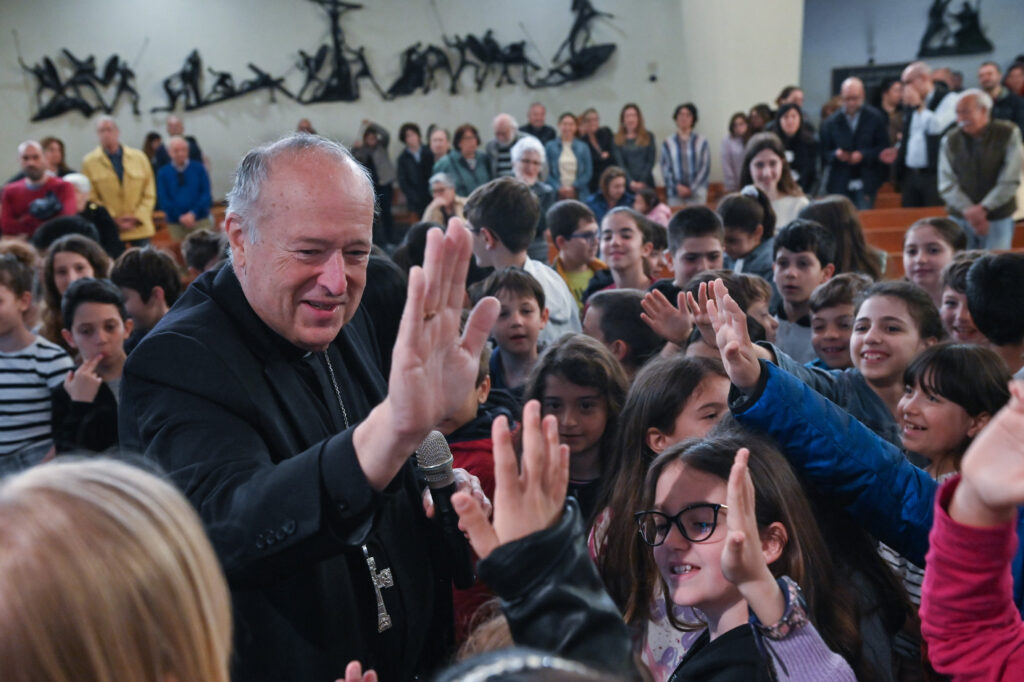
After speaking at the normal family Mass that preceded the more formal event, the cardinal playfully high-fived a number of the Italian children. The choir sang familiar and popular Italian hymns, accompanied by guitars and bongo drums. The overall sense of welcome, solidarity and understated cheerfulness felt tangibly different from other similar solemn ceremonies honoring prelate dignitaries.
The humble missionary ambiance of the cardinal’s vision of a Church “on the move” was alive and well thousands of miles away from the United States in Monte Sacro, the “Holy Mountain” where Romans have been offering prayers since pre-Christian times. Here’s hoping the newest iterations of them raised on high in song, word, and silence there continue to enliven the universal Church, including our ongoing expression of it in New Jersey, in lasting and substantial ways.
Originally from Collingswood, Michael M. Canaris, Ph.D., teaches at Loyola University, Chicago.



 at the bottom and then tap “Add to Home Screen”
