




Peace in the Risen Lord who is Mercy. On the Third Sunday of Easter, the Church proclaims a Gospel passage that is a favorite of many – the Walk to Emmaus (Lk 24:13-35).
On the way to Emmaus, two of Jesus’ disciples (not of the Twelve) were conversing and debating about Jesus’ death, burial and, unexpectedly, the empty tomb. They were also incredulous, not believing the women’s account of the angels and their message about the resurrection. The two were downcast and confused; their hopes were dashed.
Then, suddenly, Jesus appeared to them and began walking with them and listened to them.
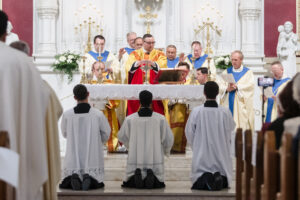
After rebuking their incredulity, Jesus proceeded to celebrate the Eucharist with them – the first time after the Last Supper. Jesus explained Scripture (the Old Testament) to them and how this referred to him. As Jesus spoke, the disciples’ “hearts were burning” within them. Then, at table, Jesus “took bread, said the blessing, broke it and gave it to them.”
Luke continues, “With that their eyes were opened and they recognized him. …
”This Gospel account is also a description of the Eucharist that we celebrate to this day – the Liturgy of the Word proclaimed, listened to, and prayed, and the Liturgy of the Eucharist: bread blessed, broken and shared with those present and with others – the sick, the homebound, the incarcerated, and those in rehabilitation.
The Eucharist is central to our faith journey. As Bishop Sullivan said, “The communal celebration of the Mass is vital to the spiritual well-being of Catholics. … The Mass has sustained generations of Catholics through war and famine. …” Bishop Sullivan went on to comment: “It takes an extreme situation like the one we face now” to bring about the suspension of all public celebrations of Mass. This absence recalls a more extreme situation: the outlawing of Mass and practice of the Catholic faith. This occurred several times in church history: in Imperial Rome, England, Ireland, Japan, Korea and Mexico among others. All Catholics suffered and some were martyred; yet the Faithful continued to practice and hand on the faith.
During this extraordinary time, all (clergy and laity) are despondent and even upset like the two disciples. However, Jesus continues to walk with us. He listens to us and is teaching and strengthening us. May the absence of the Eucharist and the sacraments create in us a greater hunger for them. May our suffering lead not to a loss of faith, but to a strengthening of faith: “In this you rejoice, although now for a little while you may have to suffer through various trials, so that the genuineness of your faith, more precious than gold that is perishable even though tested by fire, may prove to be for praise, glory, and honor at the revelation of Jesus Christ” (1 Pt 1:6-7).
Father Matthew R. Weber is pastor of Holy Cross Parish, Bridgeton.



 at the bottom and then tap “Add to Home Screen”
