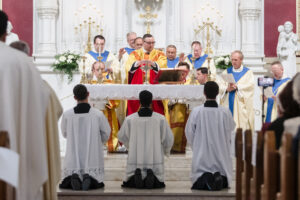






During his homily at the Chrism Mass last April, Bishop Dennis Sullivan spoke about some of the issues facing our local Church that weigh heavily on his heart. The second one he addressed caught my attention, when he mentioned “the increasing numbers of Latino immigrants into our Diocese and, unfortunately, the lack of priests and deacons who can effectively minister to them.” Listening to his homily, I felt like he was addressing me directly, for he had strongly and persistently encouraged me over the previous year to begin preparing myself for potential ministry in a bilingual parish. I had been dragging my feet in trying to find a language school for the summer, but his words resonated, so I began planning more seriously.
As I was investigating language schools, another phrase of Bishop Sullivan’s came to my mind: “Michael, the Church in the United States needs priests concerned with the poor. Form priests for the poor.” In almost every correspondence of his during my four years working at the seminary in Rome, he has reminded me of the Church’s preferential option for the poor. In my work with seminarians as a formation advisor, I have heeded his advice and tried to challenge them to make sure the poor are part of their consideration when thinking about pastoral assignments, especially during the summer that they are required to remain in Europe.
Aware that I, too, would need to spend the majority of the upcoming summer in Europe to work on my Spanish language skills, I recognized that it would be hypocritical of me to encourage seminarians to do things I myself was unwilling to do. Bishop Sullivan’s Chrism Mass homily and his notes to me made clear that the only way I could truly prepare to effectively minister in another language was to spend the month abroad being a priest among the poor. I must admit, I did not approach this summer away from home with the best disposition, but the Lord worked in me nonetheless.
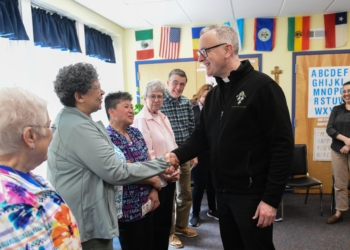
For my first two weeks in Spain, I lived and worked at a residence run by the Missionaries of Charity. This residence had one part dedicated to elderly homeless men and another dedicated to men suffering from HIV/AIDS. I worked in the latter. Those weeks were so very good for me both as a man and as a priest. When one volunteers with Mother Teresa’s Sisters, you do whatever is asked. For me, that included a lot of menial tasks like sweeping and mopping the same floors each morning, hanging laundry to dry multiple times each day and helping the men who needed assistance at mealtimes. All the while, each day provided opportunities to speak with both the men and the volunteers. As the days went on, the men grew more comfortable with the priest living among them. I began to learn about them, their families and their histories. I knew which men liked to go for a walk in their wheelchairs along the river each morning and which men would be up for a game of dominoes prior to dinner. As they grew to trust me, I benefitted even more from the experience.
A particular grace from my time with the Missionaries of Charity concerned one of the homeless men who had terminal cancer. The Superior told me her daily prayer was that he would return to the sacraments because he did not have much time left to live, but was unwilling to admit it. After he returned from a couple of days in the hospital, I was surprised the following afternoon to find him sitting outside my door waiting for me to finish lunch in order to talk and to go to Confession. Sister’s prayers were answered! A few hours later, I got called to his bed as he had a major setback. After speaking with him, I turned around to see a handful of the sisters in the room with us, one holding a stole, one holding the oil of the sick and another with the ritual book for the Sacrament of the Sick. Immediately, I anointed him, said the Apostolic Pardon and off he returned to the hospital where he would die a short time later. What a grace!
Upon the conclusion of my two weeks with the Missionaries of Charity, I prepared myself for my next experience in Spain. I spent those two weeks living in one of the houses of the Cenacolo Community, a residence for men (or women) recovering from addictions (www.hopereborn.org). In this community, the residents do not pay anything, but commit themselves to a unique type of recovery program centered around prayer, work and friendship. They live without cell phones, computers or television. I even had to hand over my watch during my weeks with them! Instead, these men pray and work hard. And so did I! I was assigned to the team taking care of the garden. Each morning, after spending an hour or so carrying buckets of water down to the garden to water the plants, we would spend the subsequent work hours in the hot Spanish sun digging ditches for a new garden and digging around the stump of an old olive tree that we needed to remove. I never sweat so much in my life!
After a couple of days living and working among these men, they began to trust me and would come to share their stories of addiction, recovery and conversion to the Lord. They would approach me to ask for advice, for the chance to go to Confession or simply to share, an important part of their recovery. Having been with them in the chapel or at meals, I felt like I knew them before I knew anything of their history. Their background did not seem to matter so much to me. Don’t we all have our own histories that include things for which we are not proud? I know I do.
The youngest man in the community, only 22 but so wise, challenged me the most. We were all playing soccer one Sunday (they do not work on the Sabbath). It was probably the first time I had played soccer in 25 years! After getting fouled, I had the opportunity to make a free kick. I told this young man, the captain, that he should take the kick for me since I was really not very good. He looked at me and said, “Remember, all of us are here to lose our fears. You kick the ball.” I will admit that it was a failure of a kick, but his words stayed in my mind. How often do I let fears control me?
On my final day with the community, the foundress, Mother Elvira Petrozzi, died. We had just started working. While carrying two buckets of water to the garden, the bell rang; I put them down and gathered with the men as we were informed of her passing. Immediately, we began praying the Glorious Mysteries of the Rosary. Walking the campus with these men, I watched them wipe tears from their eyes as we prayed. Very few of them had ever met Mother Elvira, but each of them would say that she had saved their life. We returned to our normal schedule after the Rosary, but that evening, I was privileged to celebrate Mass with the men. Not only with them, but some former members of the community who lived nearby with their wives and children as well. Another tremendous grace for me before returning to Rome.
Both communities this summer shared three things in common: tremendous devotion to Jesus in the Most Blessed Sacrament, with daily time in Adoration; love for the Blessed Virgin Mary, who always draws us to her Son (I prayed the Rosary daily with the men living with the Missionaries of Charity and three times a day with the men of the Cenacolo Community); and dependence on Divine Providence, relying on the generosity of others for food, clothing, supplies, sustenance, etc. These three things can be truly inspiring and life-changing.
Working closely with Bishop Sullivan for five years, I witnessed his fatherly care and pastoral concern for the priests and the people of our Diocese. He knows us because he is everywhere! At the same time, he possesses a tremendous ability to recognize the needs of a parish and to consider which priest could best suit those needs. Oftentimes, these insights catch us off guard. However, I saw how well those assignments worked out when approached with humility and obedience.
As he asked me to open myself to improving my Spanish language skills for a potential future assignment in a bilingual community in our Diocese, my initial reaction was not one of humility or obedience. I ignored what I knew to be true for the other priests of Camden and focused instead on my own desires and my lack of confidence in learning another language. His Chrism Mass homily pushed me to trust his discernment of what would be best for me.
Spending the summer in communities founded by Mother Teresa and Mother Elvira certainly did not make me fluent in Spanish, but it opened my mind and heart in ways that I could not have anticipated. I am confident that I am a better priest because of it, too. I look forward to sharing my experience with the seminarians over the coming months and know that I can now credibly challenge them to work with those on the peripheries of society as well, as they have much to teach us.
On my end, as I continue to prepare myself for parish ministry in our Diocese, this summer abroad will force me to regularly ask myself:
• How much do I allow people’s external appearances to affect the way I view them?
• Do I try to get to know people rather than judgmentally acting on what I think I know about them and their pasts?
• How quickly do I speak when I am with people whose first language is not English?
• How patient and helpful am I with someone trying to speak English whose vocabulary and grammar are still quite elementary?
• When do I allow my own desires to stand in the way of living a life of humility and obedience?
• In what ways do I allow my fears to prevent me from living in true freedom?
Father Michael Romano is director of admissions for the Pontifical North American College in Rome and former vocations director for the Diocese of Camden.




 at the bottom and then tap “Add to Home Screen”
