



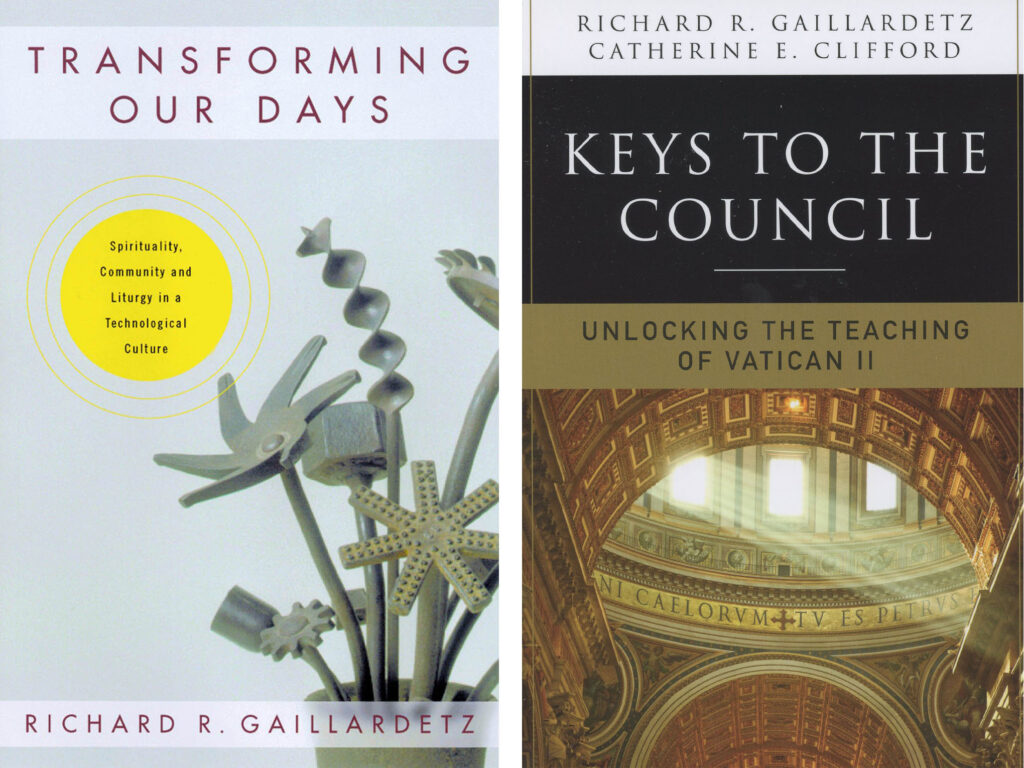
The world of Catholic ecclesiology lost a towering figure recently as Richard R. Gaillardetz passed away from pancreatic cancer Nov. 7. Born in 1958, he was one of the most important American post-Vatican II voices on questions of authority, ecumenism, the interpretation of doctrine and the exercise of the magisterium in the Catholic Church. A semester rarely passes when I don’t use one of his 13 books or countless articles and essays in my classes.
After studying at the University of Texas, St. Mary’s University in San Antonio, and the University of Notre Dame, Gaillardetz had a varied career teaching at a number of different kinds of institutions: the University of St. Thomas Graduate School in Houston, housed on the grounds of St. Mary’s seminary where he was able to teach both ordained and lay students; the University of Toledo, a secular university with an endowed chair of Catholic Studies; and Boston College, a Jesuit university housing one of the preeminent Catholic theological faculties in the world. He served a long term as chair of that reputable department and was one of its most prominent faces until his relatively recent diagnosis less than two years ago.
I was blessed to have his support over the course of my own career trajectory, as our passions intersected in many ways. Rick and I exchanged a very meaningful series of emails in the last days of his life, a memory that I will always treasure (along with a few epic meals in Rome and elsewhere, where we discussed Church history and the papacy for hours over red wine).
Among his most widely read books are: “An Unfinished Council, When the Magisterium Intervenes,” “The Church in the Making” and “By What Authority?” I am using “A Church With Open Doors” this semester in my graduate course. It’s a collection of essays edited with Professor Edward Hahnenberg of John Carroll University, Ohio, about what ecclesiology might look like in the third millennium of Christianity, as it faces new demographic and cultural challenges.
Two of the most profound of Gaillardetz’s publications are “Ecclesiology for a Global Church” and “A Daring Promise.” The first deals with the seismic shifts unfolding in contemporary Catholicism as the global south (what some scholars call “the majority world”) rightly takes its place as at least a complementary epicenter to current Catholic life, alongside the corridor between Europe and North America. The second explores the spiritual contours involved when one takes the “leap of faith” into the sacrament of matrimony, and its implications on a shared adventure of a life lived in communion and partnership. Both are stellar examples of his comprehensive fluency with the tradition, lithe theological mind, and ability to write with clarity, acumen and penetrating insight.
As a former president of the Catholic Theological Society of America and representative of the United States Conference of Catholic Bishops in official Roman Catholic-United Methodist ecumenical dialogue, his work was recognized by his peers, and those with responsibility for Church governance, as indispensable and influential. In a widely disseminated lecture he offered in Rome in the closing months of his life, he somewhat pointedly called the academic theological community to task for being too quick to criticize the Church, without ever eviscerating the need to serve as both prophets to the world and to the hierarchy at times. But his deep and enduring love for the people of God continued to color nearly every piece he wrote or talk he gave.
His work is not perfect, which he plainly understood. He was too conversant with hermeneutical perspectives to argue that his or any other perspective somehow prevails over the limited horizon by which any viewpoint is conditioned. Each theologian speaks out of a given context, moment and formative lens. Such particularity needs to be refined and improved by encountering those with radically different frameworks. Rick’s ecclesiological vision made this point repeatedly, as he strove to make sure diverse voices intersected with his own, redounding to the betterment of the whole Church.
He will be sorely missed, but I am convinced that his contributions will continue to ripple outward for generations to come, as people draw nourishment and a grasp not of “what” to think, but of “how” to think, from the legacy that he so dutiful crafted and the gauntlet that he laid at our collective feet to pour out our lives in service of the Church and in the commitment to integrating the quest for understanding with a faith that does justice.
Among the most lasting of these testimonies will be the public spiritual reflections that he offered through his final stages of suffering as the veil that separates the earthly from the heavenly thinned, which are available on his personal Caring Bridge website, and which ought, in my opinion, to be formally published, or at least widely disseminated.
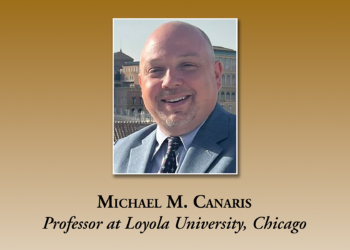
An alumnus of Camden Catholic High School, Cherry Hill, Michael M. Canaris, Ph.D., teaches at Loyola University, Chicago.



 at the bottom and then tap “Add to Home Screen”
