






The arresting images of Pope Francis standing alone in the rain in a desolated Piazza San Pietro will undoubtedly be one of the lasting, haunting symbols of this pandemic, and likely of his pontificate. In offering a blessing urbi et orbi, “to the city and to the world,” the Holy Father prayed as universal shepherd of the Christian flock, and stood in solidarity with all the suffering and first responders of every nation and creed across the globe. In response, I have asked my students (in our online classes) to read chapters 34 and 35 of what is widely reported to be the Pope’s favorite novel, Alessandro Manzoni’s “I Promessi Sposi,” usually translated into English as “The Betrothed.” If you are looking to pass a half hour while in confinement, I encourage you to explore it, available for free in English online.
Manzoni’s work is one of the two most enduring classics of Italian literature, alongside Dante’s “Divine Comedy.” Virtually every Italian has read at least sections of it in school, where its influence is almost on par with something akin to the American Declaration of Independence or our familiarity with Mark Twain. It obviously has global reach, as the Argentine pope was so moved by it in his Latin American youth that he has encouraged every engaged couple to read it in their pre-Cana formation.
In the section I have focused on with my students, Manzoni has the protagonists Renzo and Lucia in the lazaretto, where those suffering the 1629-31 Great Plague of Milan received the meager medical or palliative treatments of the day. Our times are not the first to see Lombardy absolutely devastated by pestilence. In the midst of such tremendous pain and grief, Renzo inspiringly forgives the treacherous Don Rodrigo as he lays infirmed and unconscious, despite the seemingly unending misery that he has caused the couple in the preceding chapters. His thirst for vengeance is somehow slaked when he brings himself to offer pardon and comfort to the man he most loathes.
There is a current of Franciscan spirituality that flows through the text, as it does through the initiatives and writings of our current Jesuit pope. Bergoglio chose the name Francis not only because of his compassion for the world’s poor, but also because of the local connection to his Roman flock where the saint from Assisi inspires Italy in much the same way Patrick does for Ireland or Rose for Lima.
In the text Father Felix implores Renzo in prayer: “Let us remember those who have gone forth to the grave. Let us look at the thousands who remain here, uncertain of their destiny; Let us also look at ourselves! … That we may be deeply sensible that life is his gift, that we may value it accordingly, and employ it in works which he will approve? That the remembrance of our sufferings may render us compassionate, and actively benevolent to others. … Let us begin from this moment, from the first step we shall take into the world, a life of charity! Let those who have regained their former strength, lend a fraternal arm to the feeble; Let the young sustain the old; Let those who are left without children become parents to the orphan, and thus your sorrows will be softened, and your lives will be acceptable to God!”
If Saint Francis was willing to embrace not only Lady Poverty, but also Sister Death, perhaps we in the midst of this moment can reframe some of our thinking away from the “silent enemy stalking us” to realize the natural cycles of life and death, and to interrogate our consciences around the manipulation and violence that we inflict upon the lungs, heartlands, and face of the globe. It is not entirely unanticipated that the natural world would re-exert its sovereignty, as it has repeatedly since the time of the dinosaurs. Our ultimate impotence to subdue the cosmos and to reign over physical life are once more in the fore of our global consciousness. Let us not waste the opportunity to return to God and learn spiritual lessons of lasting import from the experience.
If we cannot bring ourselves yet to love “Sister Virus,” we ought at the very least to realize that our petty differences and limited egoistical horizons are not the ultimate arbiters of life and death. We exist in radical dependency in the face of Mystery, both natural and supernatural.
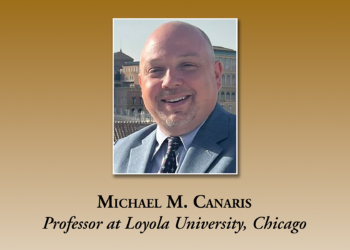
Originally from Collingswood, Michael M. Canaris, Ph.D., teaches at Loyola University, Chicago.



 at the bottom and then tap “Add to Home Screen”
