





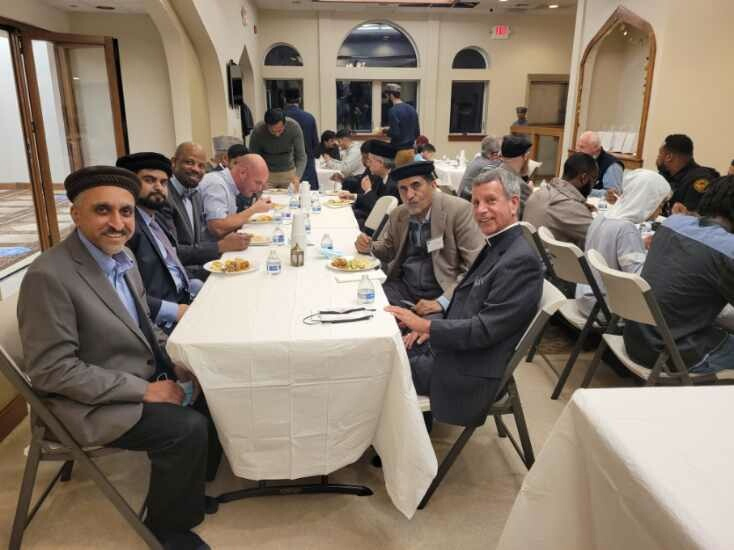
Earlier this month, I was invited to be one of the guest speakers at an Interfaith Iftar gathering at the Ahmadiyya Muslim Community’s Al-Nasr Mosque in Willingboro. Ramadan is a month of prayer, fasting and almsgiving. Iftar dinners celebrate the breaking of the fast, which lasts from sunrise to sunset during Ramadan. Many mosques invite non-Muslims to join them for the breaking of the fast.
The event was one that called together a number of speakers from the wider community, including Rabbi Ben David, senior rabbi at Congregation Adath Emanu-El in Mount Laurel; Rep. Andy Kim and other religious and civic local leaders. We were asked to speak on the subject “Justice through Compassion.” Most of the religious speakers made note that in a rather rare confluence of holidays, Passover, Easter and Ramadan fall around the same time this year. The last time this occurred would have been more than 30 years ago.
All three of the great monotheistic faiths look to the moon for the setting of our holidays at times. While Jewish and Muslim calendars are based upon the movements of the moon, Christian calendars primarily rely on the movements of the sun. Muslims fit 12 months in 354 days, unlike the Christian or Gregorian calendar, which also has 12 months but 365 days in a year. Therefore, the Islamic cycle of holidays moves across the Gregorian calendar over the course of a good three decades. The Islamic calendar makes no attempt to harmonize with the solar calendar. Therefore, Islamic holidays can and do appear in all different seasons from year to year. The Islamic calendar is purely a lunar calendar and is highly effective at beginning each month with a new moon. Therefore, both Jews and Muslims with their lunar calendars share an appreciation of the cycles of the moon. For Jews and Muslims, looking at the moon is like looking at a calendar – if it is the full moon, it is always the 15th of the month.
The Jewish holiday of Passover and the Easter date for most Western Christian Churches always occur quite close together, sometime early in the spring. However, they do not always fall on the same days each year. This year, Passover began April 15, Good Friday, and the Christian Holy Week, which began April 10 on Palm Sunday climaxed from Holy Thursday evening on April 14 to Easter Sunday.
The difference is because the Gregorian calendar dates Easter Sunday, since the year 325 AD at the great Council of Nicaea, to the first Sunday following the Vernal Equinox. Jews fix Passover on their calendar, which can fall on any day of the week. Jewish calendars are strictly lunisolar, and the Christian calendar is solar and makes no attempt to harmonize with the lunar calendar. Hebrew months always begin with the new moon, and their holidays always occur in a prescribed season. Passover is always in the spring, Rosh Hashana always in the fall and Hanukkah is always in the winter. Both Jews and Christians fix their calendars from both the lunar and solar movements to fall in prescribed seasons. In the winter, while Christians celebrate Christmas, Jews celebrate Hanukkah. In the spring, when Christians celebrate Easter, Jews celebrate Passover.
Given this rare confluence of holidays this year, many of the speakers at the mosque made note – including myself – of how these holidays have some overlapping themes. Certainly for Christians and Muslims, the overlapping of Lent and Ramadan speak of two penitential seasons, which share the themes of prayer, fasting and almsgiving. Jews and Christians share the themes of moving by God’s grace from slavery in Egypt for the Jew and slavery to sin for the Christian to the freedom of the promised land for the Jew to the promise of a restored Paradise through the Resurrection of Jesus Christ.
May these overlapping holidays remind us of the patrimony that we share as spiritual sons and daughters of Abraham, called to respect one another, and to look for the similarities rather than the differences of our celebrations of God’s love for us all. Let us pray for peace in our world. Peace in Ukraine, and peace among Jews and Muslims in the Holy Land of Israel. Chag Pesach sameach, Happy Passover, Ramadan Mubarak, Blessed Ramadan, Happy and Blessed Easter!
Father Joseph D. Wallace is diocesan director of Ecumenical and Inter-religious Affairs and pastor of Christ the Redeemer Parish, Atco.



 at the bottom and then tap “Add to Home Screen”
