




Easter is the most important date for Christians throughout the world. However, Christians in the East and West celebrate Easter using different calendars and thus have separate ways of calculating what day it should fall on.
In the year 325 AD, the undivided Church met in Nicea to discuss some very weighty issues facing the institution, which included a common date for Easter. Prior to the Council of Nicea, churches around the world celebrated Easter at various times contingent on the local bishop’s adherence to one of many forms of calculating the date for Easter. It was at the Council of Nicea that the Church fathers decided to establish one date for its celebration throughout the Christian world. They decreed that Easter would fall on the first Sunday that occurs after the vernal equinox, but always after the Jewish Passover.
To avoid confusion over the date, the vernal equinox was established as March 21. This was their attempt to guarantee that all churches would celebrate Easter together on the same day. The vernal equinox, colloquially now known as the First Day of Spring, is an annual solar event that occurs in late March as the sun crosses the celestial equator going north. They decided that it would fall after the Passover to preserve the sequence of the saving acts of God in Jesus Christ.
The Great Schism of 1054, which divided the Churches of East and West, ultimately disrupted the unified date for celebrating Easter. However, though they were divided by Church leadership, both Roman Catholic and Eastern Orthodox churches still held to the calculation of Nicea. Though, over time, the Roman Catholic Church no longer felt the need to celebrate Easter after Passover.
The Roman Catholic Church formulated a new calendar, known as the Gregorian calendar, in 1582 AD, while the Orthodox Church kept the Julian calendar. The Orthodox Church still adheres to the original calendar system of the Julian calendar, where the vernal equinox now falls on April 3.
With a hope of remedying this confusion and maybe someday the very schism, last week, the Ecumenical Patriarch of Constantinople, the head of the Eastern Orthodox Church, Bartholomew I, expressed his desire that Christians in the East and West begin celebrating Easter on a “unified date.” He said, “It is a scandal to celebrate separately the unique event of the one resurrection of the one Lord.”
The Ecumenical Patriarch made his comments during a homily March 31, the day the West celebrated Easter.
Noting that in 2025, both the Roman Catholic and Eastern Orthodox Easters will align on April 20, he added, “We beseech the Lord of Glory that the forthcoming Easter celebration next year will not merely be a fortuitous occurrence but rather the beginning of a unified date for its observance by both Eastern and Western Christianity.”
He also commented that next year, Christians will be celebrating the 1,700 anniversary of the First Council of Nicea. “Among (the Council of Nicea’s) pivotal discussions was the matter of establishing a common time frame for the Easter festivities. We are optimistic, as there is goodwill and willingness on both sides” to find a common date.
Pope Francis has also shared his desire for a common date for Easter several times throughout his pontificate. Almost ten years ago, he said the two Churches “have to come to an agreement.” He has even joked that Christians could say to one another, “When did Christ rise from the dead? My Christ rose today, and yours next week!”
In recent years, he has said, “Let us have the courage to put an end to this division. … The sign we should give is: One Christ for all of us. Let us be courageous and search together: I am willing, yet not me, the Catholic Church is willing to follow what Saint Paul VI said. Agree and we will go where you say. I dare even to express a dream: That the separation with the beloved (Orthodox) Church, the longest in the history of the Church, can also be, please God, the first to be resolved.”
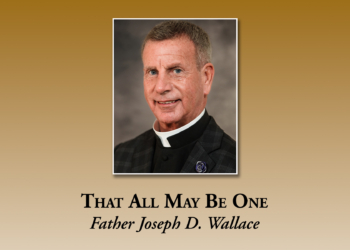
Father Joseph D. Wallace is diocesan director of Ecumenical and Inter-religious Affairs and pastor of Christ the Redeemer Parish, Atco.




 at the bottom and then tap “Add to Home Screen”
