




Fr. Rene Canales
The following story is the second in a series of Immigration Stories, in which Catholics from the Diocese of Camden share pieces of their journeys. This series is running in advance of two immigration-related events in the diocese: Bishop Dennis Sullivan will celebrate a Mass for Immigrant Families on May 3 at 7:30 p.m. at Divine Mercy Parish in Vineland, and May 5 has been designated “Justice for Immigrants Sunday” throughout the diocese. This Sunday will be observed with prayer and a postcard campaign to lawmakers in Washington, urging comprehensive immigration reform that provides a path to citizenship for our immigrant sisters and brothers.
Earlier this week, Father Rene Canales was telling me the story of how he came to the U.S. from El Salvador. “There’s a song about it,” he said.
It’s called “Tres Veces Mojado,” which literally means “Three Times Wet” — since crossing borders illegally often means swimming across rivers. The song tells the story of a Salvadoran immigrant who has to cross three borders dangerously in pursuit of economic opportunity. First to Guatemala, then Mexico, then the United States.
“It was a struggle to get through those countries. If you were seen, they would send you back,” Father Canales told me. “The journey is dangerous: many people die.”
Like so many of his Salvadoran friends and relatives, Father Canales’ immigration story includes harrowing travel far from home to support his family. His story is yet another reminder that our nation’s immigration system is in dire need of repair.
The youngest of six children, Rene Canales was born in La Unión, El Salvador, on Oct. 29, 1974. Tension and instability were rising in the country, as poverty and political repression moved El Salvador toward civil war. A military junta overthrew the nation’s president two weeks before Rene’s fifth birthday.
Just three years later, Rene’s father passed away. The war continued to rage. “There was nothing for us,” Father Canales said.
In 1991, when he was just 16 years old, Father Canales left El Salvador with a group from his area, determined to make it to the United States for an opportunity to support his mother. Escorted by a coyote — a smuggler who takes people across the U.S.-Mexico border — the group traveled by foot and bus, hiding from authorities as they moved toward the United States.
Finally, Father Canales and the group made it across the U.S. border into Arizona, and he traveled to Homestead, Fla., where he had friends. Without documents and unable to speak English, the only job option for Father Canales was to work in agriculture. He hoped to work for two years, save money, and then return to his family in El Salvador.
Father Canales picked cucumbers, squash and zucchini for hours a day, seven days a week, in the hot South Florida son. “One day, I asked for a raise,” he said. The farmer told him, “You ask me one more time, and I will call INS [Immigration and Naturalization Service] on you.”
“And that was the end of [the conversation],” Father Canales said.
The American Dream seemed backbreaking. “My first experience was not that this is a country of law and justice and opportunity for all,” he said. “There was work, work, work, work.”
In 1995, Father Canales decided to move to New Jersey, since he had cousins here. Because he had applied for political asylum as a refugee from El Salvador’s civil war — asylum he was never granted — Father Canales was given a Social Security number and temporary work authorization papers.
He worked in the kitchens at different casino restaurants in Atlantic City, washing pots and pans. When he wasn’t working, he was involved in the Latino Catholic community in Atlantic City. He had felt stirrings of a religious vocation since he was 7 years old, and in 1997 he applied to enter formation for the priesthood in the Diocese of Camden. He was accepted in 1998.
“My last day of work at the Trump Marina was Sept. 1, 1998. I started at St. Charles Borromeo Seminary in Philadelphia on Sept. 2,” he said, with a laugh.
As he moved through formation, Father Canales continued to struggle with the U.S. immigration system. He wasn’t granted political asylum, and because he was studying to be a priest, it was unclear if he needed a religious visa or an educational one. He was ultimately able to remain in the United States because Salvadorans were eligible for “temporary protected status,” due to the continuing political unrest in El Salvador. “I almost didn’t make it,” Father Canales said.
Finally, in 2011, after almost 20 years in the United States, he obtained a green card: permanent resident status. This meant he could safely travel home. He saw his mother for the first time in 11 years, and only the second time since he had first left home.
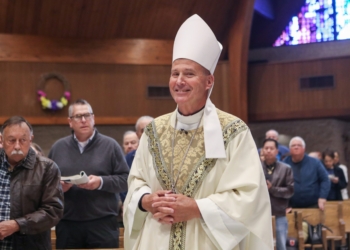
Today, Father Canales is a beloved spiritual leader, serving at St. Clare and St. Gabriel parishes in Gloucester and Salem counties.
“Father Rene has taught me what it means to evangelize with joy,” said Pam Tremblay, who works with Father Canales at St. Clare’s. “With his energetic and loving spirit, he welcomes all peoples and inspires them to live their faith joyfully.”
Father Canales celebrates the sacraments in Spanish and English, and helps immigrants navigate the system. He has also been involved with a group of priests, sisters, and laypeople in the diocese who have been urging members of Congress to enact just, comprehensive immigration reform.
“I see too much suffering. People shouldn’t be going through what I went through,” Father Canales said. “As we speak, people are suffering because of unjust laws and broken systems. [Our immigration system] needs to be fixed.
“I want to be the voice of people who cannot be heard because of their illegal status,” he continued. “I can speak up. They cannot.”






 at the bottom and then tap “Add to Home Screen”
