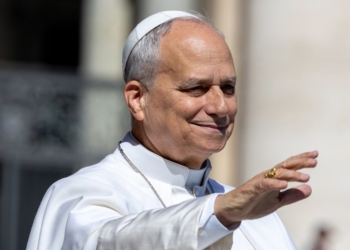





On May 9, Pope Francis officially inaugurated the calling of the Jubilee 2025 on the steps of Saint Peter’s Basilica by presenting a “bull of indiction,” which announces that the Holy Year will open at the Vatican on Dec. 24, 2024. For several months, the Dicastery for Evangelization has been working with four other commissions – namely pastoral, cultural, communications and ecumenical – as they have been busy planning the Jubilee events.
In an ancient ritual, Pope Francis presented his document, “Spes Non Confundit,” or “Hope Does Not Disappoint,” to the archpriests of the papal basilicas of Saint Peter, Saint Paul Outside the Walls and Saint Mary Major; the vicar of the archpriest of the Basilica of Saint John Lateran; and to top officials of the Dicasteries for Evangelization, the Eastern Churches and Bishops. He wrote, “The time has come for a new Jubilee when once more the Holy Door will be flung open to invite everyone to an intense experience of the love of God that awakens in hearts the sure hope of salvation in Christ.”
The papal bull proclaimed that Christians are called to “abound in hope” in order to be credible witnesses of God’s love. The pope wrote that they are called to be signs of hope by having children, welcoming migrants, visiting prisoners, working for peace, opposing the death penalty, helping young people find a job, pressure rich countries to forgive the dept of poor countries, pray for the souls in purgatory and to lobby to divert money from military spending to help feed the poor of the world. He added that “hope is born of love and based on the love springing from the pierced heart of Jesus upon the Cross.” In a world torn apart by war, divisions, environmental destruction and economic challenges, hope is needed in our world. “Christian hope does not deceive or disappoint because it is grounded in the certainty that nothing and no one may ever separate us from God’s love,” he said.
Registration for the Jubilee will open sometime in September and will be available in nine different languages. More than 32 million pilgrims are expected in Rome for the Jubilee. Three pilgrimage itineraries are proposed for the Jubilee: the traditional 15-mile pilgrimage of the seven churches of Rome; a pilgrimage dedicated to the women patrons and doctors of the Church; and a journey across the “European Union Churches.” This European piece will have a distinctive ecumenical aspect, as the Jubilee coincides with the 1700th anniversary of the Council of Nicaea (325AD), the first of the great Councils grappling with the issue of the full Divinity of Christ. This includes non-Catholic churches in Rome such as the National Church of Greece, San Teodoro, which was given to the Eastern Orthodox Patriarchate or the German Lutheran Church. These churches have an ecumenical dimension that preserves the memory of the great Council of Nicea, which dealt not only with the Divinity of Christ, but also set a formula for determining the date of Easter.
“The Council Fathers chose to begin that Creed by using for the first time the expression ‘We believe,’ as a sign that all the Churches were in communion and that all Christians professed the same faith,” the pope wrote in “Spes Non Confundit.”
Throughout his pontificate, Pope Francis has often spoke of the “ecumenism of martyrs” or the “ecumenism of blood,” which includes the martyrdom of all Christians killed for the profession of the faith, regardless of denomination. Last July, Pope Francis set up a new commission named “Commission of the New Martyrs – Witnesses of the Faith” where he called upon the Dicastery for the Causes of Saints to draw up a list of Christians killed for their faith since the year 2000.
Pope Francis wrote that “the Council of Nicea was a milestone in the Church’s history. The celebration of its anniversary invites Christians to join in a hymn of praise and thanksgiving to the Blessed Trinity and in particular to Jesus Christ, the Son of God, ‘consubstantial with the Father,’ who revealed to us that mystery of love.”
At the same time, the pope said, the Jubilee is a “summons to all Churches and Ecclesial Communities to persevere on the path to visible unity and in the quest of fitting ways to respond fully to the prayer of Jesus ‘that all may be one. As you, Father, are in me and I am in you, may they also be in us, so that the world may believe that you sent me.’”
Father Joseph D. Wallace is diocesan director of Ecumenical and Inter-religious Affairs and pastor of Christ the Redeemer Parish, Atco.




 at the bottom and then tap “Add to Home Screen”
