



“The highest honor that has ever been paid to a Colorado Catholic layman immediately following death has been given within the last week to a negress, Julia Greeley, an aged woman, who died in poverty in the Sacred Heart Parish, but who is declared by the Jesuit Fathers of that church to have been the most zealous apostle of the Sacred Heart they have ever known. And she died on the feast of the Sacred Heart. She has the distinction of being the only Catholic layman in the history of Denver whose dead body lay in state in a Catholic church.”
So begins the obituary of the Servant of God, Miss Julia Greely, about 80 years of age, written in June 1918.
In the United States, there are currently six African-American candidates for sainthood. Three of them have been designated “Servant of God,” which signifies that the initial stage of inquiry into the sanctity of the person has officially begun at the diocesan level. The other three candidates have been given the title “Venerable” by the Holy Father, which indicates that the cause for sainthood has been officially approved by the Holy See and accepted by the Sacred Congregation for the Causes of Saints in Rome.
Among the six, one is a priest (Ven. Augustus Tolton), three are religious sisters (Ven. Henriette Delille, Mary Elizabeth Lange, and Thea Bowman), and one is a layman (Ven. Pierre Toussaint). Julia Greeley is the only laywoman.
Born into slavery in Missouri around 1840, a slave overseer’s lash, which struck her mother, also grazed young Julia’s right eye, which permanently impaired her vision. Throughout her life, fluid oozed from the eye and was a constant annoyance to her. She was never without a handkerchief to daub it. But she never complained about it, never let it get in the way of the ministry of charity she would embrace. Love “does not brood over injury. It bears all things, endures all things” (1 Cor 13:5, 7).
For about a decade before emancipation, Julia labored as a cook and a nanny for a prominent family of Saint Louis. During that time, she was befriended by the sister of the mistress of the house, a widow with four children, who would later marry William Gilpin, the first governor of the Territory of Colorado. In the 1870s, Julia followed the Gilpins to Colorado and was employed in their household. It was through the influence of Mrs. Gilpin that Julia entered the Catholic Church and was baptized in 1880.
It did not take long for Julia to enter wholeheartedly into the sacramental and prayer life of the church, as well as into active ministry to the poor and needy. She became a daily communicant, a devotee of the Rosary, and an ardent supporter of devotion to the Sacred Heart of Jesus. She fasted almost every morning and said holy Communion was the only nourishment she needed. In 1901, she became an active member of the Secular Franciscan Order.
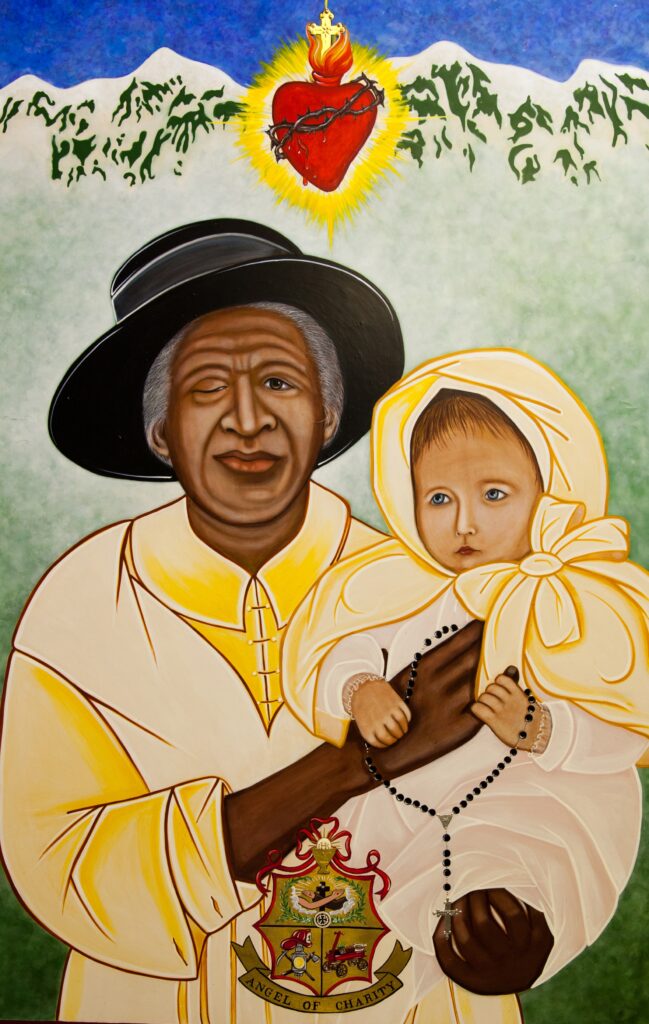
Julia had a special love for children and relished the opportunity to take care of them. In fact, the only surviving photograph of her is with a child, Marjorie, whom she is holding, with Julia’s precious Rosary in her little hands.
However, Julia is most renowned for her ministry as Denver’s “Angel of Charity.” With her floppy hat, handkerchief in hand, and red wagon full of goods she either bought herself with her meager earnings or begged for, Julia made her way through Denver’s back streets and alleys after nightfall to deliver goods to those in need. She did so not to embarrass the poor folks she helped out. Love “is not pompous. It is not inflated” (1 Cor 13:4).
She would rescue old dolls, clean them and fix them up for poor children. For older girls who did not have a proper dress to attend a social, she successfully solicited gently-used dresses from Denver’s wealthier citizens. Once she was even spotted carrying a mattress on her back for a family that had no bed! “Love is kind” (1 Cor 13:4).
In spite of her own poverty and physical limitations — she also suffered from arthritis in the legs —Julia was full of the joy that comes from serving others. “Love does not seek its own interests” (1 Cor 13:5). Her beautiful smile was a manifestation of the joy that filled her soul.
In 2016, Archbishop Samuel Aquila of Denver opened Julia Greeley’s cause for sainthood. Her body was exhumed, washed, dressed, and placed in a tomb in the Cathedral Basilica of the Immaculate Conception. Since then, 12,000 pages of testimony about her life and sanctity have been sealed and taken to Rome for further examination.
For further information, please log on to the Julia Greeley Guild.
So faith, hope, love remain, these three; but the greatest of these is love” (1 Cor 13:13).
Father Edward Kolla is parochial vicar at Christ the Good Shepherd Parish, Vineland.




 at the bottom and then tap “Add to Home Screen”
