



Archeologists have obviously unearthed many cultural and artistic artifacts that date back earlier than 1,700 years ago. A recent documentary piqued my interest in the Rudston Monument in England, as it claimed it has stood for 6,000 years; Göbleki Tepe in Turkey is much older, with some scientists believing the worship space can be dated to 11,000 years ago.
Some of these ancient sites no doubt paint the picture of what Saint Justin Martyr once argued were expressions of pre-Christian longing for, and experience of, transcendence and mysticism, each being what he called a “Seed of the Word” (Logos Spermatikos).
And yet, after the Incarnation experience, the early Church still had to learn through ongoing conversation, contemplation and often vehement disagreement about the ultimate significance of Jesus from Nazareth, who came to be called the Christ, and what meaning his ministry, Death and Resurrection had for the world.
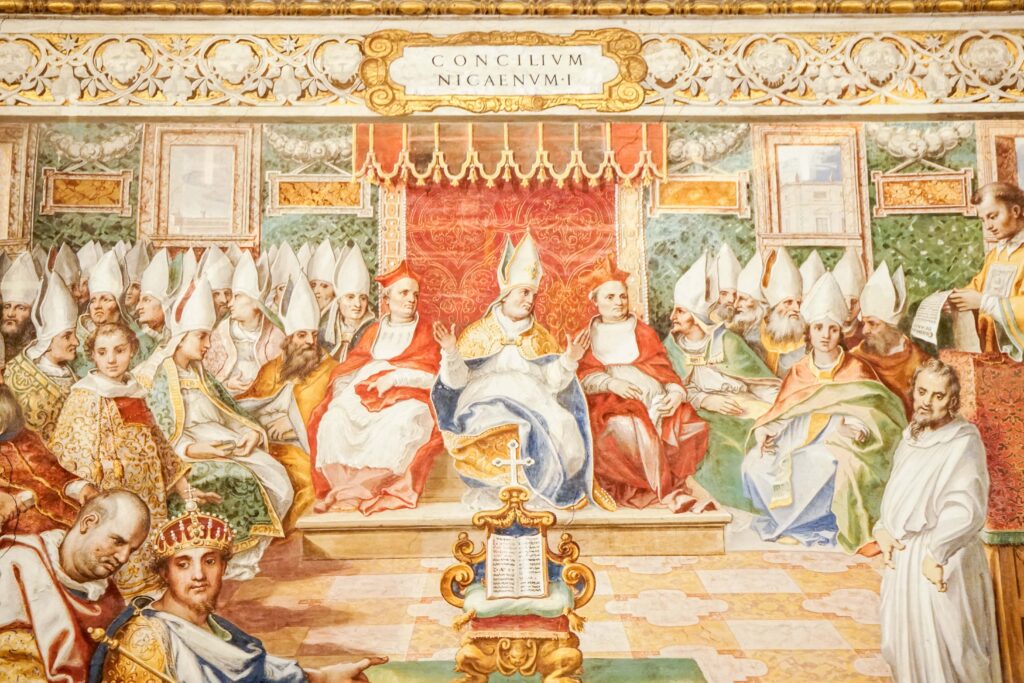
Though this process is not, and never can be, fully completed on this side of the end of history, major milestones have appeared as markers along this millennia-long journey of discipleship. We celebrate an important anniversary of one of them this year: the seventeen-hundredth anniversary of the Council of Nicaea.
This synodal gathering was an incredibly consequential assembly, which Christians of all stripes within and outside the Catholic Church recognize as the first ecumenical council. The meeting was convened not by a pope, but by the Roman Emperor Constantine, who felt political pressure to attain consensus about Christological claims that were dividing his lands, along with other controversies like how to choose a date for Easter each year.
Some of its statements ought to be familiar to you: “Consubstantial/homooúsios with the Father”; “God from God, Light from Light, True God from True God”; and “through whom all things were made.” (“One, holy, catholic and apostolic church” was added later).
Saint Peter and the other apostles, along with centuries of subsequent Christians, had never heard or used these specific formulations of words, which were developed in response to particular challenges arising to the faith in later generations. But the developing creed’s ability to unite Christians for so many centuries with what we profess was the authentic experience of those closest to the Cross and empty tomb nevertheless remains remarkable.
In honor of this influential moment in the history of the Church, the International Theological Commission released a text April 3 with the title (in English): “Jesus Christ, Son of God, Savior – 1700th Anniversary of the Ecumenical Council of Nicaea (325-2025).” As of this writing, the official Vatican text is only available in Italian, Spanish, French, German and Portuguese, though a press release and summary of goals were presented in English.
The text contains four chapters, along with some preliminary notes, an introduction and conclusion. It explores the doxology and doctrinal formulations forged at the council, but with an overarching goal of presenting the council not as a repository of arcane, academic statements, but as an ecclesial event with consequences for the contemporary world. Thus, the authors claim, “Nicaea is a communal act of expressing the truth, with the aim of communicating it to the whole Church.” (§105)
The members of the international commission go on to conclude: “In Jesus, homooúsios [same in substance] to the Father, God himself comes to save us, God himself has bound himself to humanity forever, in order to fulfill our vocation as human beings. As the Only Begotten Son, he conforms us to himself as sons and daughters beloved by the Father through the life-giving power of the Holy Spirit. Those who have seen the glory (doxă) of Christ are able to sing it and let the doxology be transformed into a generous and fraternal announcement, that is, into a kerygma …. The proclamation of Jesus, Our Salvation, is not a battle or mêlée, but rather a conformity to Christ, he who looked upon those he met with love and compassion (cf. Mk 10:21; Mt 9:36) and allowed himself to be led by another, the Spirit of the Father. The proclamation will be fruitful if it is Christ who acts in us: in fact, it is good to remember that when he sent his disciples on a mission, ‘the Lord worked with them.’ (Mk 16:20) He is there, working, struggling and doing good with us. In a mysterious way, it is his love that is manifested through our service, it is he himself who speaks to the world in that language that sometimes supersedes words.” (§121-124)
The full text is worth reading once it is available, as we continue to ponder all these years later what it means to claim there was never a time, not even for an instant in eons past, when the Second Person of the co-eternal triune God was not in existence – one stanza in the unfolding love letter between God and all that is not God.
An alumnus of Camden Catholic High School, Cherry Hill, Michael M. Canaris, Ph.D., teaches at Loyola University, Chicago.



 at the bottom and then tap “Add to Home Screen”
